Vue normale

Adobe wants you to play with generative AI in its Project Indigo camera app

The experimental tools enable distraction removal, art style–based edits and more, but only for a small subset of users.

A side-by-side image of the same ornate metal lantern, shown on a stone pedestal in a lush garden on the left and on a rocky mountain ledge with dramatic peaks at sunset on the right.Adobe

Last year, Adobe’s Nextcam team launched Project Indigo, an experimental camera app for iPhones that offered full manual controls and promised a more natural look from smartphone photos. Now, the team has announced AI Playground, an experimental generative AI tool inside of Project Indigo.

In its announcement, Adobe explains that text-based editing (e.g., asking an AI chatbot to make changes to a photo for you) is still clunky, both in its results and usability. This new tool aims to improve that experience by keeping more of the process – both capture and edit – in one app. It says that AI Playground aims to “explore how generative AI can assist mobile photographers at the point of capture.”

AI Playground offers a handful of buttons that, when tapped, trigger specific generative AI prompts engineered by Adobe. These include options for removing distractions, creating a shallow depth of field, applying certain styles, changing lighting and critiquing photos. There’s also a Custom Edit button where users can input their own prompts, either via typing or dictation. For now, Adobe says it is using Google’s Nano Banana model, but that is subject to change, and may even change on a per-button basis.

A photo of a stone garden lantern with a mobile AI editing interface overlaid in the center, flanked by the original garden scene on the left and a hand-drawn-style illustration of the same lantern on the right.
For now, the AI Playground offers four different buttons: Object Editing, Styles, Photo Guidance and Custom Edit.
Adobe

The “Styles” button allows users to apply a range of preset styles, turning photos into drawings or paintings or changing the lighting. Adobe says the available options “represent techniques we have found to be most successful when applied to everyday snapshots,” so it isn’t an endless list. It also clarifies that it trained the model to identify and highlight the main subject to keep focus on the most important parts of the photo.

A side-by-side image of a smiling woman in an art gallery, first with a busy crowd behind her on the left and then with the background cleared of people so only the empty gallery and paintings remain on the right.
The AI Playground allows users to remove distractions in the camera app, instead of opening a separate editing app.
Adobe

Object Editing offers tools familiar to editing apps, but Adobe says it is “exploring whether simple editing operations can be performed in the camera app using a generative model.” There are buttons for removing distractions and creating a shallow depth of field. If those specific tools don’t cover what you are looking to do, the Custom Edits button lets you change almost anything, similar to standalone generative AI tools. That includes completely swapping out backgrounds and specifying different styles. Adobe also showed off the ability to turn a drawing into a photo-like image, or change a sculpture into a “real” person.

A side-by-side image in an art gallery showing a white marble statue of a woman leaning to listen on the left, and on the right the same pose transformed into a lifelike young woman in flowing white clothing standing on the statue’s base.
The AI Playground lets you completely reimagine photos, including turning sculptures or paintings into photo-realistic-style people or scenes.
Adobe

Adobe also highlighted the feedback section, which looks to be a more robust version of Google’s “Camera Coach,” albeit one that critiques photos after the fact, rather than giving you suggestions as you’re composing. It says that it is aimed at helping users learn or advance their photography by providing critique. The tool can provide both reshooting suggestions since it operates within a camera app, along with editing suggestions. Adobe says it is “working on customizing these prompts to reflect individual phone models and lenses, each of which has unique capabilities,” so that users get suggestions specific to what their phone is capable of.

There are some caveats with the AI Playground. First, while it’s free (for now) and doesn’t require sign-in, Adobe is only rolling this out to a small percentage of Project Indigo users. It says that if AI Playground is successful, there will be a paid version. Adobe also makes it clear that this is an experiment inside of an experimental app, so things are subject to change. You need to be connected to the internet to use AI Playground, and to save transmission and generation time, images are 2K pixels on a side.

A three-panel image showing a man in glasses lit dramatically at a table on the left, and on the center and right his photo displayed within a mobile “AI Playground” interface that provides detailed photo critique and reshooting tips.
The critique tool can provide detailed feedback on how to improve an image.
Adobe

The Nextcam team also explains that it has had to create a workaround for HDR images, as image-generation models only output SDR images at this point. So, if you use Nano Banana to edit an HDR photo (even one taken with Project Indigo), it will produce an SDR image. To address this, Adobe says it built a custom ML model to post-process the SDR image and boost it back to HDR, but warns that it isn’t always accurate.

The announcement also briefly addresses ethics as well. Adobe says it is “working to attach metadata to AI-edited images produced from the AI Playground by using technology from Adobe’s Content Authenticity Initiative,” and specifies that some models, such as Nano Banana, apply invisible watermarks to images. At the end of the day, though, Adobe puts the onus on users: “Whether the edits you apply are ‘fair’ or ‘misleading’ depend on what you do, who you share the images with, and how you present them.”

A cyclist in a bright jacket rides up a rural road lined with grass and trees, shown first in heavy gray fog and then in warm golden sunlight, highlighting a dramatic change in lighting.
The AI Playground means you can completely alter a photo with a simple prompt.
Adobe

Ethics aside, it seems like an interesting move for the app, given that the original goal of Project Indigo was to produce more natural images that offer “SLR-like” quality from your iPhone. DPReview’s Dale Baskin even chose Project Indigo as his Gear of the Year last year, because it unlocked the ability to take more natural images, encouraging him to use his phone for photos more often. The AI Playground tools, however, seem to take things in a very different, more synthetic direction.

Additionally, the results, at least for now, don’t necessarily inspire confidence. The image at the top of this article looks more like a video game rendering than a photograph, with a distinctly synthetic sheen rather than the ‘natural’ look Indigo set out to offer. Plus, in some instances, such as the cycling image above, Adobe acknowledges that the models will change details that you don’t want changed. That includes altering face shape and expressions, even if it isn’t part of the user’s prompt or intent. The company’s workaround is to upload reference photos, which certainly isn’t ideal.

For those interested in testing AI Playground, you’ll need to update the Project Indigo app to version 1.1. If you are one of the selected users, you’ll see a screen pop up inviting you to use the feature. If you’re not a fan of GenAI in your camera app and you get invited, you can simply decline and keep using Project Indigo as you did before. Adobe also says that the Nextcam team is working on non-GenAI computational photography features that it plans to launch soon.

About the Author: Abby Ferguson holds an MFA in photography and blends a fine-art background with extensive editorial and commercial experience. She built and led an in-house imaging program for a large vacation rental company and has served as an associate editor at Popular Photography. She also teaches at a local community college and serves on its Photographic Technology Program Advisory Board, sharing her knowledge and enthusiasm for the medium.

Want to stay up to date on the latest product news and releases? Add DPReview as a preferred source to ensure our independent journalism makes it to the top of your Google search results.

add as a preferred source on google

An RX100 is surely next, why can’t I get excited about that?

The RX100 series represented a big breakthrough for image quality, back in 2012, but the six iterations since then suggest it’s not about to turn into my dream camera.

Sony RX100 V backlit in front of out-of-focus autumnal treesCarey Rose

I’m not completely shocked that Sony updated the RX10: the existing model was clearly out of production and increasingly silly second-hand prices suggested there was pent-up demand. And now the work of integrating more modern components with a Type 1 sensor has been done, surely an updated RX100 will be next?

I found myself thinking about what that might look like, and the more I do, the more I suspect it won’t be what I want.

Two years ago I made the argument that there is a market for enthusiast compacts: small cameras with decent image quality and sufficient direct control to give a satisfying photographic experience. I proposed an RX100-style camera with a less-expensive sensor and the original 24-70mm equiv F1.8-2.8 lens. Sadly, that’s not what I’m expecting Sony to make, at all.

Sony is a technology company. A technology company that makes some very good cameras, but ultimately a company that believes that their cameras will always be made better by throwing more and newer technology into them.

The RX100 series have always been products whose engineering I admired, rather than cameras I enjoyed

So instead of the stripped-back camera with direct controls and a (relatively) accessible price tag that I’d love someone to make, I suspect we’ll get a camera with, at the very least, all the bells and whistles of the RX10 V. I’m going to guess it’ll have the rangier but slower 24-200mm equiv lens, the ability to shoot at framerates around double the speed of a pro-targeted DSLR and a list price of at least the $1500 that the VII’s launch price would equate to, today.

And thinking about this made me remember how frustrated I’ve always been with the RX100 cameras. Because, with their introduction of the Type 1 (13.2 x 8.8) sensor to the compact market, they represented a huge step forward in terms of how much image quality you could fit in your pocket. The JPEG color on the first one was perhaps a little wonky but that 116mm2 sensor was nearly three times the size of the Type 1/1.7 (43mm2) chip that had dominated the space up until then, and that’s the kind of difference you could see in every photo.

Top-down view of an Olympus XZ-2 in someone's hand
The Olympus XZ-2 iHS had a relatively small sensor but a bright lens with a useful range. It also had a clicking dial around the lens that gave good feedback when changing settings and worked well with the touchscreen interface. It also had a switch that de-clicked the ring and engaged a different function, for additional control.
Richard Butler

But despite the appearance, price and that short, bright lens, the RX100 never felt like an enthusiast compact. Compared to the likes of the Olympus XZ models or Canon’s G and S-series cameras, the Sony sorely lacked engaging control points. Typically I’ll use an enthusiast compact in Aperture Priority mode, so would want to be able to control the aperture value and exposure compensation: both of them settings that adjust in fixed, stepped intervals. The RX100 doesn’t have a well-placed clicking control point, meaning you have to change most settings via the vague, free-rotating ring around the lens. There’s a lag before it recognizes that your input is intentional and there’s no tactile feedback that you’ve changed anything.

The result was a user experience that left you feeling detached from the photo taking process

The result, even before you visited the old, rather chaotic menus, was a user experience that left you feeling detached from the photo taking process: the precise opposite of what I believe a standalone camera needs to offer. The RX100 series have always been products whose engineering I admired, rather than cameras I enjoyed.

I remember being advised “stop trying to make it do what you want, and just use it as a point-and-shoot,” and finding that helped. But if I wanted to just take snaps, I’d probably use a smartphone, because the phone makers know their devices aren’t about taking control, so they’re happy to shoot and combine multiple images with every shot, letting them rival or exceed the image quality of a Type 1 camera taking single photos.

I could be wrong, of course. Sony might significantly rework the RX100 to make it fun to take control of. Or it might not make one at all. And, even if it does, I’m not going to assume that the things I, personally, want are the things that the market as a whole wants: Sony will have a much better idea of what sells and what doesn’t, and of what would-be customers are asking for.

But, while the whole thing remains hypothetical, you can’t blame me for hoping.

About the Author: Richard graduated as a scientist but had a lot more fun writing and shooting for his university magazine. A number of years spent variously as a reporter, writer and editor on science and engineering titles combined his knowledge of science with his interest in images and words. But it was spotting the connections between emission spectra, white balance and all the nonsense he’d taught himself playing around in Photoshop that helped kindle an interest in digital photography. Searching for a camera led to him discovering DPReview and Richard was recruited by Phil Askey in 2007. He’s been combining his love of photography, communication and attention to detail (pedantry?) ever since. He has unusually strong opinions about lenses for the APS-C format.

Want to stay up to date on the latest product news and releases? Add DPReview as a preferred source to ensure our independent journalism makes it to the top of your Google search results.

add as a preferred source on google

Celebrating the DPReview community: A mid-2026 update

From DPReview’s Community Manager, we take a quick look at the state of the community in mid-2026, and where we’re headed next.

Blurred crowd of people holding up their forumsnick10

As we enter the second half of this year, I wanted to take a moment to say thank you for all your fantastic contributions in the forums and elsewhere, and to consider where we go next together on a community level.

One of the great things about our community is that every day I see photographers talking about their exciting new G.A.S. purchases (my own “needs” list keeps expanding, too), sharing unique photos like the above and reminding each other that we truly have a special place that supports both gear and photography interests.

So far this year, you’ve started so many fantastic discussions, several of which are still ongoing as of several weeks ago.

One of the community’s great strengths is when you engage with each other and constructively answer questions from both new and old members. Thank you for inviting those new members into our community.

Ab S
Baby birds with snow on their heads.
Ab S

Showcasing your content

One of the most exciting initiatives you’ve continued to proudly coordinate for years now are the weekly photo threads. I love these because every day brings a new opportunity to give you a reason to share your photography on a fresh topic.

For those who are not aware, various community members (often from camera-specific forums) coordinate weekly photo showcase threads that encourage everyone to post a photo on the week’s topic. Topics range from nature to indoor decorations to photos taken with a specific camera brand, and sometimes it’s completely open-ended. They are usually more informal and less rules-based than structured photo challenges, which you may have also heard about. Everyone is welcome to participate. Feel free to include a short story along with the photo.

If you are a new member and need a way to “break the ice” on getting involved, sharing your photography wherever you can is a great start.

If you are new to photography itself, don’t feel like you’re “not professional enough” because there is no such thing. Our community is not some elites-only club, even if it feels intimidating at first upon seeing a technical-heavy discussion in forums like Studio and Lighting Technique.

cezirkle
Biker on crowded street with reflective helmet.
cezirkle

What’s next for our community

I’ve seen some great ideas about how to make the forums an even more valuable and enjoyable place to share your gear choices and photography. I’m committed to giving all the content you create the support it deserves, even if it takes a little while to develop support programs for it. Please keep those great ideas coming.

Here are a few of the projects I’m looking forward to collaborating on with you all over the rest of the year and into the next:

  • Create more activities across the forums, including within the photo and album system itself, to maximize opportunities to share your photography. This includes expanding on the per-forum section photo albums we created just a couple of months ago.
  • Explore better ways to showcase your gear and photography how-to guides and community reviews – a place that would keep them more in the spotlight than an endless ongoing forum of posts that would otherwise eventually bury the guide.
  • Ensure the rest of our community outside the forums has more opportunities to become aware of and contribute to your discussions and activities. This includes us reaching out more on places like reddit to bring them to the forums. Do you know about a photography group that we could invite to our community? Please let us know! 
wouterv
Onlooking a music festival crowd – black and white.
wouterv

Whether you’ve been part of the community for more than 25 years, or this is the first DPReview article you’ve read, I hope you will stop by the forums and say hello. While you’re there, feel free to share your photography. We can’t wait to hear from you!

Special thanks to community members, nick10, cezirkle, Ab S and wouterv for their photos being spotlighted in this article. You can find these photos and more in the weekly photo threads.

About the Author: Mathew Anderson is a proud Community Manager for the technology industry and a past visitor to DPReview.com for all his camera needs. He is currently the lead of DPReview’s community and primary communication link between the community and DPReview’s team.

Want to stay up to date on the latest product news and releases? Add DPReview as a preferred source to ensure our independent journalism makes it to the top of your Google search results.

add as a preferred source on google

NiSi released a new 16mm f/2.8 ASPH lens for Hasselblad XCD & Fujifilm GFX mount

Par : PR admin
19 juillet 2026 à 01:42


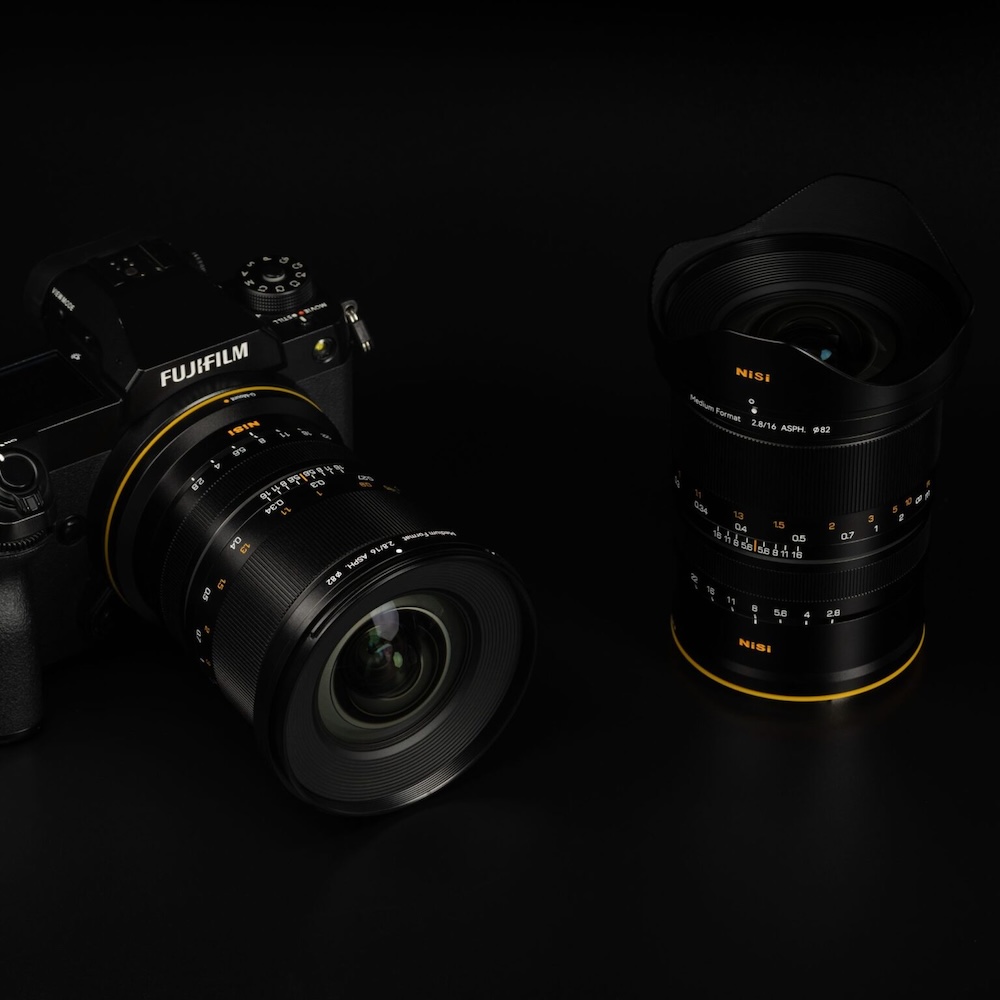
NiSi released a new 16mm f/2.8 ASPH ultra-wide prime lens for Fujifilm GFX-mount and Hasselblad XCD mount. The lens is equivalent to 12.6mm and has a field of view beyond 118 degrees. Orders are now open at B&H Photo and at the official NiSi online store (GFX | XCD):


Here are the details:

  • Ultra-Wide 16mm Field of View: With a full-frame equivalent of approximately 12.6mm, it delivers an expansive field of view exceeding 118 degrees for dramatic medium format compositions.
  • Bright f/2.8 Maximum Aperture: A fast f/2.8 aperture lets you work at lower ISO for cleaner night skies, astrophotography, and dim interiors on high-resolution sensors.
  • Built for 100MP Medium Format Sensors: The advanced optical design resolves fine detail from center to edge across the entire image circle, matching today’s highest-resolution medium format cameras.
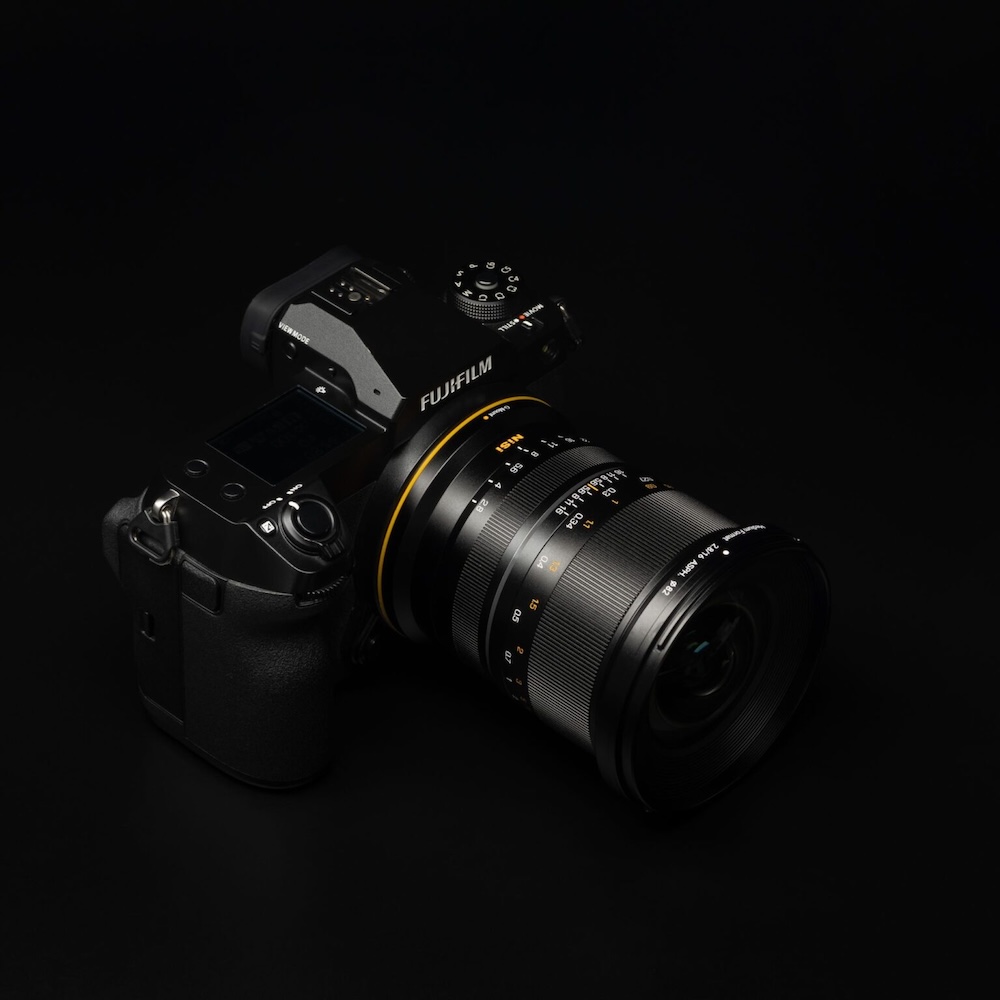
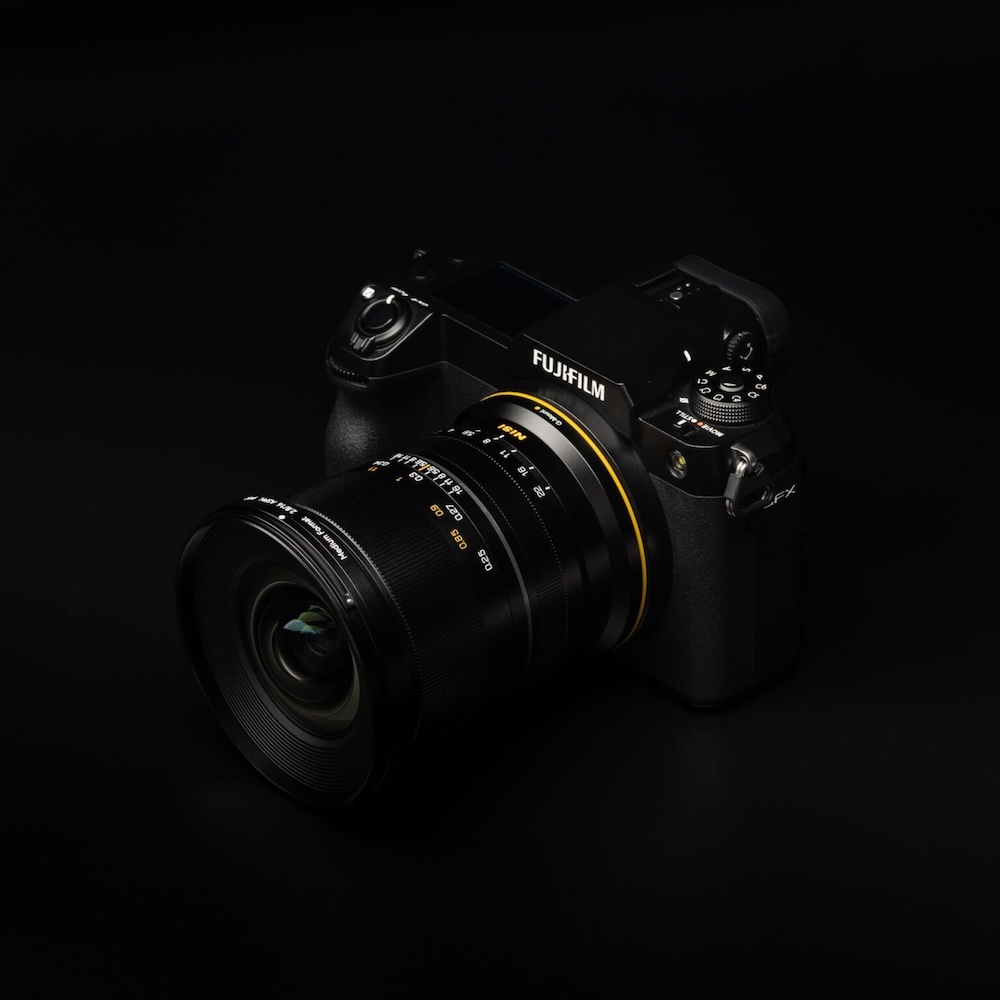
  • Native Fujifilm G-Mount Fit: This version mounts directly to Fujifilm GFX medium format bodies with no adapter, in a compact 108mm barrel that balances well in the field.
  • 12-Group, 16-Element Optical Design: Three glass aspherical elements and four ultra-low dispersion elements work together to deliver outstanding sharpness, contrast, and color accuracy.
  • APO-Level Chromatic Aberration Control: Axial and lateral color fringing is held to a minimum even wide open, resulting in clean edge definition and true-to-life color across the frame.
  • Clean 8-Point Sunstars: A specially designed 8-blade aperture creates crisp, defined 8-point sunstars from f/4 to f/22 for striking starburst effects in cityscapes and night scenes.
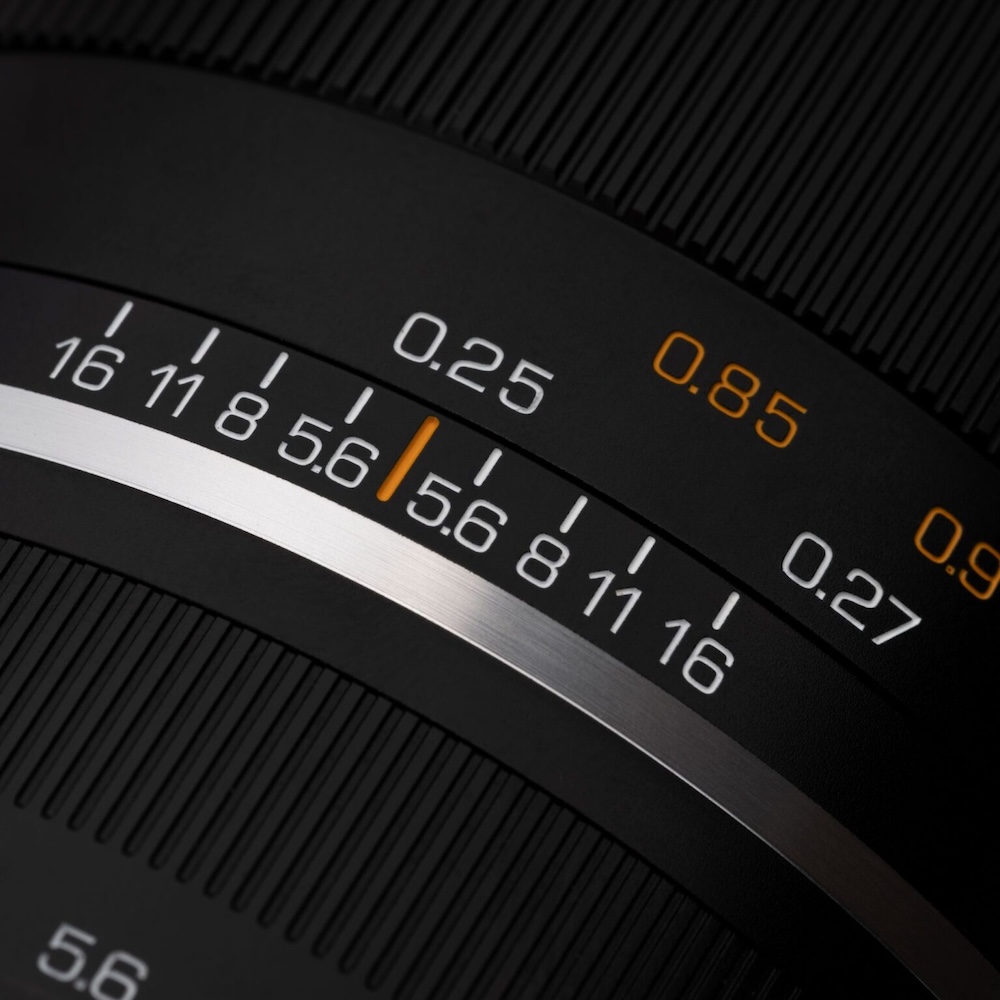
  • 0.25m Close-Focus Capability: A minimum focusing distance of just 0.25m enables close-up compositions with strong foreground impact and an exaggerated ultra-wide perspective.
  • Weather-Sealed Metal Body: A durable metal barrel with a weather-sealing ring helps resist moisture and dust, staying compact and lightweight at approximately 835g.
  • 82mm Filter Thread with SA+ Coating: An 82mm front thread accepts screw-in filters, while SA+ anti-reflection and ultra-hard surface coatings deliver low flare and lasting protection.

Designed for Fujifilm GFX Medium Format Cameras

This Fujifilm GFX (G-Mount) version mounts natively to Fujifilm GFX medium format bodies with no adapter required. It brings genuine ultra-wide coverage to a system that has long lacked an affordable, fast wide prime, unlocking sweeping landscapes, tight interiors, and night-sky work for high-resolution shooters who want maximum angle without compromise.

16mm Ultra-Wide Coverage

With a full-frame equivalent focal length of approximately 12.6mm, the NiSi 16mm f/2.8 delivers an ultra-wide field of view exceeding 118 degrees. That sweeping angle captures vast scenes, expansive skies, and exaggerated foreground perspective that longer lenses simply cannot reach, making it a natural choice for grand vistas and confined interior spaces alike.

Advanced Optical Design

A 12-group, 16-element optical formula includes three glass aspherical elements and four ultra-low dispersion elements. Together they suppress distortion, control aberrations, and keep lines straight even at the edges, delivering excellent image quality and resolving power across the large medium format image circle for architecture and symmetrical compositions.

Resolving Power for 100-Megapixel Sensors

The optical design delivers outstanding resolution from center to edge across the entire image circle, perfectly matched to high-resolution medium format cameras. Fine textures, distant detail, and subtle tonal transitions are rendered cleanly on today’s 100MP sensors, with peak performance reached around f/5.6 for the most demanding studio and landscape work.

Stays Sharp Wide Open at f/2.8

Even wide open at f/2.8, the NiSi 16mm f/2.8 holds sharp detail from the center to the edge. Three aspherical elements help control coma, rendering point light sources cleanly, which makes it a strong performer for Milky Way and astrophotography. The bright aperture also lets you shoot at lower ISO for cleaner, less noisy night-sky frames.

Minimal Chromatic Aberration

The lens delivers APO-level control of chromatic aberration across the entire image circle. Axial and lateral color fringing is kept to a minimum even wide open, resulting in clean edge definition and true-to-life color in high-contrast scenes such as backlit horizons, city lights, and bright winter skies, so files need less correction in post.

Clean 8-Point Sunstars and Close Focus

A specially designed 8-blade aperture produces clean, defined 8-point sunstars from f/4 to f/22, balancing image quality with a strong starburst effect and a small, tidy center spot. A close 0.25m minimum focusing distance and 0.12x magnification let you push in on foreground subjects for added depth, scale, and dramatic wide-angle storytelling.

Precision Handling and Durable Build

The manual focus ring moves smoothly across a 180-degree rotation, while the clicked aperture ring gives accurate, tactile stop control. A weather-sealed metal body, cinema-inspired painted markings, SA+ anti-reflection coating, and an ultra-hard surface coating that resists water, oil, and fingerprints round out a lens built for serious, repeatable work in tough conditions.

Whether you are capturing the Milky Way, expansive landscapes, or dramatic architecture, the NiSi 16mm f/2.8 ASPH. delivers a rare combination of ultra-wide coverage, a bright f/2.8 aperture, and ultra-high resolution. Its 82mm filter thread also pairs with the JetMag Pro 95MAG magnetic system using a dedicated adapter. Built for the Fujifilm GFX (G-Mount) medium format system, it stands among the highest image quality ultra-wide medium format lenses available today, ready for ambitious work in the studio and the field.

Via FujiAddict

The post NiSi released a new 16mm f/2.8 ASPH lens for Hasselblad XCD & Fujifilm GFX mount appeared first on Photo Rumors.

Tamron’s new 12-20mm F2.8, out and about

Has Tamron hit the target with its latest fast ultra-wide zoom for Sony and Nikon? Check out our gallery to decide for yourself.

A wide-angle photo of some goalposts, shot from low down and off to one side, on a sunny dayMitchell Clark

Tamron’s 12-20mm F2.8 adds a fast, ultra-wide option for Sony and Nikon shooters. It goes wider than its rival zooms on the Z-mount and is smaller and lighter than its closest competitor on E-mount, making it an interesting addition to both systems.

We had a chance to use it, prior to launch, with Mitchell taking it with him on his vacation out beyond Eastern Washington. He’s been sending back samples, to broaden the range of the gallery. Have a look to see how this compact ultra-wide performs.

Loading gallery…

About the Author: Richard graduated as a scientist but had a lot more fun writing and shooting for his university magazine. A number of years spent variously as a reporter, writer and editor on science and engineering titles combined his knowledge of science with his interest in images and words. But it was spotting the connections between emission spectra, white balance and all the nonsense he’d taught himself playing around in Photoshop that helped kindle an interest in digital photography. Searching for a camera led to him discovering DPReview and Richard was recruited by Phil Askey in 2007. He’s been combining his love of photography, communication and attention to detail (pedantry?) ever since. He has unusually strong opinions about lenses for the APS-C format.

Want to stay up to date on the latest product news and releases? Add DPReview as a preferred source to ensure our independent journalism makes it to the top of your Google search results.
add as a preferred source on google

Is the camera industry waking up to enthusiast demand?

After a nearly decade-long absence, we’re starting to see a revival of enthusiast compacts

A Leica D-Lux 8 compact camera, held in someone's hand, pointing towards the cameraRichard Butler

I’ve always liked enthusiast compacts: relatively small cameras with built-in lenses and a decent level of direct control. A camera I can travel with but still enjoy using. But, following a halcyon period in the early 2010s, the available options dwindled to the point that it became almost impossible to buy one.

However, things seem to have moved on since CP+ 2025, when we received relatively little enthusiasm from the manufacturers we asked about the prospects of a compact camera revival. The first flicker had already come the year before, from a slightly unexpected quarter, when Leica announced the D-Lux 8, a refreshed version of the enthusiast model last updated 6 years prior.

Front view of the Sony RX1R III
The Sony RX1R III: one of my favorite cameras of last year. However, between inflation, tariffs in the US and its targeting of an incredibly small niche, its price made it look ridiculous. Until you compare it to the Leica Q models that are its closest competitors.
Richard Butler

Then, perhaps even more unexpectedly, in mid 2025 Sony updated its full-frame, prime lens compact, the RX1, a decade after the previous version had been released. It was not a camera I expected to ever see, as I thought its job as a signifier that Sony ‘gets’ photography had been served, now that its full-frame Alpha cameras have received such widespread uptake. But, while some reviewers insisted it should have been more ambitious, I found the camera that actually existed to be one that addressed almost all the shortcomings of its predecessor, and added up to an excellent (albeit determinedly niche) photographers’ compact.

Signs of life

By 2026, the tone of many manufacturers has changed when asked about the market for compacts, and these past few months have seen the release of two major updates of well-liked, but seemingly abandoned models.

The Panasonic L10 is a substantial reworking of the LX100 series, eight years after the last model. It brought a larger body and the same, rather laggy zoom, but, like the RX1R III, it directly addressed the biggest criticisms we’d had with the previous versions. So again, while it’s easy for armchair R&Ders to demand more, the thing that you can buy is rather good.

And now we have the Sony RX10 V, which brings the latest autofocus and video performance levels along with a bigger battery, better viewfinder to a (comparatively) large-sensor superzoom, bringing into sharp relief the degree to which camera performance has continued to improve in the 9+ years since the last version. Even if image quality appears to have plateaued (or even peaked?) for now.

A Canon PowerShot V1 vlogging compact with mic screen attached, its screen is flipped out and has the DPReview test scene superimposed on it.
Canon’s vlogging-focused PowerShot V1 has a lens we’ve not seen before, whereas all the revived enthusiast photographer’s cameras have made do with the optics from the previous models.
Richard Butler

All four models have been met by derision from some quarters, not helped by the cumulative effect of inflation driving the prices up, in money terms at least. Others have criticized the degree to which these new cameras depend on existing parts for some of their key components (in all four cases, the lens designs date back around a decade, to the often less-demanding pixel counts of that time). And it’s true that none of these makers have shown the faith in the enthusiast photo sector that Canon and Sony did in the vlogging market, when they spent the money to develop new optics for the likes of the PowerShot V1 and ZV-1 II. But most of them got redesigned bodies and accommodate different batteries to their predecessors, so there’s more than just parts-bin diving going on.

Another criticism we’ve seen is that you can buy an ILC more cheaply. And this is sometimes true, even if you exclude second-hand and end-of-life bargains that no new camera can ever compete with. But, even in the (very) few instances where you can closely match the spec of these enthusiast compacts, while maintaining a similar level of hands-on, direct control and competing on size, it usually turns out that the person making the criticism simply doesn’t like the concept of fixed lens cameras, which can lead to the whole point of such cameras being dramatically missed.

Three-quarter view of the Sony RX10 V
Mirrorless cameras can undoubtedly be more flexible than a camera with a built-in lens, but let’s remember that they nearly got known as “compact system cameras,” and that not everyone necessarily wants to buy into a system.

There are times when you want the near-endless flexibility of an ILC (or ‘system camera’ if you prefer). But sometimes, some of us want a smaller camera, or a self-contained one. One that does the thing it’s designed to do, without constantly inviting the cost of additional lenses or forcing you to ponder which combination to pack.

I’m not, at this point anyway, suggesting we’re entering another golden age of enthusiast compacts. It’s clear that the cameras we’ve seen so far are updates of existing models (and not necessarily upgrades, to the extent you might hope). Sadly, I don’t think anybody is about to put the effort into delivering a larger-sensor successor to the Olympus XZ-2, which to me remains the high watermark for enthusiast compacts, in many regards. But at least, for whatever concerns we might each have about pricing or increased size, there are, after all this time, options.

About the Author: Richard graduated as a scientist but had a lot more fun writing and shooting for his university magazine. A number of years spent variously as a reporter, writer and editor on science and engineering titles combined his knowledge of science with his interest in images and words. But it was spotting the connections between emission spectra, white balance and all the nonsense he’d taught himself playing around in Photoshop that helped kindle an interest in digital photography. Searching for a camera led to him discovering DPReview and Richard was recruited by Phil Askey in 2007. He’s been combining his love of photography, communication and attention to detail (pedantry?) ever since. He has unusually strong opinions about lenses for the APS-C format.

Want to stay up to date on the latest product news and releases? Add DPReview as a preferred source to ensure our independent journalism makes it to the top of your Google search results.
add as a preferred source on google

Here’s how to keep updated on new DPReview website changes

What we’ve updated on the new site, and when.

A computer monitor showing the new DPReview.com homepageDPReview.com

We recently launched the new DPReview website with a beta logo at the top of the page. The site is in beta for a reason: we’re aware that there are things to fix and improve, and our team is actively working to address outstanding issues. The beta logo reflects our ongoing effort to improve functionality, features and the overall user experience.

The DPReview logo with a blue tag to the right that says Beta.
The beta logo reflects our ongoing effort to improve functionality, features and the overall user experience. We’ll drop the label once we’re confident the site has earned it.

To make sure you know where to find the latest updates, report bugs or usability issues, or discuss changes to the site, we’ve set up a dedicated forum section to consolidate this information in one place.

Keep updated on changes

Progress updates: To see the latest updates from our team, visit the dedicated Change log thread. This is where we’ll post updates to let you know what changes, updates or bug fixes we’ve made to the site. We are making updates on a rolling basis based on a combination of prioritization and ease of fix. We expect this process to go on for quite some time.

Report a bug or usability issue: If you encounter a bug or usability issue, please use the Known issues and bug reports thread in our forum to share it with us. We keep the first post in that thread updated with all the reports we’re tracking, so please check there first to see if your issue has already been reported before reporting a new one.

New site discussion: If you have other questions or just want to discuss the new site, please create a post in the Website redesign feedback, questions and help section of the forums.

One more thing: If you haven’t already done so, we encourage you to read our article Gear Patrol founder Eric Yang: Why we rebuilt DPReview after 25 years, which provides additional context for why we’re making this change now.

We’ve already heard a lot of valuable feedback, and will continue to gather it to help shape our development and improvement roadmap. Thank you for your patience, feedback and support as we get things dialed in.

About the Author: Dale Baskin is a professional photographer, writer, and filmmaker based in the Pacific Northwest. He is the Managing Editor of DPReview.com.

Want to stay up to date on the latest product news and releases? Add DPReview as a preferred source to ensure our independent journalism makes it to the top of your Google search results.
add as a preferred source on google

This Kodak-branded film camera offers a low-cost entry into 35mm film photography

Kodak licensee Reto has launched a new film camera with styling that mimics popular retro compacts, giving film-curious shooters a nostalgic entry point.

Six Kodak cameras in various bright colors rest on a blue-and-white striped blanket outdoors, with assorted fruit and several Kodak film rolls surrounding them.Reto

Kodak licensee Reto has quietly added another beginner-friendly 35mm camera to its analog lineup. The Kodak EC35 is a fixed-focus point-and-shoot aimed squarely at casual shooters and film-curious newcomers thanks to its affordable price and ease of operation.

The EC35 is a simple 35mm film camera with a plastic body and 25mm, fixed-focus, 2-element acrylic lens. It’s a point-and-shoot camera, featuring a fixed F10 aperture and a constant 1/100 sec shutter speed. It does offer manual film advance and rewind, though, for a more traditional film experience. There’s also a built-in flash powered by a single AA battery.

It’s highly compact, weighing 102 g (3.6 oz) and measuring 119 x 65 x 41.5mm (4.7 × 2.6 × 1.6″). It features a slide-out cover to protect the lens, just like highly popular retro compact film cameras, such as the Olympus Stylus (Mju series) and Contax T3.

An empty road extends into the distance, bordered by green bushes and trees, with misty hills visible under a cloudy sky. Scene photographed using a KODAK EC35 reusable 35mm film camera.
A sample image from the Kodak EC35.
Reto

While the camera uses Kodak branding, it comes from Reto, the Kodak licensee behind the viral Kodak Charmera cameras. Reto has been steadily rebuilding a Kodak-branded analog ecosystem with playful, affordable cameras like the Ektar H35 half-frame, the H35N half-frame and the Snapic A1, a compact with a 25mm three-element glass lens and double-exposure mode. The EC35 slots in as a more basic model that produces full 35mm frames, sitting below the feature-rich Snapic A1 with its LCD, auto wind/rewind and multi-exposure features.

The Kodak EC35 comes in six colors: black, white, yellow, lavender, light blue, light pink and light green. It’s available for purchase now for $35, the same price as Lomography’s recently released half-frame camera.

About the Author: Abby Ferguson holds an MFA in photography and blends a fine-art background with extensive editorial and commercial experience. She built and led an in-house imaging program for a large vacation rental company and has served as an associate editor at Popular Photography. She also teaches at a local community college and serves on its Photographic Technology Program Advisory Board, sharing her knowledge and enthusiasm for the medium.

Want to stay up to date on the latest product news and releases? Add DPReview as a preferred source to ensure our independent journalism makes it to the top of your Google search results.
add as a preferred source on google

Lomography’s new half-frame camera doubles your film frames for $35

Lomography’s affordable new half-frame film camera makes shooting film simple.

A colorful disposable camera held up to a face, ready to take a photo, with a green wall in the background.Lomography

Lomography is jumping on the half-frame trend with its latest camera. The appropriately named Half-frame Simple Use Reloadable Film Camera is an affordable option that aims to make film easy for those looking to explore the medium.

As a half-frame camera, it uses half of each 35mm frame, resulting in 17 mm x 24 mm vertical images and letting you get twice as many photos from a roll as a traditional 35mm camera. The small point-and-shoot looks like a classic disposable camera and comes pre-loaded with a roll that gives you 40 shots before you need to reload. Despite its lightweight, disposable-style design, the camera is fully reloadable, and with a standard 36-exposure roll, you can capture up to 72 images.

Split-screen black and white photo: On the left, a person rides a bicycle with legs outstretched. On the right, a person in loose clothing stands against a bright sky, seen from a low angle.Lomography

Lomography designed the camera to be easy to use. It features a fixed-focus 21mm lens, a single 1/120 sec shutter speed, a fixed F9 aperture and no ISO adjustment options. It offers a built-in flash to help in low-light situations and has integrated gels to slide in front of the flash for pops of color. There are also shooting instructions printed on the camera body to help you use it if you’re new to film.

You can choose between two preloaded versions of the half-frame camera: one with LomoChrome Classicolor ISO 200 film, and the other with Lady Gray ISO 400 black and white film. You can also opt for a kit that includes six additional rolls and a case to store your film. Sitting well below options like the Pentax 17, it’s meant to be an affordable, casual way to enjoy film.

The Lomography Half-frame Simple Use Reloadable Film Camera is available for preorder now and costs $30 with black-and-white film and $35 with color film.

About the Author: Abby Ferguson holds an MFA in photography and blends a fine-art background with extensive editorial and commercial experience. She built and led an in-house imaging program for a large vacation rental company and has served as an associate editor at Popular Photography. She also teaches at a local community college and serves on its Photographic Technology Program Advisory Board, sharing her knowledge and enthusiasm for the medium.

Want to stay up to date on the latest product news and releases? Add DPReview as a preferred source to ensure our independent journalism makes it to the top of your Google search results.

add as a preferred source on google

Fuji and Canon registered new cameras

Par : PR admin
16 juillet 2026 à 19:24


Both Fujifilm and Canon registered new cameras in Asia. Canon registered a new DS126965 camera on July 1st. It features dual-band Wi-Fi. This brings Canon’s total registrations for fiscal year 2026 to three new devices: DS126947, DS126973, and DS126965, none of which have corresponding existing models:


Fujifilm now has two registered and not yet announced cameras:


  • Fujifilm FF260001: registered on April 7, 2026, featuring the X-Processor 6 APS-C interface, tri-band Wi-Fi 6, NP-W255 battery, and CMOS Image Sensor.
  • Fujifilm FF260002: registered on July 3, 2026, featuring the X-Processor 6 interface, tri-band Wi-Fi 6, and CMOS Image Sensor – this will probably be the rumored Fujifilm X-T6:

Fujifilm F260001 Found: Likely Fujifilm X-T6

Updated list of upcoming/rumored Fujifilm cameras and lenses

Source: E8M_8888

The post Fuji and Canon registered new cameras appeared first on Photo Rumors.

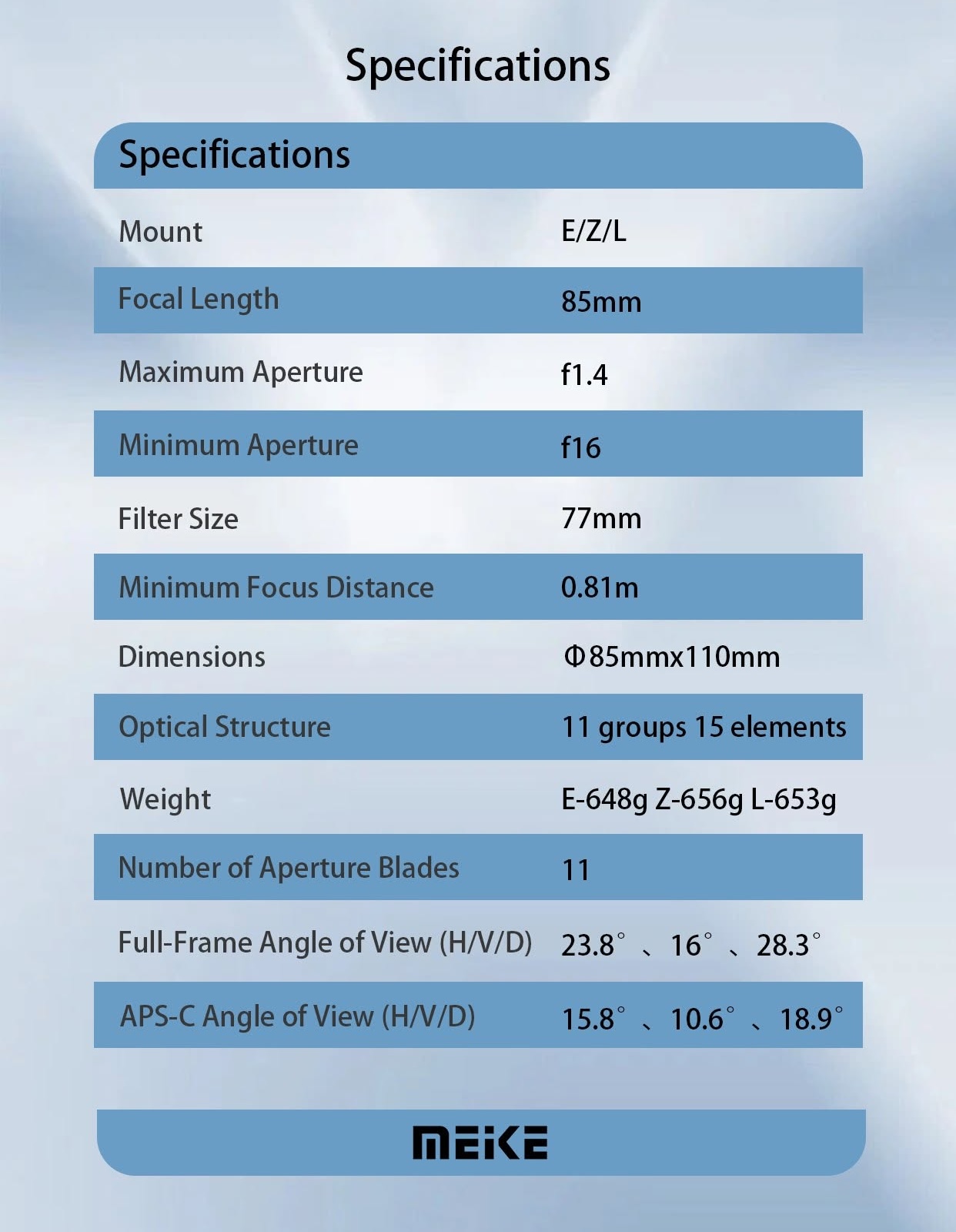
Officially launched: Meike AF 85mm f/1.4 MIX Ⅱ full-frame lens (L/E/Z)

Par : PR admin
16 juillet 2026 à 16:55


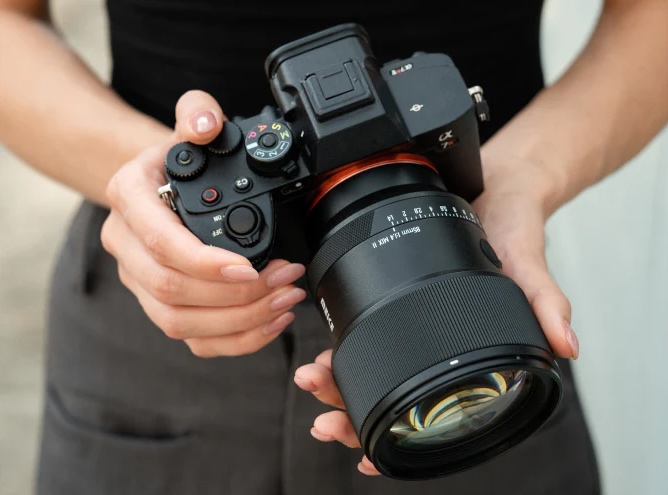
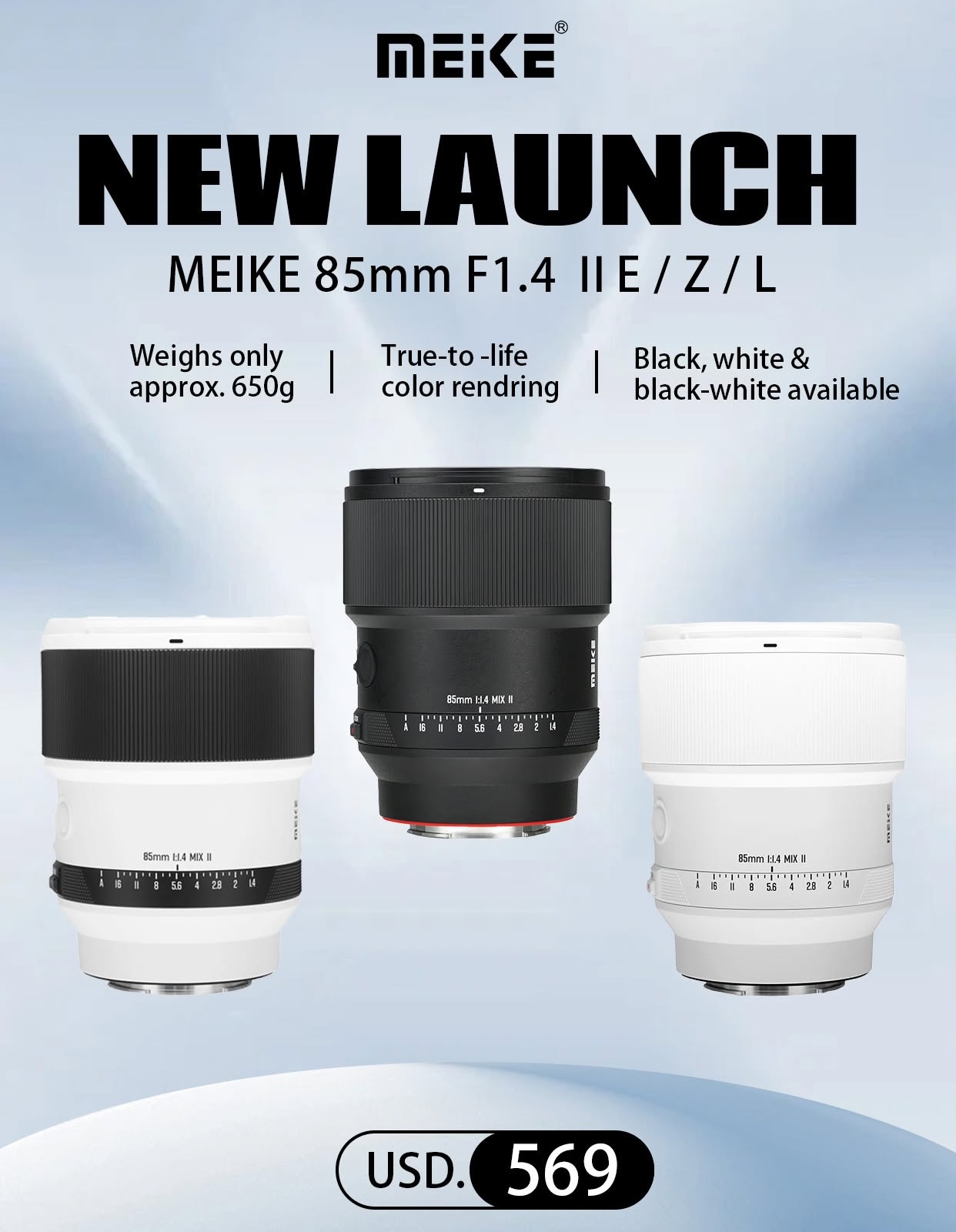
Meike officially launched the AF 85mm f/1.4 MIX Ⅱ full-frame lens for L/E/Z mount:

 
Here is the list of lens updates:

  • Sharper. Faster. Lighter.
  • 67MP Ready – Image quality capable of 10K resolution
  • APO Optics – Minimized chromatic aberration for cleaner color
  • Three Colors Available – Black, Panda, and White
  • Edge-to-Edge Sharpness – Exceptional detail across the frame
  • Hyperb STM AF – Fast, precise, and whisper-quiet autofocus
  • Lightweight Design – Only around 650g
  • Click/De-click Aperture Ring, Aperture Lock & Fn Button

The new Meike AF 85mm f/1.8 lens for GFX mount will be announced on July 20th:


The post Officially launched: Meike AF 85mm f/1.4 MIX Ⅱ full-frame lens (L/E/Z) appeared first on Photo Rumors.

The first Russian anamorphic cinema lenses

Par : PR admin
16 juillet 2026 à 15:58


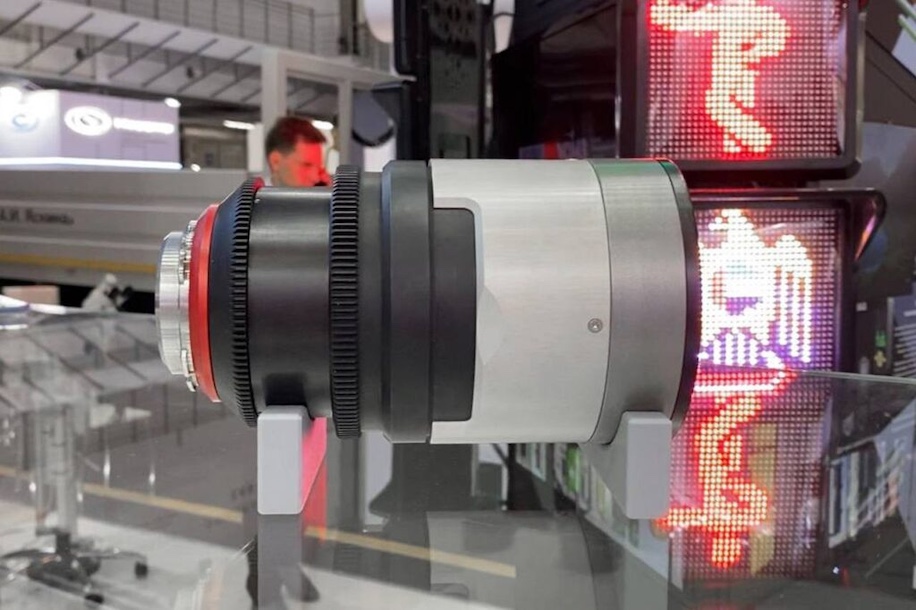
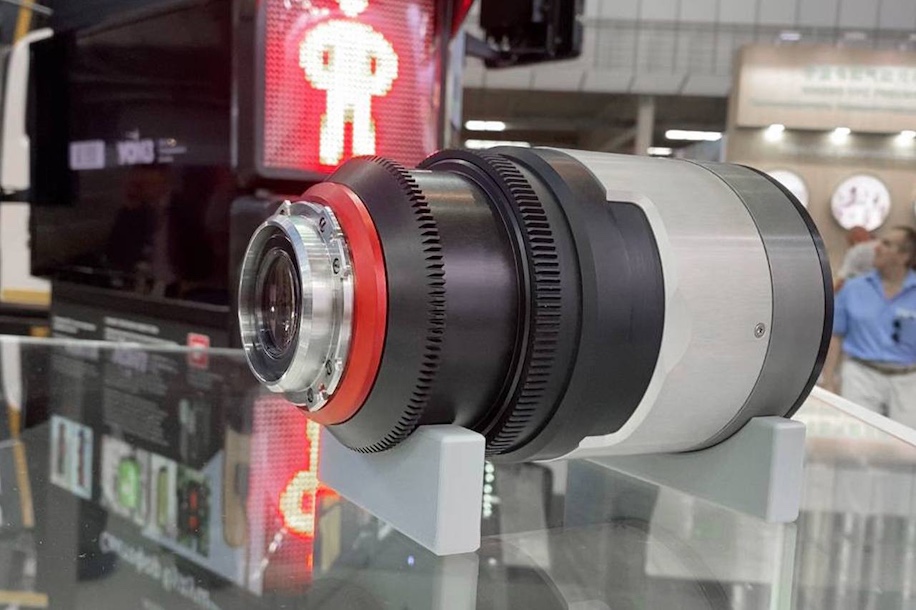
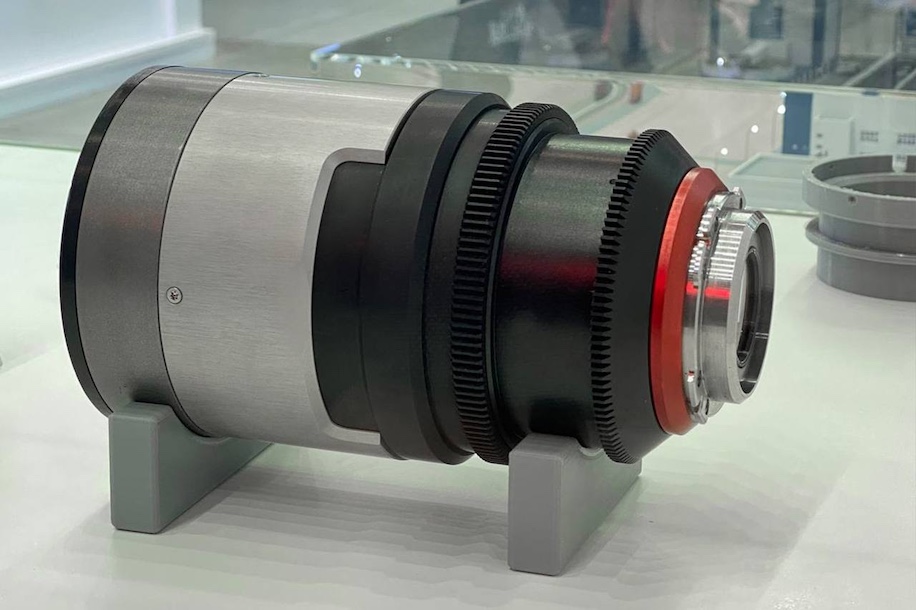
The first 80mm Russian anamorphic cinema lens (previously reported here) was recently presented by Shvabe Holding (part of Rostec State Corporation) at the Innoprom 2026 show. This marks the first time a domestically produced anamorphic film lens has reached the ready-made prototype stage in Russia. The anamorphic series, developed by the Lytkarinsky Optical Glass Plant (LZOS) within the Shvabe holding, includes four focal lengths:

  • 40mm
  • 60mm
  • 80mm (first finished model, now shown)
  • 100mm

All lenses feature a 2x anamorphic squeeze, PL mount as standard (with adapters available for other mounts), and are designed for digital cinema cameras.

Shvabe announced the first Russian anamorphic cinema lenses

Key lens highlights:

  • Ultra-wide field of view without the edge distortion and corner darkening typical of wide-angle spherical lenses.
  • Distinctive cinematic rendering, including characteristic bokeh and flares.
  • High image quality and “unique picture” that sets them apart from many foreign alternatives.
  • The front elements have an unusual concave shape – a hallmark of this optical design that enables the horizontal squeeze while preserving overall image integrity.

“The development of anamorphic lenses is an important step by a domestic manufacturer for the development of the Russian film industry. In addition to the extended horizontal frames and high image quality, they allow you to create unique cinematic effects. We will launch the film lenses into mass production next year. It is planned to produce 4 sets of products as part of the first installation batch. Test copies will appear this year. They will be available for delivery to film studios, and their cost will be lower than their foreign counterparts.” — Lev Borisov, Deputy General Director for Sales of Civilian Products at Shvabe Holding

Development Timeline & Availability

  • July 2026: 80mm ready-made model presented publicly for the first time.
  • Later in 2026: test copies are expected to become available for film studios.
  • 2027: serial/mass production launch, starting with an initial batch of 4 sets.

LZOS & Shvabe Background

Lytkarinsky Optical Glass Plant is one of Russia’s premier optical manufacturers. It is the only facility in the country capable of producing large-scale ground- and space-based mirrors used in major telescopes worldwide. The plant also produces the well-known Rubinar mirror lenses.

Previous coverage of Russian lenses is available here.

The post The first Russian anamorphic cinema lenses appeared first on Photo Rumors.

Hasselblad’s Phocus Mobile app finally arrives on Android

Since Hasselblad launched Phocus Mobile 2 in 2019, its mobile Raw editing workflow has been confined to iOS – until now.

Three smartphone screens, each showing a photo editing app interface with options for exposure, contrast, brightness, and HDR settings; all display a nighttime landscape photo being adjusted.Hasselblad / Albrecht Voss

Hasselblad launched Phocus Mobile 2 in 2019, as an iOS-only app for editing Raw files from its medium format cameras on phones and tablets. Now, the company has announced Phocus Mobile v1.0.0 for Android, finally bringing the mobile workflow to Android users with the X2D II 100C, X2D 100C and 907X + CFV 100C.

Like the iOS version, Phocus Mobile for Android includes a robust set of editing tools, including exposure, curves, white balance, sharpening, cropping, lens correction and more. It also supports batch adjustments and basic asset management with the ability to add ratings and mark favorites. Images can be imported over Wi‑Fi or, for those using the X2D II 100C (with firmware version 1.3.16.1 or later), via USB‑C. Files can then be exported as Ultra HDR JPEG, HDR TIFF, as well as standard JPEG, TIFF, HEIF or 3FR Raw.

Hasselblad says that the Android app brings its end-to-end Natural Color Solution (HNCS) to mobile, allowing for a consistent look whether editing on desktop or mobile. The app supports HDR viewing and editing for X2D II 100C files on compatible HDR devices. It also features the company’s AI-powered Raw noise reduction, which it says is tuned for its 100MP sensors. The noise reduction tool offers two modes, allowing users to prioritize either cleaner files or better micro-contrast.

There are some hardware caveats, though. The app requires an Android device with at least 12 GB of RAM and Android 12 or later. That said, Hasselblad recommends Android 16 or later and devices powered by Snapdragon 8 Gen 3 or newer for the best experience. Given that the phone needs to handle 100MB files, that shouldn’t come as much of a surprise.

Hasselblad’s Phocus Mobile for Android is now available on the Google Play Store for free.

Press release:

HASSELBLAD BRINGS PHOCUS MOBILE TO ANDROID

Phocus Mobile for Android extends the Hasselblad mobile workflow with Hasselblad Natural Colour Solution (HNCS), Hasselblad Natural Noise Reduction (HNNR), a comprehensive editing toolkit, and streamlined photo management.

GOTHENBURG, Sweden — Hasselblad is pleased to announce that Phocus Mobile V1.0.0 for Android is now available¹ for the X2D II 100C, X2D 100C and 907X & CFV 100C. Long requested by the Hasselblad community, the Android release brings the Hasselblad mobile imaging workflow to a broader community of photographers.

Phocus Mobile, the official companion app for Hasselblad medium format digital cameras, delivers the end-to-end Hasselblad Natural Colour Solution (HNCS) experience on mobile. It combines AI-powered noise reduction, a comprehensive editing toolkit, and streamlined photo preview and management into a complete mobile workflow. Android users can now review, edit, organise, and export images directly from their mobile device, allowing them to continue working wherever they are.

THE END-TO-END HNCS MOBILE EXPERIENCE

Phocus Mobile for Android brings the end-to-end Hasselblad Natural Colour Solution (HNCS) experience to Android. True-to-life colours, smooth tonal gradation, and rich highlight detail are preserved from preview through final export. Photographers can review and edit images away from the desktop, knowing the natural colour and tonal precision of their images are preserved throughout the mobile workflow.

On HDR-supported Android devices², HDR images captured with the X2D II 100C reveal the full spectrum of HNCS HDR, with intricate shadow detail, luminous highlights, and colour gradations that closely match what the eye sees. In addition to standard editing tools, the app supports precise HDR highlight adjustment, giving photographers greater control when refining high-contrast images.

HDR images captured with the X2D II 100C, as well as RAW images from the X2D II 100C, X2D 100C, and 907X & CFV 100C, can be previewed, edited, and exported in the app. HDR images can be exported as Ultra HDR JPG, while RAW images can be exported as Ultra HDR JPG or HDR TIFF.

HASSELBLAD NATURAL NOISE REDUCTION FOR HIGH ISO PHOTOGRAPHY

Hasselblad Natural Noise Reduction (HNNR) is now available in Phocus Mobile for Android.³ When shooting at high ISO settings for low-light or night photography, the AI-powered RAW noise reduction solution produces cleaner, more natural-looking images while preserving fine image detail. Calibrated and optimised for Hasselblad medium format sensors and trained on hundreds of thousands of Hasselblad images, HNNR reduces noise in 100MP RAW images in approximately 15 to 20 seconds.

Two processing modes are available. Purity Mode prioritises noise suppression for the cleanest possible result, making it ideal for most scenes. Detail Mode preserves luminance noise to better retain micro-textures and fine image detail. Both modes work seamlessly with Hasselblad Natural Colour Solution (HNCS) to preserve the signature natural colours, colour fidelity, and smooth tonal gradation in every image.

HNNR is especially beneficial for the 907X & CFV 100C, which does not feature in-body image stabilisation, expanding handheld shooting possibilities in low-light conditions.

PROFESSIONAL MOBILE EDITING AND PHOTO MANAGEMENT

Phocus Mobile for Android combines a comprehensive editing toolkit with streamlined photo preview and management. A full suite of editing tools—including exposure adjustment, curves, white balance, monochrome correction, lens correction, noise reduction, sharpening, cropping, rotation, and keystone correction—provides precise control directly from an Android device. Edit settings can also be copied and applied in batches to speed up high-volume editing workflows.

Images can be quickly imported via Wi-Fi or, for supported cameras, a wired USB-C connection.⁴ Once imported, images can be organised using star ratings and favourites for faster image selection and review before being exported in JPG, TIFF, HEIF, or 3FR RAW formats.

¹ Phocus Mobile for Android supports Android devices with at least 12 GB of RAM running Android 12 or later. For the best colour display and editing experience, Hasselblad recommends Android 16 or later and devices powered by Snapdragon 8 Gen 3 or newer. Refer to the official Hasselblad website for compatibility information

² HDR viewing and editing features require a compatible HDR-capable Android device. Refer to the official Hasselblad website for a list of recommended devices.

³ Hasselblad Natural Noise Reduction (HNNR) currently supports only devices powered by Snapdragon 8 Gen 3 or later. Refer to official website for more details.

⁴ Wired USB-C connection is only supported on X2D II 100C with firmware version 1.3.16.1 or later when using Phocus Mobile for Android.

About the Author: Abby Ferguson holds an MFA in photography and blends a fine-art background with extensive editorial and commercial experience. She built and led an in-house imaging program for a large vacation rental company and has served as an associate editor at Popular Photography. She also teaches at a local community college and serves on its Photographic Technology Program Advisory Board, sharing her knowledge and enthusiasm for the medium.

Want to stay up to date on the latest product news and releases? Add DPReview as a preferred source to ensure our independent journalism makes it to the top of your Google search results.

add as a preferred source on google

Inside Getty Images’ 2026 World Cup coverage: 10-hour days and wild fans

Getty Images staff photographer Maddie Meyer shares her touchline gear setup, rapid-fire workflow and what it’s like shooting from the middle of a celebrating crowd.

A photographer kneels beside a soccer goal on a stadium field, adjusting a camera. Other media crew members and equipment are present, with a large FIFA World Cup 2026 sign displaying "New York New Jersey" in the background.Getty Images

Getty Images photographer Maddie Meyer sets up a camera behind the goal.

After more than a month of drama, the 2026 FIFA World Cup is finally heading into its finale, with the last games set for this weekend. Over the course of the tournament, a small army of photographers has been crisscrossing stadiums to keep pace with the matches and the stories unfolding around them.

One of them is Maddie Meyer, a Getty Images staff photographer who has spent this World Cup on the touchline and in the stands, documenting everything from tunnel nerves to wild celebrations. Meyer took the time to speak with me between matches, sharing insights into what it’s like to cover such an event and how she stays on top of her game.

Finding her way

Camera held by a person standing on a metal platform overlooking a stadium; large stadium lights and a soccer field crowded with spectators are visible below.Getty Images

While Meyer was always interested in photography, she didn’t start out wanting to be a sports photographer. She grew up in Washington, D.C., playing soccer and thinking she would follow the path of Doug Mills, a prominent New York Times photographer she’d known since childhood. “I’ve known him since I was 8, and I looked up to him so much,” she said. “I remember his pictures from the Torino Olympics and thinking this might be the coolest thing I’ve ever seen.”

Meyer recognizes that having Mills to look up to early on was quite important for her path. “It was so cool to have somebody in my life so early to show me this is a job you can have,” she told me. “He was super encouraging; he said the only difference between me and you is I’ve worked hard at this for 40 more years.” Meyer kept shooting through middle and high school and went on to study photojournalism at Ohio University.

She still thought she wanted to be a White House photographer until she started working with her college athletics department and realized how much she loved traveling with teams and being outside. That led her to apply for a Getty Sport internship in New York City, which quickly felt like the right fit. “I loved the pace and the scale and the intensity of it. After I graduated from college, I got hired in Boston in 2015. I have been here ever since, and I still love it,” she said.

Managing the chaos

Two soccer players embrace; one wears a white jersey labeled BELLINGHAM with the number 5, and the other is in dark green. A trophy appears blurred in the background.
Jude Bellingham #10 of England and Erling Haaland #9 of Norway embrace in the tunnel before the FIFA World Cup 2026 Quarter Final match between Norway and England at Miami Stadium on July 11, 2026 in Miami Gardens, Florida.

Canon EOS R1 | RF 85mm F1.2 L USM | F1.2 | 1/3200 sec | ISO 4000
Maddie Meyer – FIFA/FIFA via Getty Images

At this point in her career, Meyer is no stranger to long days and constant travel, but this World Cup has been especially demanding, with matches held in 16 cities across 3 countries. Group play was the most intense stretch, with 50 Getty editorial photographers bouncing between host cities to cover 72 group‑stage matches. “We were traveling the day of sometimes, so it was like, wake up, take a flight, check into the hotel, head to the stadium,” said Meyer.

Once she’s at the venue, the workday around a single match stretches to roughly 10 hours. Meyer said that the Getty team at a game (generally two to three photographers during group play) typically arrives about five hours before kickoff. They start by setting up remote cameras behind the goals and photographing the dressing rooms. When the teams arrive, the atmosphere shifts quickly. “Some of the African teams come and actually sing down the tunnels and the hallways with drums, which is really cool,” she described. “So I love that right off the bat, sometimes you get a really interesting cultural taste right away.”

Those are some of the more genuine moments that we see of these athletes before they step out and see these tens of thousands of people

Maddie Meyer

From there, Meyer follows the team as they walk the pitch and go through their warmups, then moves into one of her favorite moments: the tunnel. “What I really like is getting access into the tunnel, where there aren’t other photographers, so to me, those are some of the more genuine moments that we see of these athletes before they step out and see these tens of thousands of people,” she said.

After the final whistle, one member of the crew typically goes out on the pitch with a steadicam. “I really love getting closer to those players, whether it’s the celebration, the dejection, it feels a little bit more intimate than using those really long lenses to photograph the action,” she said. They wrap up the day by capturing the press conferences and packing up before heading to the next city.

The long hours and frequent travel can wear anyone down, so Meyer leans on small rituals to keep herself steady. including bringing small things from home and making time for movement. She likes to bring a few comforts from home and find regularity where she can. “I love having my good-smelling soaps in the shower, little things that make me feel like I’m not just sitting in the rain in my raincoat all the time,” she explained. “I also always try to get some sort of exercise in, either walking or in the gym, just kind of moving my body, because most of the time, we’re kind of curled up in these weird positions.”

She also explained that sleep is non-negotiable. “I really believe I can do anything in the world if I have 8 hours of sleep,” she said. “I tell my colleagues, too, listen, if we’re not sleeping and we’re running between places, let’s be really gentle with each other the best we can, because we’re running on fumes sometimes.”

What goes on behind-the-scenes

Soccer player in white uniform sliding to tackle the ball from opponent in red uniform on grass field, with a crowd in the background.
Desire Doue #20 of France competes for the ball against Marcus Holmgren Pedersen #16 of Norway during the FIFA World Cup 2026 Group I match between Norway and France at Boston Stadium on June 26, 2026 in Foxborough, Massachusetts.

Canon EOS R1 | RF 400mm F2.8 L IS USM | F2.8 | 1/3800 sec | ISO 640
Maddie Meyer – FIFA/FIFA via Getty Images

Meyer and her teammates certainly have their hands full during an event. She told me that she typically has four cameras in action during World Cup matches: one remote camera behind the goal, and three on her. She usually fits those handheld cameras with a 400mm lens, a 70-200mm, and, depending on her placement, something wide-angle to catch close action. Across the team, there are multiple remotes behind each net, all positioned to cover key moments around the goals.

Before kickoff, Meyer sets up the remote camera’s exposure and focus, making sure it’s ready for action near the net. She explained that the remote cameras behind the goals are hardwired, as there’s far too much interference to rely on wireless connections during matches. It is still manually triggered, either by remote editors or by someone nearby using a foot pedal.

From the opening match on June 11 to the final on July 19, the Getty Images team will have shot more than 2.6 million images. Thankfully, the photographers aren’t working alone. The Getty Images FIFA World Cup team consists of 115 people, including 20 editors in New York who help oversee operations and are ready to receive images as they come in.

They can have photos ready within 30 seconds of capture, often before television replays are available.

“They have a diagram of where everybody is. So after a goal is scored, they’ll say, ‘Oh, that’s in Maddie’s corner, take a look at what she’s sending us.’ So they’re able to prioritize whose work they want to look at to get those pictures out quickest,” Meyer explained. She works under a “tag and send workflow,” meaning she looks through and sends pictures that she wants the editors to see, often within seconds of something happening.

The remote cameras are handled differently. Those are set to send all of the images to New York as soon as the cameras fire. Once the editors have the photos, they crop, tone, caption and send the pictures out for use. A Getty Images representative told me that they can have photos ready within 30 seconds of capture, often before television replays are available.

Meyer explained that the current process is vastly improved from when she first started. “In 2015, I photographed the Women’s World Cup, and it was self-edit, so I had my laptop out on the sideline, and it was super challenging,” she explained. “Versus now, it’s just such a win for everybody. The editing team does a way better job than me out in the sun, squinting into my laptop. And also, I’m able to shoot more and really focus on the game.”

Staying prepared

Soccer player in a white jersey labeled KANE 9 kneeling on grass with head lowered and hands on the ground during a match.
Harry Kane #9 of England celebrates after the 2-1 victory during the FIFA World Cup 2026 Quarter Final match between Norway and England at Miami Stadium on July 11, 2026 in Miami Gardens, Florida.

Canon EOS R1 | RF 400mm F2.8 L IS USM | F2.8 | 1/2000 sec | ISO 2500
Maddie Meyer – FIFA/FIFA via Getty Images

With so much happening around each match, Meyer tries to go in as prepared as possible. “I think it’s always great to understand the key players and some of the storylines,” she said, noting that her European colleagues have been especially helpful since they see many of these players regularly and can flag people to keep an eye on.

More than scouting, though, Meyer focuses on her particular location for the match. “We’re assigned where we’re shooting, and so I really think about the backgrounds, how the game is gonna kinda flow,” she said. She went on to explain that she’s also very intentional about which moments are hers to photograph, versus ones that are better for her colleagues to capture. “I really think this is my little piece of the pie, this portion of the field,” Meyer said. “I’m gonna really think about what lenses show off what’s going on here.”

I always think, what would I tell her about today? What makes this different? What makes this interesting?

Maddie Meyer

Meyer said she also thinks about her mom a lot when photographing. “She’s a big Maddie fan, but not a big sports fan,” she said. “And I always think, what would I tell her about today? What makes this different? What makes this interesting? What makes this special?” She uses that mindset to make sure she’s telling the bigger story, making it interesting for more than just die-hard soccer fans.

Another challenge Meyer faces is making her pictures feel distinctive. “Sometimes the photos do end up looking the same as the person sitting next to you,” she explained. “I try to think about lens choices – can I shoot really wide to show atmosphere? Tight to show details or faces? A very shallow depth of field to highlight the action? That can be where the difference comes into play when our position can’t be unique.”

A favorite moment on the world stage

Crowded stadium with fans cheering and waving flags during a soccer match, many in Argentina jerseys showing visible excitement and celebration.
Argentina fans celebrate after the 3-2 victory during the FIFA World Cup 2026 Round of 16 match between Argentina and Egypt at Atlanta Stadium on July 07, 2026 in Atlanta, Georgia.

Canon EOS R1 | RF 15-35mm F2.8 L IS USM | 19mm | F2.8 | 1/1600 sec | ISO 3200
Maddie Meyer – FIFA/FIFA via Getty Images

As the 2026 World Cup nears its end, Meyer doesn’t hesitate when asked about a favorite moment from the tournament: the Egypt–Argentina match. She was roaming rather than in an assigned spot on the touchline, which she said presents a fun challenge, since she can go anywhere and doesn’t have set compositions and backgrounds in mind as she does otherwise.

There had been lots of back and forth, but Egypt was up towards the end. She got a message saying they would have access to the Egypt locker room, asking whether she would go in with them if they won. “I was like, okay, do I leave before the match is over to wait outside their locker room, or do I stay up a little bit longer?” she recalled. Then, Argentina scored, and she decided to go with the Argentina fans and figure out how to get to the locker room later if she had to.

“The Argentina fans are incredible,” she said. “These people are so passionate. They travel so well. They have the instruments. They’re just out of their minds in the best way that you want to see.” She also told me that she loves how much they want everyone involved, and they are not shy about having a photographer in their midst.

What I think is so fun about the World Cup is just how passionate these people are.

Maddie Meyer

“They ended up winning, crying, shirts off, screaming, and I have all these pictures with a 15mm, and all these people, it’s like, babies, old men, young people, and that was super memorable to me, of just kind of being in that chaos,” she said. “Being on the pitch, it feels pretty high pressure as a photographer, but up there, I was like, I’m in this. And they’re like, ‘Get in here, sister!’ I’m like, okay, I’m not celebrating. I’m gonna photograph you celebrating. One of the guys took my phone and was like, ‘I’m taking pictures of you!’ It was just, like, the rails have come off up here.”

For Meyer, that moment captures a lot of what makes the World Cup special. “What I think is so fun about the World Cup is just how passionate these people are, and getting to be maybe a little bit too close to them even was great,” she told me.

Beyond the World Cup: why the small games matter

Soccer match underway on a green field inside a packed stadium, surrounded by fans. Large overhead screens show live footage, and bright lights illuminate the pitch beneath a partially transparent dome roof.
A general view of kick off during the FIFA World Cup 2026 Round of 16 match between Argentina and Egypt at Atlanta Stadium on July 07, 2026 in Atlanta, Georgia.

Canon EOS R1 | RF 15-35mm F2.8 L IS USM | 16mm | F4.5 | 1/1250 sec | ISO 2500
Maddie Meyer – FIFA/FIFA via Getty Images

While Meyer is photographing on the big stage these days, she is quick to stress that professional events aren’t the end-all, be-all. “Even though I love being at the World Cup, it’s not all about the World Cup,” she said. “There’s so much joy, and sometimes, frankly, better pictures in the smaller events, in the high school, in the college, in the MLS, NWSL, all those types of things.”

It’s a good reminder that although big events like this get most of the spotlight, smaller events are important, too. “As much as I love it, and I love talking about it, I never want people to leave talking with me, thinking it’s this or nothing, because there’s a picture to be made at every single level,” Meyer said.

You can see more of Meyer’s work on her Instagram or through Getty Images.

About the Author: Abby Ferguson holds an MFA in photography and blends a fine-art background with extensive editorial and commercial experience. She built and led an in-house imaging program for a large vacation rental company and has served as an associate editor at Popular Photography. She also teaches at a local community college and serves on its Photographic Technology Program Advisory Board, sharing her knowledge and enthusiasm for the medium.

Want to stay up to date on the latest product news and releases? Add DPReview as a preferred source to ensure our independent journalism makes it to the top of your Google search results.

add as a preferred source on google

Max Lowe shares the experiences that shaped his adventure photography and filmmaking

Max Lowe is a filmmaker, photographer and storyteller. Recipient of a National Geographic Young Explorer’s grant, Max’s work ranges from wildlife filmmaking to personal, human-centered stories.

Person in winter clothing holding a camera, standing in a bright, snowy landscape with clear sky; their shadow is cast on the ground.Max Lowe

This is the story of Max Lowe, a filmmaker, photographer and storyteller based in Bozeman, Montana. Recipient of a National Geographic Young Explorer’s grant early in his career, Max’s work ranges from wildlife filmmaking to deeply personal, human-centered stories. In our conversation, he spoke about learning photography through trial and error, discovering magical places around the world and finding serendipity and inspiration in his own backyard.

Our ‘What’s in your bag?’ community spotlight series features readers sharing their favorite gear and photography, including from past DPReview collaborators such as Max.

Meet Max Lowe

Outdoor gear-clad figure views a monitor showing a landscape scene, with camera equipment positioned in front inside a camouflaged tent or hide.
Nikon Z6 | AF-S Nikkor 35mm F1.4G | F3.5 | 1/500s | ISO 1250
Max Lowe

Photography became a way for Max to engage more deeply at home in Bozeman, Montana, eventually leading to a career spanning National Geographic Expeditions, documentary filmmaking and editorial photography. While he has photographed hundreds of places around the world, he says one of his biggest creative challenges remains capturing the essence of his hometown.

“I’ve never been able to truly capture the essence of the way I love Montana. It’s a place where people put their own interpretations. It’s a place I want to keep finding new ways to illustrate to the world, because it holds that depth and importance to me as my home.”

Max’s parents were a major influence in starting his photography career. “I grew up with a mountaineer for a father, and my mom was an artist. At some point, my mom gave me one of her old cameras. Both my mom and dad made it in the world in different artistic ways. Because of that, I felt I needed to find an artistic path for myself, and photography became that for me. Photography has this magical way of making you feel like you belong somewhere you otherwise might not.”

Career and projects

Two hikers on a rocky mountain slope with jagged peaks in the background and a hazy valley below, beneath a bright sky.
Nikon D750 | AF-S Nikkor 24-70mm F2.8G ED @ 36mm | F2.8 | 1/4000s | ISO 200
Max Lowe

One of the most significant turning points in Max’s career came in 2012, when he received a National Geographic’s Young Explorers Grant. That opportunity led to trips with National Geographic Expeditions that continue to this day, and the grant community introduced Max to many of the photographers, filmmakers and storytellers who helped shape the work you see in this article.

“In the earlier years of my work as a full-time photographer and filmmaker, I had more personal ambition to just go places for the sake of going, in the selfish sense. At this point, I’m more compelled to travel because I can get a unique lens on the world – pun intended. There are really cool photography-focused trips that many companies put on, but National Geographic Expeditions goes to some rather remarkable places. I’ve been lucky to make many friends within the National Geographic scene, fellow photographers I look up to and reach out to for collaboration. That camaraderie is what really makes it special.”

Max’s documentary work

Two people sit closely together on a couch, facing the camera with relaxed expressions. The background is softly lit and features several indistinct objects out of focus.
Max Lowe and his wife, Lia
Jack Fox

One of Max’s current projects is The Kind Ones, a documentary he’s producing with his wife, Lia. They spent eight weeks at a rural hospital on the North Carolina coast, where Lia worked as a travel nurse while Max documented patients, nurses and moments of care. He described the careful balance between telling meaningful stories and respecting the people involved.

“During the pandemic, everyone rallied around healthcare workers, but in the years since, these tremendous workers just fell back to where they’d been before. After the pandemic, Lia was at a low point in her career. She wanted to talk about the fact that the humans within the healthcare system are often disregarded as a major component of how we function as a healthy society.”

A person in black scrubs stands by a hospital bed with a stethoscope and badge, surrounded by medical equipment and posters in a clinical room.
Max Lowe’s wife, Lia Lowe, while shooting his documentary The Kind Ones in North Carolina.
Max Lowe

“We were filming with her every day, capturing beautiful and often difficult moments with patients. Her portrayal of the value nurses bring, not only in the medical care they render, but in the human care and appreciation for life in its most complicated moments. The project is a challenge: working together in a nuanced way to think about what to photograph, and especially what not to.”

Kind Ones is scheduled for release in late 2026. If you’re interested in Max’s other film works, including the acclaimed feature doc detailing his own family story, “Torn” (2021), the Oscar Shortlisted “Camp Courage” (2023) and more.

What’s in Max’s bag

Black backpack with camera equipment—cameras, lenses, lens filters, a tripod, cables, and a microphone—neatly organized on a tiled floor.
Max Lowe’s camera bag
Max Lowe

Max’s approach to equipment depends heavily on the project, though when it’s a personal endeavor, he has some go-to favorites.

Max’s go-to gear:

Lenses:

Favorite camera: When traveling on his own, Max prefers simplicity. One of his favorites is a Rolleiflex 4×4 medium-format film camera, which he uses regularly for personal projects. “I still shoot quite a bit of film, mostly for my own interests. The Rolleiflex is a bit complicated to use. I’ve failed to properly expose images plenty of times. Unlike modern digital cameras, it offers little immediate feedback. Sometimes you shoot a frame you think will be great, only to blow the exposure or end up with a blurry image.”

Small cabin on a green hill, surrounded by trees, overlooking a valley and distant mountains with sunlight shining through a partly cloudy sky.
Montana mountains
Max Lowe

Max has found hidden benefits in the challenges of shooting film. “There’s something cool about photography being this format in which we can learn to fail and do better in small, incremental ways. You’re really forced to learn about ISO, shutter speed, aperture and all the other functions of a camera.”

Still, the camera Max uses most often is the one already in his pocket, an iPhone 16 Pro Max. “Probably the camera I use most is my phone, honestly.” Rather than focusing on gear for its own sake, he emphasized carrying equipment that lets him remain present with people and stories while staying ready when meaningful moments arise.

Photography ethics

Person in traditional clothing with a red cap walks along a narrow woodland path beside a shallow stream on Croatia’s Dalmatian coast.
Croatia Dalmatian Coast forest path

Canon EOS 5D Mark IV | Canon EF 35mm F1.4L II USM | F1.4 | 1/400s | ISO 320
Max Lowe

Throughout our conversation, Max returned to the idea that storytelling requires trust, context and respect. He believes photographers should continually ask themselves why they’re taking an image and who ultimately benefits from it.

“Trust is paramount in our work, especially when we’re working with other people. If it’s someone sitting alone on a subway platform crying, I probably wouldn’t shoot a photo of that, because it would feel exploitative. But if you go up to the person, ask them what’s wrong, hear their story and get a little more insight into what they’re experiencing, and then ask if you can shoot a photo of them in that moment. You’re going to get a more compelling image that way.”

Person standing on a narrow stone pier above choppy blue water below a cliffside fortress and seaside buildings on Croatia’s Dalmatian coast.
Dalmatian Coast

Canon EOS 5D Mark IV | Canon EF 16-35mm F4L IS USM @ 16mm | F5 | 1/125s | ISO 100
Max Lowe

Max also stressed the importance of building relationships and understanding stories before documenting them. “If I’m going to, say, Egypt as a storyteller, I want to find an in – someone who knows the place in a unique way, and within that, a unique story that defines the place and my experience there. When you’re invited by someone who calls a place home, the experience is much richer. Finding someone like that is a tremendous gift that deepens a photographer’s interpretation and understanding of the world.”

Some of Max’s film projects have required him to revisit a scene, and he found that the assumptions he made on a first pass often missed its real context, whether because he was distracted or because his own priorities got in the way.

“Understanding the context of the scene is a major necessity for an artist. Ask yourself: why are you taking that photo? Is it for the benefit of those people? If you’re a photojournalist capturing the story of refugees fleeing the war in Ukraine so that the world can understand that pain, does your work have the power to change things for the better?”

Curiosity and flexibility

A white cat naps curled over the wheel well of a parked white truck, resting on the tire in a sunlit Italian street.
Cat in Italy sleeping on a tire.
Max Lowe

Max’s work is also heavily tied together by curiosity and a willingness to adapt to whatever story unfolds before him. Opportunities will come up to take that perfect shot, and one mustn’t hesitate for long to take it. One such image that surprised him in its success came from an ordinary moment in Italy. “It was just a photo of a cat sleeping on the tire of a Land Cruiser. I snapped it in passing – it was something I saw and was like, ‘Oh, that’s cute.'”

The image was made with a simple point-and-shoot 35mm film camera, and the reaction wildly exceeded his expectations. “It got this massive response on social media and ended up winning an honorable mention in a photo contest called ‘Flow.'”

White owl in flight over a grassy tundra while another white owl shelters its chicks on the ground under a gray sky.
Snowy Owls photographed for Frozen Planet 2 documentary.

Nikon D850 | Nikon AF-S NIKKOR 200-500mm F5.6E ED VR @ 500mm | F5.6 | 1/1250 sec | ISO 640
Max Lowe

Max’s wildlife filmmaking has presented very different challenges. While working on a Frozen Planet II segment about snowy owls near Utqiagvik, Alaska, he ran into an unexpected obstacle. “It gets surprisingly hot because the sun is up around the clock in summer, and that heat rising off the tundra creates these distortions,” Max told us. “Atmospheric distortion made long-lens footage unusable. We ended up having to switch our whole approach on the spot, because the conditions meant the gear we’d brought just didn’t work. Camera traps certainly would have helped, but we didn’t think we’d need them when we planned the trip.”

The experience reinforced one of his recurring lessons: adaptation and flexible expectations matter more than rigid planning.

Max’s advice for photographers

Red bush plane flies over a sprawling glacier winding through rugged snow-covered mountains under a bright blue sky.Max Lowe

As I was listening to Max’s stories and adventures, there were countless gems of advice sprinkled throughout. To close out this story about Max, I wanted to list a couple of final pieces of advice that didn’t fit in the stories he told above. I hope they help you improve your photography as much as they got me thinking about mine.

The moment dictates the shot

“Many visual artists approach their work by thinking about a specific shot they want, such as a bear emerging from its den, or whatever it might be. But I approach all my work in a more freeform, creative way, whether that’s photography or filmmaking. You want to allow leeway for the experience to give you the story, instead of putting pressure on yourself to seek something out and setting yourself up for failure.”

You want to allow leeway for the experience to give you the story, instead of putting pressure on yourself to seek something out and setting yourself up for failure.

“It can be scary to step out of your comfort zone and into someone else’s world, but it leads to much richer experiences for both you and your audience. It’s not that you should never go anywhere without a plan, just make sure you stay open to that depth when it presents itself.”

mall bird with a bright yellow body and orange-red head perched on a weathered wooden branch against a dark, softly blurred background.
Nikon D750 | AF-S Nikkor 24-70mm F2.8G ED | 36mm | F2.8 | 1/4000s | ISO 200
Max Lowe

Don’t ignore what’s in front of you

“It’s a mistake a lot of artists make – not seeing the value in what exists right in front of them. I’m constantly looking at the world around me, at how unique little moments occur without anyone conjuring them up. One day, I was in my office when a Western Tanager landed on a branch outside the window. Tanagers are these beautiful yellow-red birds that migrate through Montana every spring. It was such a cool moment, and I wanted to hold it forever. Find those moments and hold them forever through your photography.”

You can check out Max’s other work at maxlowemedia.com.


Editor’s note: This article continues a series, ‘What’s in your bag?’, highlighting DPReview community members, their photography and the gear they depend on. Would you like your photography to be featured? Tell us about it by filling out this form . If you’re selected for a feature, we’ll be in touch with next steps.

About the Author: Mathew Anderson is a proud Community Manager for the technology industry and a past visitor to DPReview.com for all his camera needs. He is currently the lead of DPReview’s community and primary communication link between the community and DPReview’s team.

Want to stay up to date on the latest product news and releases? Add DPReview as a preferred source to ensure our independent journalism makes it to the top of your Google search results.

add as a preferred source on google

❌