Vue normale

OM Digital Solutions financial report: sales flatlined, operating loss widened, mirrorless volume slipped

Par : PR admin
27 août 2026 à 16:03

 
OM Digital Solutions (the company behind OM System) is privately held, so it does not publish its financial reports. The numbers in this post come from Toyo Keizai’s Japan Company Handbook Industry Map. OM Digital Solutions continues to operate in the red for 2025, with sales plateauing after a few years of steady growth. Here is how the latest numbers break down compared to previous years since the company spun out of Olympus:

Year Sales (Revenue) Operating Profit Mirrorless Units Sold
2025 ¥36.3 billion -¥1.6 billion 120,000
2024 ¥36.6 billion -¥1.2 billion 130,000
2023 ¥29.2 billion -¥210 million
2022 ¥28.2 billion -¥640 million
2021 ¥21.9 billion -¥1.8 billion

Sales essentially flatlined. The operating loss widened. Mirrorless volume slipped by about 10,000 bodies. A separate corporate-data compilation is more precise for the fiscal year ended March 31, 2025:

  • Sales: ¥36.619 billion
  • Operating profit: -¥1.242 billion
  • Ordinary profit: -¥1.247 billion
  • Net income: -¥1.403 billion
  • Total assets: ¥33.28 billion (down from ¥41.13 billion a year earlier)
  • Retained earnings: -¥9.0 billion

New OM System PEN camera confirmed for September 9th, first teaser already out

Is the digital camera industry really recovering?

The latest financial results from Nikon, Fujifilm, Tamron, GoPro, Kodak, and Panasonic

Via dclife

The post OM Digital Solutions financial report: sales flatlined, operating loss widened, mirrorless volume slipped appeared first on Photo Rumors.

Hasselblad’s latest financial results: sales up 20%, gross margins declined sharply, net profit fell 20%, operating profit reached a new high

Par : PR admin
24 août 2026 à 03:00


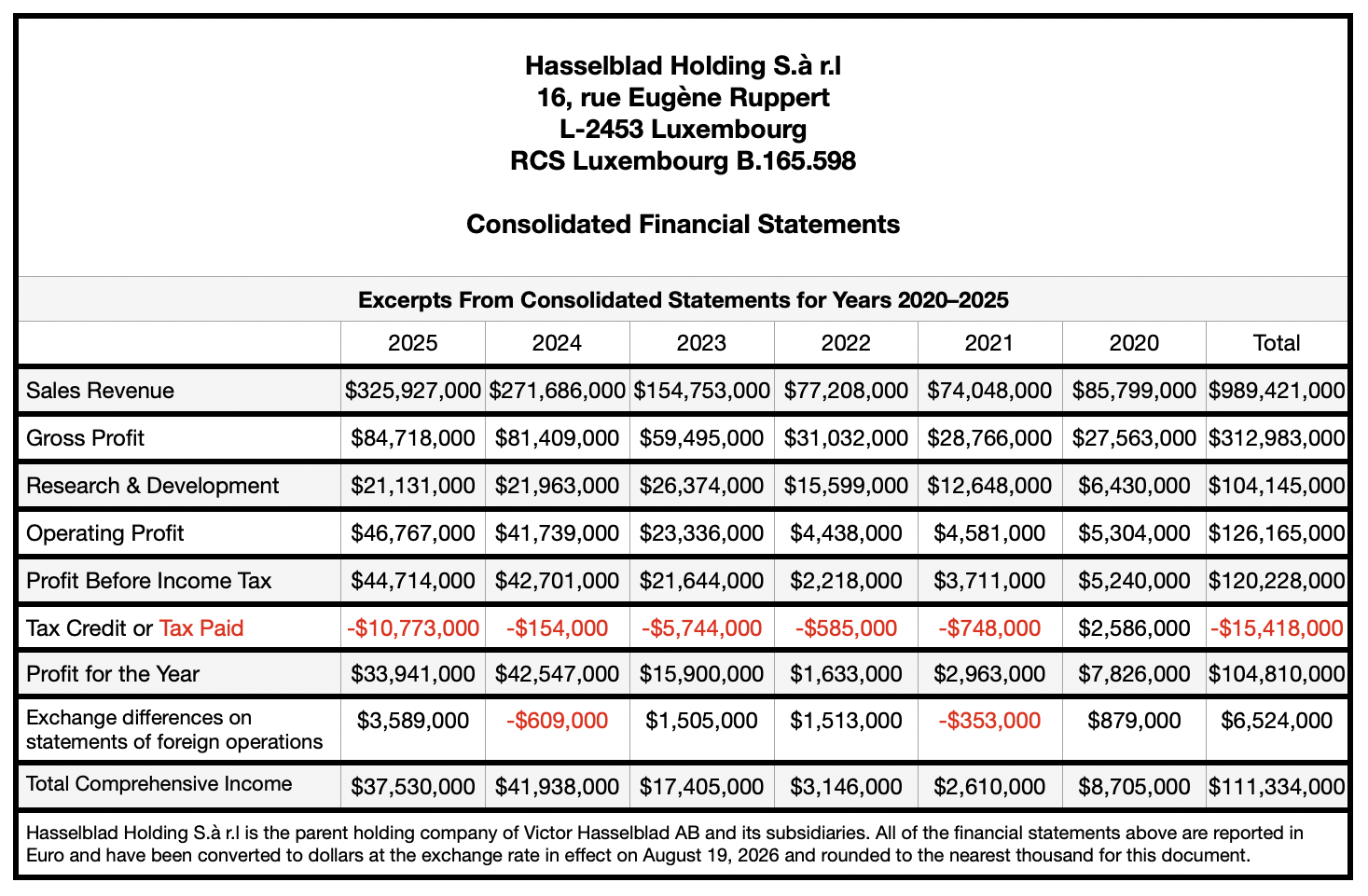
Hasselblad operates as a private company under its parent entity, DJI, so it does not publish detailed quarterly earnings calls or SEC-style public reports. However, official annual corporate filings submitted by its operating subsidiaries (Victor Hasselblad AB in Sweden and Hasselblad Holding S.à r.l. in Luxembourg) reveal the following recent financial figures:


Victor Hasselblad AB (Primary Operating Entity)

  • Sales Revenue: SEK 1.89 billion
  • Operating Income: SEK 438.2 million
  • Net Profit: SEK 344.8 million

Business Highlights & Drivers

  • Growth Trajectory: Hasselblad’s financial turnaround in recent years has been largely driven by the strong adoption of the X2D 100C mirrorless system, followed by the 907X & CFV 100C and compact XCD lens releases (e.g., XCD 28P, XCD 25V, XCD 20–35E, XCD 75P).
  • Parent Support: Since being acquired by Chinese technology firm DJI, Hasselblad has leveraged shared supply chain efficiencies and technological integration, moving the brand back into strong profitability compared to its losses in the early 2010s.

Hasselblad 2025 financial results

All figures below are the dollar-converted figures from the financial table you provided; the actual filing is in euros.

$ millions 2025 2024 Change
Sales revenue $325.9M $271.7M +20.0%
Gross profit $84.7M $81.4M +4.1%
R&D $21.1M $22.0M −3.8%
Operating profit $46.8M $41.7M +12.0%
Profit before tax $44.7M $42.7M +4.7%
Tax credit / (tax paid) −$10.8M −$0.2M
Profit for the year $33.9M $42.5M −20.2%
Total comprehensive income $37.5M $41.9M −10.5%

The big story: revenue continues to surge

Hasselblad’s revenue has grown dramatically over the past three years:

  • 2022: $77.2M
  • 2023: $154.8M +100%
  • 2024: $271.7M +75.6%
  • 2025: $325.9M +20.0%

So revenue has more than quadrupled since 2022 and increased almost 4× between 2020 and 2025. The implied 2020–2025 revenue CAGR is approximately 30.6%.

Gross margin deteriorated significantly

This is probably the most interesting part of the results. Hasselblad’s gross profit increased only from $81.4M to $84.7M, despite revenue increasing by $54.2M. That means the gross margin fell from approximately:

  • 2024: 30.0%
  • 2025: 26.0%

That’s a substantial deterioration. For comparison:

Year Revenue Gross margin
2020 $85.8M 32.1%
2021 $74.0M 38.8%
2022 $77.2M 40.2%
2023 $154.8M 38.4%
2024 $271.7M 30.0%
2025 $325.9M 26.0%

So despite the enormous increase in sales, Hasselblad is generating less gross profit per dollar of revenue than it did several years ago.

Matt Granger’s Hasselblad Expert Setup Guide now updated for the latest X2DII camera & 35-100mm lens

Operating profit still improved

Despite the weaker gross margin, operating profit increased from $41.7M to $46.8M, or approximately 12%. Operating margin was:

  • 2024: 15.4%
  • 2025: 14.3%

So operating profitability remained quite strong, but the margin slipped. One notable factor is R&D. Hasselblad spent approximately $21.1M on R&D in 2025, down from $22.0M in 2024 and $26.4M in 2023. R&D therefore represented about 6.5% of revenue in 2025.

Net profit declined substantially

This is where the headline looks less impressive. Hasselblad’s profit for the year fell from $42.5M in 2024 to $33.9M in 2025, a decline of approximately 20%. The difference is particularly notable because operating profit actually increased. The table shows a $10.8M tax expense in 2025, compared with only about $154,000 in 2024. That explains much of the gap between the improvement in operating profit and the decline in net income. Net margin consequently dropped from approximately 15.7% in 2024 to 10.4% in 2025.

Six-year picture

The overall trajectory is striking:

Year Revenue Operating profit Net profit
2020 $85.8M $5.3M $7.8M
2021 $74.0M $4.6M $3.0M
2022 $77.2M $4.4M $1.6M
2023 $154.8M $23.3M $15.9M
2024 $271.7M $41.7M $42.5M
2025 $325.9M $46.8M $33.9M

In other words, 2025 was Hasselblad’s biggest sales year by a very large margin, and operating profit was also a record in this six-year series. But 2024 was actually the better year for bottom-line profitability.

You can download the financial records from this page.

The latest financial results from Nikon, Fujifilm, Tamron, GoPro, Kodak, and Panasonic

The post Hasselblad’s latest financial results: sales up 20%, gross margins declined sharply, net profit fell 20%, operating profit reached a new high appeared first on Photo Rumors.

The latest financial results from Nikon, Fujifilm, Tamron, GoPro, Kodak, and Panasonic

Par : PR admin
22 août 2026 à 19:52


Here is a recap of the latest financial results from Nikon, Fujifilm, Tamron, GoPro, Kodak, and Panasonic:


Nikon:

Nikon’s Q1 results (April-June 2026, fiscal year ending March 2027) showed overall revenue rising to ¥164.1 billion (+¥6.0 billion YoY), but the Imaging Products business declined sharply. Imaging revenue fell 8.8% to ¥72.9 billion from ¥80.0 billion, while operating profit dropped 27.5% to ¥8.1 billion from ¥11.1 billion, with the margin slipping from 14.0% to 11.1%. Unit sales of interchangeable-lens digital cameras fell to 210,000 (from 270,000) and lenses to 310,000 (from 370,000), driven primarily by a contraction in demand in China; higher memory prices further pressured profitability despite foreign-exchange gains and U.S. tariff refunds. Nikon responded by cutting its full-year Imaging forecasts (revenue down ¥13 billion and operating profit down ¥3 billion versus prior guidance).


Fujifilm:

The Imaging segment (cameras and Instant systems) performed well, with revenue rising 16.2% to ¥168.8 billion and operating income up 3.9% to ¥43.4 billion. Consumer Imaging led the growth on strong Instax demand, especially mid- to high-end models such as the instax mini Evo and instax WIDE 400, the successful April 2026 launch of the entry-level instax mini 13, and expanded film production capacity while Professional Imaging (X-series and GFX digital cameras) also posted higher revenue, driven by solid sales of the X-T30 III and X-E5 plus continued strong demand for the long-selling X100VI, particularly in Asia.


Tamron – four new lens releases expected this year:

Tamron’s 2nd Quarter/1st Half FY2026 results showed overall H1 net sales of ¥43.281 billion (+3.8% YoY) but operating income of ¥7.689 billion (-16.5% YoY), with Q2 sales up 11.4% and operating income down 14.5%; the Photographic Products (camera/lens) segment was the main drag, posting H1 sales of ¥27.534 billion (roughly -8-10% YoY) and operating income of ¥5.943 billion (-29.3% YoY), while Q2 segment sales dipped 1.1% and operating income fell 22.7%.


GoPro – camera sales down 38%, cash down to $27 million:

GoPro reported Q2 2026 results with revenue of $105 million, down 31% year-over-year, driven by weaker hardware sales as sell-through fell to about 291,000 camera units (down 38% YoY). Subscription and service revenue rose 11% to $29 million (28% of total revenue, up from 17%), including $2 million from an AI content licensing program, while the subscriber attach rate hit a record 69% (vs. 54%). Retail channel revenue was $58 million (56% of total, down 48% YoY), while GoPro.com revenue reached $47 million (44%, up 13% YoY). The $19 million tariff refund benefit was partially offset by a $15 million component-commitment charge; the company posted a net loss of $51 million ($0.30 per share) versus a $16 million loss a year earlier and adjusted EBITDA of -$29.5 million.


Kodak:

Eastman Kodak reported strong second-quarter 2026 results, with consolidated revenue rising 18% year-over-year to $311 million from $263 million, driven by Print segment revenue of $195 million (+10%) and Advanced Materials & Chemicals revenue of $105 million (+40%). Gross profit surged 61% to $82 million (margin expanding to 26% from 19%), Operational EBITDA climbed to $36 million from $9 million, and GAAP net income reached $17 million versus a $26 million loss in the prior-year period, marking the company’s fourth consecutive quarter of year-over-year improvement in revenue, gross profit, and Operational EBITDA. Cash ended the quarter at $290 million (down $47 million from year-end 2025, largely due to Term Loan repayments partially offset by pension asset redemptions), as CEO Jim Continenza highlighted “stability and growth” and Kodak’s shift into a growth-focused phase with improved operational and financial leverage.


Panasonic:

Panasonic Holdings’ Q1 FY2027 results delivered the company’s strongest first-quarter operating profit in 41 years, but the camera business played no meaningful role in the surge. Group sales rose 6.4% year-over-year to ¥2,018.9 billion, while operating profit more than doubled to ¥182.5 billion (adjusted operating profit ¥186.4 billion) and net profit attributable to shareholders reached ¥188.9 billion, driven almost entirely by AI-infrastructure demand, especially data-center energy storage systems (nearly doubled) and related electronic components such as conductive polymer capacitors. Full-year guidance was raised to ¥7,800 billion in sales and a record ¥590 billion in operating profit (the highest annual figure in 42 years). In contrast, the LUMIX camera business sits inside the Imaging Solution Business Division, which is buried within the AVC unit of the Smart Life segment (alongside TVs and communication networks). Smart Life was the only major segment to post lower sales (¥311.1 billion, down roughly 2–8% depending on currency adjustment), with AVC itself falling nearly 14% to ¥73.1 billion from ¥84.8 billion a year earlier due to weaker demand in Europe and China; segment profit improved modestly only because of rationalization and restructuring, not volume or product strength. Rising memory prices were explicitly cited as a headwind that further weighed on the AVC/camera-adjacent business, underscoring that Panasonic’s record quarter had essentially nothing to do with cameras.

The post The latest financial results from Nikon, Fujifilm, Tamron, GoPro, Kodak, and Panasonic appeared first on Photo Rumors.

Sony also confirms the Tamron acquisition offer in their latest Q1 FY2026 financial results

Par : PR admin
3 août 2026 à 00:48


Sony also confirms the Tamron acquisition offer in their latest Q1 FY2026 financial results:

Earlier today, Sony released its Q1 FY2026 financial results (for the three months ended June 30, 2026). While the big headline numbers were incredibly strong—consolidated sales up 8.2% to JPY 2,837.8 billion and operating income surging 40% to JPY 476.5 billion—the biggest takeaway for the Alpha community was the formal confirmation we’ve all been waiting for: Sony has formally submitted a proposal to acquire Tamron.

Sony Q1 FY2026 Financial Results: Sony Confirms Tamron Acquisition Offer

Tamron confirms non-binding acquisition proposal from Sony

Sony to acquire Tamron?

Via SonyAddict

The post Sony also confirms the Tamron acquisition offer in their latest Q1 FY2026 financial results appeared first on Photo Rumors.

Canon Q2 2026 financial results: profit up, 90% tariffs refunded, compact camera production increases

Par : PR admin
29 juillet 2026 à 23:49


Canon released its Q2 2026 financial results. Here is the recap:

  • Market conditions remained weak in Europe, affected by the Middle East situation, and in the U.S., where the tariff impact persists.
  • Net sales rose 3.6%, reaching a record high for a second quarter, driven by continued sales growth in compact camera and network camera businesses, and revenue growth in semiconductor lithography equipment driven by memory-related demand
  • Higher costs resulting from a rise in memory prices and the Middle East situation, absorbed by refunds on additional U.S. tariffs and yen depreciation
  • Increased operating profit by 35.2% to 159.2 billion yen

Details on the Canon Imaging Business:

  • Camera sales increased significantly, driven by strong demand for compact cameras, which continued from the first quarter.
  • For compact cameras as well, we will further increase production volumes in the second half of the year and aim to achieve full-year sales growth of more than 50%.
  • For interchangeable-lens cameras, revenue increased as sales of full-frame models, led by the EOS R6 Mark III launched last November, grew compared with the first quarter, resulting in a higher average selling price.

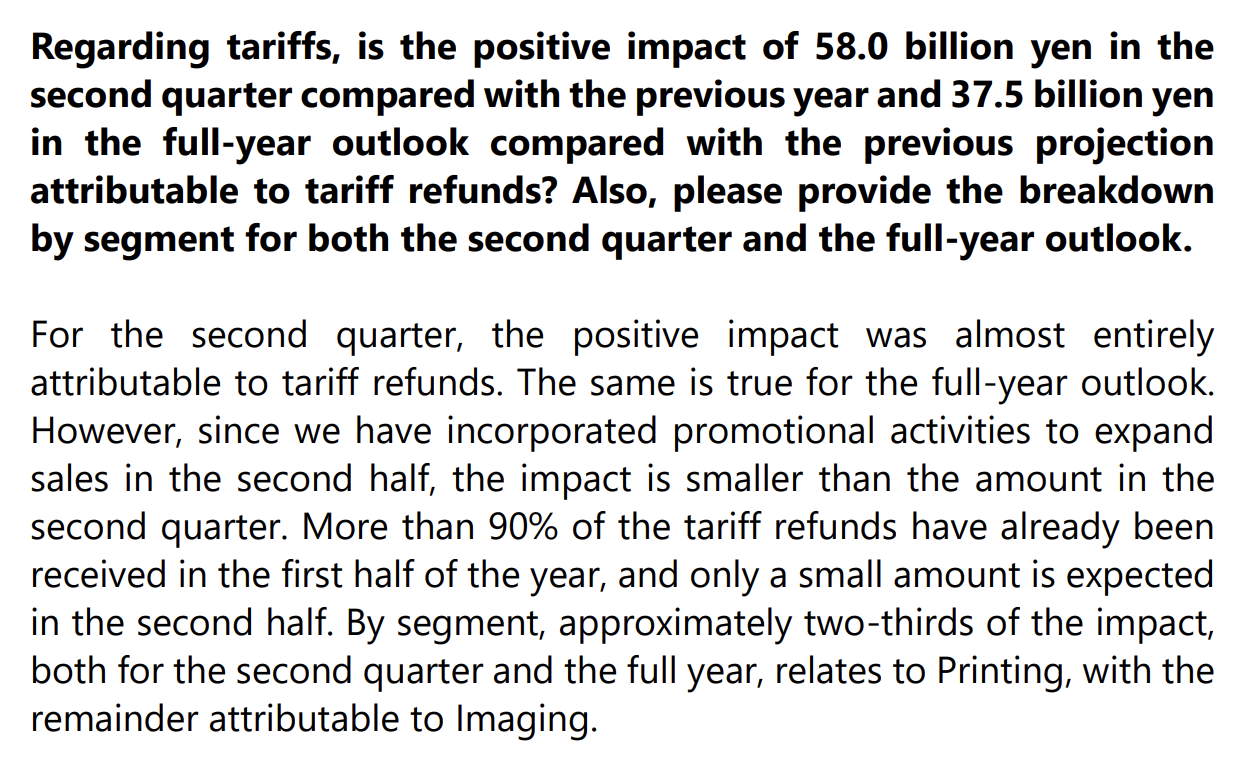
Canon got back 90% of the Trump tariffs that we, the consumers, paid through price increases:

Breaking: Canon to increase prices in the US as a result of the new Trump tariffs

Detailed Canon camera report:

The compact camera market continues to expand, driven by the growing number of new camera users, particularly among younger consumers. As for the interchangeable-lens camera market, while we lowered our outlook to reflect the impact of the Middle East situation, we still expect the market to reach 6.45 million units.

In the second quarter, compact camera sales increased significantly as we were able to meet strong demand through the production expansion implemented in the second half of last year.

For interchangeable-lens cameras, sales of full-frame models increased significantly compared with the first quarter, led by the EOS R6 Mark III, which was launched in November last year. Combined with an increase in the average selling price, this resulted in revenue growth of 12.9% year on year.

In the second half of the year, for compact cameras, which continue to perform strongly, we will further expand production capacity to eliminate supply shortages as quickly as possible and drive additional sales growth. For interchangeable-lens cameras, in addition to the EOS R6 Mark III, which contributed to sales growth in the first half of the year, we will strengthen sales of full-frame models, led by the EOS R6 V, a full-frame mirrorless camera for video creators launched in June. As a result, we aim to achieve full-year revenue growth of 11.6% for the camera business.


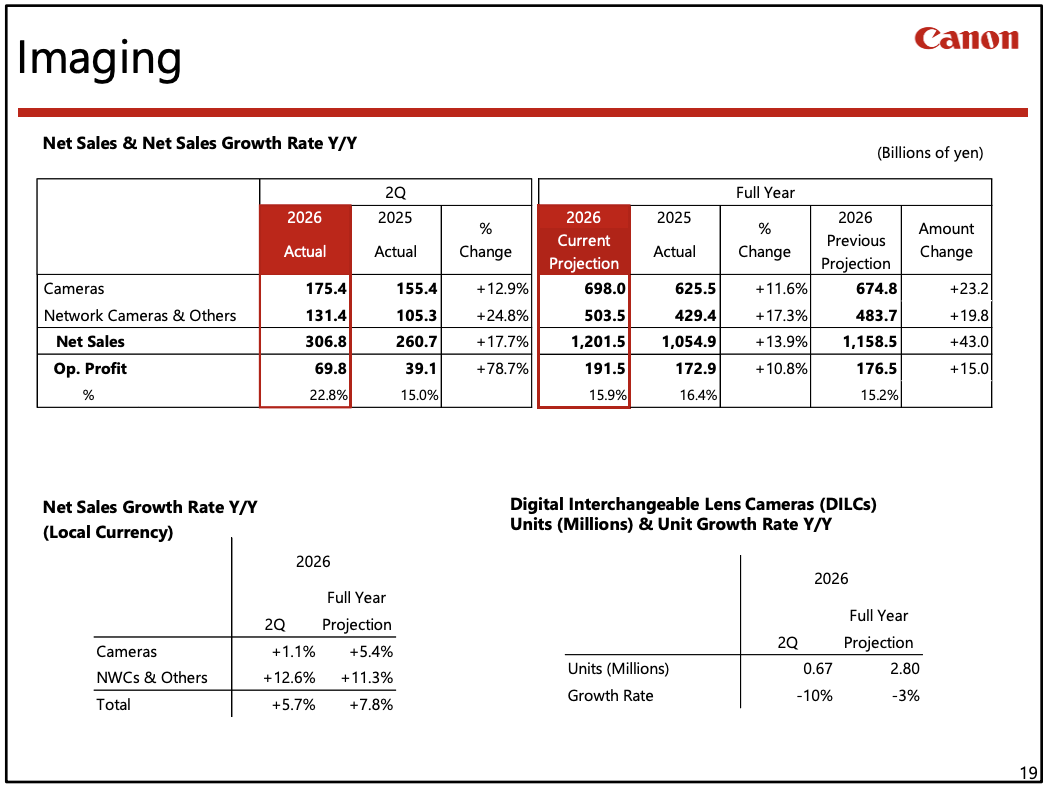
Recap of the latest Canon Q2 financial results (cameras):

  • Cameras net sales: ¥175.4 billion, +12.9% YoY.
  • Full-year 2026 Cameras sales projection: ¥698.0 billion, +11.6% YoY (revised upward).
  • Strong demand for compact cameras continued from Q1 and was the main sales driver. Canon plans to further increase production in the second half and is targeting more than 50% full-year sales growth in the compact category.
  • Interchangeable-lens cameras (ILCs): Revenue grew thanks to higher sales of full-frame models (especially the EOS R6 Mark III), which raised the average selling price.
  • DILC unit shipments: 0.67 million units (down 10% YoY).
  • Full-year DILC projection: 2.80 million units (up 15.9% YoY).
  • Canon described the Imaging business as “highly profitable,” aided by the mix of higher-priced photography camera models. Full-year Imaging operating profit was raised to ¥191.5 billion (+10.8%).

Source: Canon

The post Canon Q2 2026 financial results: profit up, 90% tariffs refunded, compact camera production increases appeared first on Photo Rumors.

❌