❌

Vue normale

New Panasonic Lumix teaser

Par : PR admin
4 octobre 2026 à 20:17


There is a new Panasonic Lumix teaser for something new coming on October 5th:

25 years of LUMIX deserves an appropriate celebration. And who’s going to win with this is you.

We can’t count yet, but it’s almost time.

05/10. Keep an eye out.

Get ready

25 years of LUMIX deserve a raised celebration. And who’s going to enjoy it is you.

We can’t count it yet, but it’s almost time.

05/10. Stay tuned.

The post New Panasonic Lumix teaser appeared first on Photo Rumors.

Save Your Photos Month: community images from each 48-hour mini-challenge

15 photography themes over a month generated a wide range of unique photos from our community. Check them out and then share your own in the discussion.

Bright blue vintage coupe with chrome trim parked on grass.Joachim Wulfers

Last month, we announced a special mini-challenge event that invited the community to submit a themed photo, with the theme rotating every 48 hours. This meant 15 distinct themes with 15 opportunities to submit a photo throughout September.

Below is a selection of the challenge participants in no particular order. Read on to see what wild and diverse photos, and the story behind them, came about from this event.

Something that moves

Painted blue wooden birdhouse on a post with a hummingbird hovering nearby.

Canon EOS 7D Mark II | Canon EF 70-300mm F4-5.6L IS USM @ 207mm | F5 | 1/2000 sec | ISO 1600
GulfCoastFL

GulfCoastFL: What are the odds I would catch this hummingbird just as it passes our Blue Angels bluebird house while being pursued by a lizard? I see these lizards every day trying to ambush the hummers on our feeders. Quick as the hummers are, I think they are safe.

Photograph of a framed photograph

Assorted vintage decor on a black shelf, including a toy train, ornate clock, glass lamp, and framed cross-stitch.
jaberg

jaberg: This photo of my father, walking in a local park, hangs in the corner where his chair once sat. The rest of the “decor” is a work in progress. My partner and I are still figuring out where things should go – most of this is waiting for an assignment.

I still see dad daily at his assisted living, but I miss having him here, in his corner.

An everyday object with an interesting story

Maurice Lacroix quartz wristwatch with silver-and-gold metal band and white dial on a textured fabric surface.
Myles Baker

GWKilgore: I’ve owned a fair few watches over the years, from my first Timex more than half a century ago to my latest smart watch bought a few months ago. It’s rare that I do not have one on my wrist.

I wear them for much the same reason that I use cameras, there is something tactile & real about both that you don’t get with the ubiquitous smartphone.

This particular watch is the oldest one that I currently own & was a gift from my wife on our first wedding anniversary, 32 years ago. Constant wear over the years shows on the case & strap, but it still keeps on keeping on.

Oddest thing around your neighborhood

Aerial view of a coastal harbor town with a Wightlink ferry in the foreground and boats on calm water.
Ansel Spear

Ansel Spear: The inappropriately scaled and situated Ben Ainslie building was built in 2014 in Old Portsmouth, the historic quarter. It was designed to give Ainslie’s racing team a local foothold during the 2015 / 2016 America’s Cup Series, held in the Solent, off Portsmouth, using AC45F foiling catamarans.

After getting through sponsors Land Rover and INEOS at an injudicious rate of knots, Ainslie’s lot up-sticks and leaves, leaving us with a colossal blot on the landscape. To call it an eyesore would be an understatement.

Most photogenic scene in your neighborhood

Bright blue vintage coupe with chrome trim parked on grass.
Joachim Wulfers

Joachim Wulfers: One of the exhibits at a hot road show.

Something old that you still use

White ceramic mug with a vintage Rolls-Royce car illustration on a wooden surface.

Apple iPhone 16 Pro | 6.8mm F1.8 | 1/60 sec | ISO 125
jaberg

jaberg: My Grandfather’s coffee mug. My father had an identical cup. It’s an object that has always been in my life – I literally can’t remember a time when it wasn’t present, and it might predate my birth. My nephew has that mug now. I don’t drink from Grandpa’s mug anymore. It sits on my dresser, organizing my “carry” pens, pencils, etc., and serves as a location for (non-e) tickets to upcoming events. A twice-daily reminder of my grandfather, my father, and from where I come.

Something outside that makes you happy

Children in traditional shepherds attire walking in a street parade with spectators and a straw-clad figure.
cbf_si

cbf_si: Cultural heritage cannot be replaced, but it must be preserved. The photograph shows shepherds’ attire on the nearby mountain of Velika Planina, where cows are still grazed and cheese is made by hand. Photo taken at the 53rd National Costume and Clothing Heritage Days held in Kamnik, Slovenia.

Something you couldn’t replace

Silver Bialetti Moka Express stovetop espresso maker on a gas burner.

Leica Q2 Monochrom | Leica Summilux 28mm F1.7 ASPH. | F6.3 | 1/50 sec | ISO 1600
beorn76

beorn76: A Moka Bialetti that has seen so many coffees over the years, never a flinch, always ready to please its many admirers eagerly and patiently waiting.

Something growing or changing

Purple and orange chili peppers growing on a leafy plant.
Spid

Spid: Chilies ripening in the glasshouse, awaiting their turn to be turned into something hot and tasty.

What’s on your dinner plate?

Pizza topped with eggplant, cherry tomatoes, and olives beside a red orange drink on a wooden table, with a pigeon nearby.

Canon PowerShot G9 X | Canon 10.2-30.6mm @ 27.1mm | F5 | 1/80 sec | ISO 250
david kohn

david kohn: When in Roma, the pigeon doesn’t get your pizza.


There are more 48-hour themes to check out in the event’s album, along with many interesting stories about the photos from our community. We would love for you to join in on the discussion!

About the Author: Mathew Anderson is a proud Community Manager for the technology industry and a past visitor to DPReview.com for all his camera needs. He is currently the lead of DPReview’s community and primary communication link between the community and DPReview’s team.

Want to stay up to date on the latest product news and releases? Add DPReview as a preferred source to ensure our independent journalism makes it to the top of your Google search results.

Nikon Z5II vs Z5IIC: what are you giving up to save some money?

Despite some obvious cuts, Nikon’s latest full-frame camera is a lesson in being inexpensive without feeling cheap.

Black Nikon Z 5IIc camera body in close-up, with model name in white letters and several control buttons visible, including one with a trash can icon.

This month, Nikon released the Z5IIC, which is essentially a version of its Z5II mirrorless camera, but with the viewfinder removed and a lower price point. And while that top-line summary is closer to the whole story than usual, there are a few nuances that are worth looking at if you’re trying to decide between the two models.

No EVF

A silver Nikon Z5IIC on a gray background, with its articulating display flipped out.
With the Z5IIC, you’re entirely reliant on the LCD for composing your pictures and videos.
Richard Butler / Mitchell Clark

The most obvious difference between the two cameras is that the Z5II has a (particularly nice) electronic viewfinder that you can use in sunny conditions, or when you’d prefer not to look at a rear screen, and the Z5IIC does not. How much that will bother you comes down to personal preference; are you willing to give up an EVF to save some money, and do you value you the camera being a bit smaller and easier to get into and out of a camera bag?

While both the Z5IIC and the Z5II have 3.2″ fully-articulating displays, the one on the more expensive, full-size model is a bit higher-resolution at 2.1 million dots, versus the Z5IIC’s 1.04M. That’s not as big a difference as those numbers may seem – they equate to 1024 x 682px and 720 x 480px, respectively – but while we found the screen to be quite usable, it is undoubtedly not quite as nice. Neither comes all that close to a display you’d find on a smartphone, though.

Storage

The Nikon Z5IIC's card slot, with an SD card inserted.Richard Butler / Mitchell Clark

This is another relatively simple arena: the Z5II has two UHS-II card slots, while the Z5IIC has one. This could be a slight annoyance when shooting video, where it can be nice to have your recording automatically roll over to a second card once you’ve filled one up, and can bring some peace of mind if you’re a photographer worried about the possibility of your card dying before you can offload it (something that can happen, but very rarely). That assurance is also nice if you’re capturing a once-in-a-lifetime event or trip.

Most shooters, however, will be perfectly well-served by a single card-slot camera. And in cases where you absolutely must have backups, Nikon’s app lets you automatically transfer 8MP JPEGs from your camera to your phone as you take them. (Unfortunately, there’s no option for full-size JPEGs or Raws, unless you have the camera directly connected to Wi-Fi and set to automatically upload to Nikon’s Imaging Cloud service).

Controls and handling

The back of a Nikon Z5IIC.Richard Butler / Mitchell Clark

The Z5IIC and Z5II have, once again, very similar controls, with essentially the exact same mix of programmable buttons on the top, rear and front plates. (The one difference: by default, the button to the right of the mode switch on the Z5II is set to AF On, while on the Z5IIC it’s focus and exposure lock, though either can be customized to behave like the other). Likewise, both cameras have twin top-plate control dials.

The one control omitted on the Z5IIC is a joystick, leaving you to control your AF point using the touchscreen or the multi-directional controller. When we were using it, we frequently found ourselves reaching for the nonexistent joystick, since it can be more convenient than using the touchscreen, especially if you’re shooting at odd angles. But at least we never had to worry about how to control the focus point when we had the camera’s EVF up to our eye…

There is one other difference between the two: the Z5II has three user-defined settings on its mode dial, while the Z5IIC only has two, replacing the third with a “Scene” setting.

Scene modes

The top plate of a silver Nikon Z5IIC.Richard Butler / Mitchell Clark

Choosing the Scene setting lets you select what you’re trying to take a picture of and have the camera automatically optimize some of its settings for it. For instance, if you set it to sports, the camera will do its best to choose a fast shutter speed. If you instead tell it you’re trying to capture a dusk or dawn scene, it’ll set the white balance to preserve the colors as your eye sees them.

This isn’t a feature Nikon has included on its full-frame cameras before, so it’s absent on the Z5II. This may make the Z5IIC seem more attractive if you’re looking for your first camera and aren’t accustomed to having full control over the wide variety of settings mirrorless cameras offer. (However, we believe you’ll be better served by learning to make those decisions yourself, rather than using a somewhat clunky mode that can restrict your creative freedom).

Size and weight

A three-quarter view of a black Nikon Z5IIC with a 26mm F2.8 pancake lens attached, against a gray background.
Even with a pancake lens, the Z5IIC isn’t tiny by any measure.
Richard Butler / Mitchell Clark

Despite the Z5IIC’s lack of an EVF, it isn’t substantially lighter than the Z5II. It comes in at 620g (22oz), versus 700g (25oz), a mere 11% reduction.

Likewise, it’s only marginally shorter at 81mm (3.2″) tall, rather than 101mm (4.0″). We did find the lack of an EVF hump meant it was easier to slip in and out of a camera bag, but it being the same thickness and width as the Z5II means you’ll probably need to have a dedicated bag to carry it around in. Once you have a lens mounted, it’s a bit big for all but the roomiest of purses, and would struggle to fit in even the most generous of jacket pockets.

Autofocus

A Nikon Z5IIC, in-hand, seen from the front.Richard Butler / Mitchell Clark

Both cameras have very similar autofocus systems, with all the features we’d want from a modern mirrorless option, including the ability to recognize and track various subjects. And while we haven’t done our in-depth testing on the Z5IIC yet, the experience we’ve had with it gives us no reason to suspect that it won’t perform the same as the Z5II.

The one other autofocus difference: the Z5II has an AF assist lamp, which the camera can use to add a little extra illumination when it’s trying to focus in an extremely dark scene. The Z5IIC trades this for a tally light to indicate when the camera is recording video.

Pricing, now and in the future

The silver Nikon Z5IIC from the front, with its sensor visible.Richard Butler / Mitchell Clark

Many people have been quick to point out that, at the moment of the Z5IIC’s launch, you can buy a standard Z5II for around the same money, or even less. And if that’s the still the case as you’re reading this, our advice is straightforward: you should buy the Z5II.

However, it’s worth keeping in mind that MSRP is always an opening bid. This is likely the most expensive the Z5IIC will ever be (at a price that still makes it the joint second least expensive full frame camera ever), and, based on past pricing trends, we expect it will be sold for remarkably cheap after a few months on the market. That is, after all, what it seems to be designed to do. If and when you can buy it for as much cheaper than the Z5II as the delta between the cameras’ MSRPs suggests, it’ll be a much easier recommendation if you’re trying to save some money while starting a new hobby.

Summary

The Z5IIC and Z5II are much more alike than they are different. Beyond what we’ve covered in this article, they’re essentially the same, spec-for-spec, with the same stabilized sensor, mechanical shutter, burst rates, ports, video modes and more. It’s remarkable how inexpensive Nikon has managed to make the Z5IIC without making it feel cheap, both in terms of features and build.

Deciding between the two will largely depend on your budget and how much you value an EVF and the other features the Z5II offers.

About the Author: Mitchell started taking pictures at 10 and hasn’t stopped since. It’s been a wide-ranging adventure, spanning a wide variety of genres and locales, and occasionally dipping into fascinations with video and filmmaking. They honed their technical knowledge doing documentation, programing and QA, writing for The Verge, and just generally messing around on the computer to see what breaks.

Want to stay up to date on the latest product news and releases? Add DPReview as a preferred source to ensure our independent journalism makes it to the top of your Google search results.

Wildlife photography’s funniest competition just hit a milestone, and the 2026 finalists are here

A decade after its founding, the Nikon Comedy Wildlife Awards received more than 10,000 submissions for the first time, a figure its co-founders say proves humour is a genuine force for conservation.

Collage featuring a praying mantis perched on a green leaf, a small bird on a branch, two lions interacting playfully, an orangutan sitting, an elephant’s trunk in close-up, and two elephants with one lifting dust with its foot.© Diego Perez, Jan Wittmer, Barbara Seiberl-Stark, Tanner Mansell, Cliff Fawcett, Heather Cudworth / Nikon Comedy Wildlife Awards

The Nikon Comedy Wildlife Awards has announced the finalists of its 2026 competition. This year’s edition drew more than 10,000 entries, which the competition says was the highest number in its history. Photographers hailed from 112 countries.

This year’s finalist selection includes 40 individual finalists, 3 under-16 finalists, 4 Portfolio Category finalists and 9 video finalists. The individual competition also includes 4 categories of its own: mammals; birds; reptiles, amphibians and insects; and aquatic species. The Overall, Category and Highly Commended Winners will be announced on December 8 at an awards ceremony in London.

The competition was founded in 2015 in part to promote conservation, and to that end, every year it lends support to a sustainable conservation organization. This year, it is working with the Born Free Foundation, an international charity that rescues and protects wild animals from exploitation while also conserving threatened species and their natural habitats.

You can see a selection of the finalist images below, and see the full gallery at the competition website.

Push Over – Barbara Seiberl-Stark, Austria

Two lions on sandy ground, one nuzzling the other’s neck with a paw.© Barbara Seiberl-Stark / Nikon Comedy Wildlife Awards

Photographer’s description: A lion pride was playing in the riverbed of Ruckomechi in Zimbabwe – The picture was taken during my very first Safari this year in june in Zimbabwe. We were out for a game drive early in the morning and were lucky to spot a pride of young lions in the dried-up riverbed just in front of the Kavinga-Camp. The rising sun bathed the landscape in glorious light and the lions had obviously a lot of fun. As there were 7 of them, it was hard to decide in wich direction or on what scene to point the camera. From all photos, I took this morning ‘Push over!’ was the funniest.

Location: Zimbabwe

Technical details: Sony a1 II | Sony FE 300mm F2.8 GM OSS | F2.8 | 1/1600 sec | ISO 1000

Lessons – Heather Cudworth, USA

Two elephants in a grassy plain, one spraying dust beside the other.© Heather Cudworth / Nikon Comedy Wildlife Awards

Photographer description: Amboseli was in the midst of a 4 year drought. The land was extremely parched. Elephants are known for giving themselves dust baths. This behavior provides protection from the sun and soothes their skin. While observing elephants tossing dust and mud over their bodies is somewhat common, I don’t think the huge plume of dust delivered directly to this youngsters face would have been possible if not for the extreme dry conditions. While this photo is objectively funny, there is a lesson to be learned by us humans, too. Our actions create ripple effects which spread far and wide. Much like this cloud of dust this baby elephant is about to endure! Mum took a break from walking to enjoy a soothing dust bath. She began to pick up piles of dirt, dust, and grass and toss them effortlessly over her head. She paused for a moment then gathered a particularly large amount of debris. She pulled her trunk back as if she was winding up for a strike-out pitch, then proceeded to shower her youngster with presumably the most high-pressure dust bath he’d ever experienced, directly to the face! Whether she was teaching him a lesson in cleaning his skin, keeping his mouth shut, or both, I don’t know. However, I am certain she got her point across. Listen to your mother, little one.

Location: Amboseli National Park, Kenya

Technical Details: Canon EOS R5 | Canon RF 100-400mm F4.5-7.1 L IS USM | 300mm | F5.6 | 1/200 sec | ISO 100

If I can’t see you – Cliff Fawcett, UK

Close-up of an elephant’s curled trunk and wrinkled head against a blurred green landscape.© Cliff Fawcett / Nikon Comedy Wildlife Awards

Photographer’s description: I watched this bull in South Africa stroll toward a group with absolute confidence, until he got within twenty yards. Suddenly, the trunk went up, the eye went into hiding, and he executed a very slow, very awkward U-turn. We’ve all been there; he just happens to weigh six thousand kilos. I was observing an elephant herd in Addo National Park, when one juvenile caught my eye, repeatedly swinging his trunk with reckless abandon. It meant I completely ignored the other thirty magnificent, full-grown elephants at the same waterhole to stay glued to one goofy youngster messing about. I kept the frame tight, resisted the urge to look away, and waited for the motion to peak. I certainly didn’t plan for him to blindfold himself, but the moment he slapped his trunk across his eye, it was peak toddler logic: if I can’t see you, you can’t see me. The second I saw it on the screen—I knew it was going straight to the Comedy Wildlife Awards.

I like to say I have a mind trained in psychology and a life shaped by adventure. What is means is that my work is rooted in an understanding of what grabs human attention and creates lasting meaning and all as an excuse to see as much of this crazy beautiful planet as possible. I’m not obsessed with gear and I don’t put too much focus on rigid composition rules. It’s about learning to see the quiet signals in images that actually move people.

Location: Addo National Park, South Africa

Technical Details: Nikon Z7 II | Tamron 100-400mm F4.5-6.3 Di VC USD | 400mm | F6.3 | 1/1000 sec | ISO 800

Sexy mantis – Diego Perez, Peru

Green praying mantis perched on a bright green leaf against a black background.© Diego Perez / Nikon Comedy Wildlife Awards

Photographer description: A tiny green mantis peeks over a leaf during a night walk in an area of Cusco, Peru, that is still waiting to be protected. I decided to enter this photograph because almost everyone I showed it to had the same reaction: they laughed immediately, even if they could not quite explain why. At first, the mantis seems to be sunbathing, or perhaps striking a rather glamorous pose. But there is also a small visual trick: half of the insect is hidden behind the leaf. Its hind legs disappear from view and, suddenly, its enormous forelegs begin to look almost like a pair of human legs.

I have photographed mantises several times before and have always found them surprisingly difficult subjects. Their long bodies, tiny heads and oversized forelegs are almost the opposite of the proportions that normally make an easy portrait. At first, I tried photographing this one with its entire body in the frame, but the images felt too familiar. So I began lowering my angle and using the leaf to hide different parts of the insect. That was when the image suddenly came together.

It was actually the first insect I photographed on the very first night of the trip, during a night walk in Camanti, Cusco. I was there documenting the forests and wildlife of the proposed Bosques del Araza Regional Conservation Area, one of Peru’s rainiest landscapes and an area increasingly threatened by illegal gold mining. The proposed protected area seeks to safeguard the headwaters of several important rivers and the biodiversity they support.

Location: Camanti, Cusco, Peru

Technical Details: Canon EOS R5 C | Venus Laowa 100mm F2.8 2X Ultra Macro APO | F14 | 1/200 sec | ISO 100

The different one – Dirk Koster, Netherlands

Three giraffes standing in a grassy savanna under a blue sky.© Dirk Koster / Nikon Comedy Wildlife Awards

Photographer description: I took this photo in 2025 in the Masai Mara, Kenya, in the Oltepesi area. Three young giraffes were standing side by side on the open, dry savanna and looked back at me with great curiosity. Then I noticed that right behind the middle one stood a single umbrella acacia, perfectly lined up with its head and neck. Suddenly that giraffe seemed to be ‘wearing’ the tree, like a green hairdo or a rather fancy hat. The other two looked completely normal, which made the middle one ‘the different one’. Nothing was staged or arranged; it was simply a matter of being in the right spot at the right moment, and seeing it. For me that is what wildlife photography is about: looking closely, being patient, and letting the animals tell the story. Sometimes they have a great sense of humour. Dirk Koster is a semi-professional nature and wildlife photographer from the Netherlands. After many years as a business consultant, he now has more time for photography. What he looks for in nature is not so different from his former work: not just what is there, but how things relate to each other. He is drawn to stories and interaction between animals. His photos are found, not staged. His work is regularly awarded on https://dk-foto.nl, and in mid-November 2026 the book ‘100 mooiste bomen van Amsterdam’ (The 100 most beautiful trees of Amsterdam, Noordboek) will be published with his photographs. Earlier he photographed in Guatemala as a member of Photographers Without Borders.

Location: Masai Mara

Technical Details: Sony a1 | Sony FE 50-150mm F2 GM | 63mm | F4 | 1/1600 sec | ISO 100

Angry Bird – Jan Wittmer, Germany

Small brown bird with a yellow crown standing on pavement against a blurred background.© Jan Wittmer / Nikon Comedy Wildlife Awards

Photographer description: During my photo trip to the island of Helgoland, I encountered a goldcrest for the very first time – and it was love at first sight. Europe’s smallest bird wandered around on the ground right in front of me, presumably searching for food. To get a perspective at eye level, I placed my camera on the ground. My heart was pounding, and my finger was glued to the shutter as the tiny bird darted back and forth every second. Suddenly, it came to a complete stop and looked straight into the camera. That was the exact moment this photo was taken.

Location: Helgoland, Germany

Technical Details: Sony a1 | Sony FE 100-400mm F4.5-5.6 GM OSS | 400mm | F5.6 | 1/4000 sec | ISO 1600

Are You Kidding Me? – Kevin Lohman, USA

Gray squirrel leaping toward a barred owl perched on a pine branch in a wooded forest.© Kevin Lohman / Nikon Comedy Wildlife Awards

Photographer description: A young Great Horned Owl had barely settled onto its perch before a protective squirrel launched a surprise aerial tackle, knocking it into the grass below. The most unbelievable part? The squirrel repeated the stunt two more times. The owl and squirrel were shaken up, but unharmed. I have been observing and photographing Great Horned Owls at this location for around nine years, and I had never seen anything like this before. An adult pair was raising two chicks, and once the young owls began branching, I started visiting them regularly in the mornings and evenings to observe their behavior. On this particular morning, I spotted one of the seven-week-old owlets perched in a pine tree along the path.

As soon as I saw the young owl, I stopped and watched it for a few minutes. It was fairly close to the ground, and I did not want to get too close. While I was standing there, the owlet hopped onto another nearby branch. I liked the way the pine branches framed it against the sky, so I raised my camera and began photographing as the young owl looked up and over its shoulder.

Just as I pressed the shutter for a burst of images, a squirrel suddenly launched from a nearby branch and landed directly on the owlet’s head, knocking both animals out of the tree. It happened so quickly that the squirrel essentially photobombed my photograph! I moved to another position and found the owlet sitting in the grass. It appeared to be fine and gradually worked its way from the ground back into the tree. Then, incredibly, a squirrel knocked it out of the tree again. The owlet climbed back up once more, this time moving closer to its mother, who was perched nearby. Surely that had to be the end of it. But no. A squirrel knocked the young owl out of the tree for a third time! After photographing these owls for so many years, I could hardly believe what I was watching. The same young owl had been knocked out of the tree three times in about an hour and a half.

After the third encounter, the adult female began hooting, and the owlet eventually made its way back up to her perch. She began preening the young owl, and the two finally settled down together. I stayed for a while longer, but everything became quiet. When I returned that evening, the mother and owlet were still perched together, with no squirrel in sight.
That morning, as was often the case during my morning visits, I was there by myself. I was handholding a Nikon Z9 with a NIKKOR Z 400mm f/2.8 TC VR S. Working with a long lens allows me to remain at a distance, stay quiet, and reposition easily without disturbing the owls. Handholding also lets me respond quickly when unexpected behavior unfolds. In this case, I was shooting a burst at 20 frames per second at exactly the moment the squirrel appeared. I certainly wasn’t expecting a squirrel to come flying into the frame and land on the owl’s head!

Location: Natural Bridges State Beach, Santa Cruz, CA, USA

Technical Details: Nikon Z9 | Nikon Z 400mm F2.8 TC VR S | TC engaged | F4 | 1/1000 sec | ISO 1000

Elvis – Paolo Torre, Italy

Close-up of a dark alligator head with open mouth and visible teeth against green foliage.© Paolo Torre / Nikon Comedy Wildlife Awards

Photographer description: This caiman emerged from the water in an area with a lot of floating vegetation, and part of it remained on its head. It resembles a 1950s rock and roll hairstyle.

Location: Pantanal, Brazil

Technical Details: Nikon D300S | 300mm | F5.6 | 1/1000 sec | ISO 200

Oops – I think I just parped – Carolyn Moore, UK

Brown hare grooming in tall green grass.© Carolyn Moore / Nikon Comedy Wildlife Awards

Photographer’s description: In the spring of this year, I went with a friend to a spot that we knew had a healthy population of hares. Our plan was to see how close we could get to the hares without disturbing them using a little of what we knew about fieldcraft – it is important to stay below the horizon when tracking hare and to disguise solid shapes – such as human shapes! Sure enough, there were a few hares in the field and the grass was just long enough to give a bit of protection to the hares and set a nice backdrop for the photographs. I set myself up with a long lens and tripod on the edge of the field using camouflage netting and wearing camouflage clothes. I stood next to the hedge using the netting to break the solid shapes that would be caused by me and my tripod. The next stage was to send my friend off to walk the perimeter of the field on the other side of the hedge with the intention of not disturbing the hares but encouraging them into, rather than away from, the field.

I didn’t need to wait for long, several hare came close to where I was standing without seeing me, enabling me to snap away without worrying them at all. I think the image shows just how relaxed this little fella was. It was a joy to watch them going about their activities and seemingly totally relaxed. This is what wildlife photography is all about for me!

Location: Wiltshire, UK

Technical Details: Canon EOS R5 II | Canon EF 500mm F4 L IS II USM + Canon EF 1.4x III | F5.6 | 1/2000 sec | ISO 2000

Ballet Dancer – Robert Nairn, UK

Gray hawk with barred wings perched on moss, wings spread against a blurred background.© Robert Nairn / Nikon Comedy Wildlife Awards

Photographer description: I am 69 and an amateur photographer and member of Ayr Photographic Society. I am a general photographer but enjoy wildlife photography and was inspired by David Bailey and bought an Olympus OM1 in 1978. However, having four children I did not return to more serious photography until after I retired. This image was taken in Dumfriesshire, Scotland with a Nikon z8 and 100-400 mm lens.

Location: Dumfries, Scotland

Technical Details: Nikon Z8 | Nikon AF-S 300mm F2.8G IF-ED VR II | F3.5 | 1/3200 sec | ISO 500

#ForTheGram – Rosie Barrett, UK

Brown bear cub climbing a tree against a blurred green forest background.© Rosie Barrett / Nikon Comedy Wildlife Awards

Photographer description: I went on a photography mission in Finland and my absolute dream species was the brown bear. After a few days of observing bears in the woods, I was lucky enough to encounter a family with 3 playful yearling’s. They were all climbing up and down the trees and one stopped for just a moment in this perfect pose. Pretty sure he knew it was for Instagram..un-bear-lieavable!

Location: Finland

Technical Details: None provided

Spicy Orangutan – Tanner Mansell, USA

Orangutan with reddish-orange fur and a black face touching its nose against a blurred green forest background.© Tanner Mansell / Nikon Comedy Wildlife Awards

Photographer description: A wild orangutan in the rainforests of Borneo appears to deliver a perfectly timed gesture toward the camera. As he finishes a meal with one finger extended, it creates the unmistakable impression that he is flipping off the lens. Though entirely coincidental, the moment captures an almost unsettling reflection of ourselves in one of our closest relatives. Taken in the disappearing jungles of Borneo, the photograph highlights both the intelligence and personality of these critically endangered great apes. Orangutans have so much personality, and there’s something wonderfully familiar about their expressions and gestures. Even though he was completely wild and just enjoying his food, I couldn’t help wondering, “Does he know what he’s doing?” That’s what makes the moment so funny to me.

I also hope the photograph encourages people to appreciate orangutans and care about protecting them. Beyond the humour, these remarkable animals face the loss of their forest habitat, and their future depends on conservation.

Location: Borneo Jungle

Technical Details: Sony a1 | Sony FE 70-200mm F2.8 GM OSS II | 200mm | F4 | 1/640 | ISO 640

Out of water – Thong Duy Vu, Vietnam

Small yellow-green bird perched on a pink banana flower against a green background.© Thong Duy Vu / Nikon Comedy Wildlife Awards

Photographer description: On a gentle sunlit afternoon, a little sunbird excitedly set off for a five-star spa deep in the forest. From afar, he spotted a “natural bathtub” – a bright red banana blossom, filled with cool water and plenty of sweet nectar. He landed on the blossom and savored the sweet nectar. After his treat, he hopped into the “tub” and began enjoying the refreshing, cool water. He tilted his head this way, stretched his wings that way, and wagged his tail, sending droplets splashing all over his body. The feeling was incredibly relaxing and refreshing. With his tiny beak, he carefully preened each feather until all the dust was gone. Then, he hopped back onto the edge of the tub, enjoyed some more nectar, and didn’t forget to sing a few cheerful notes as if to say, “Today I must be the freshest, cleanest, and most dazzling bird in the forest!” He jumped back into the tub, repeating his routine—tilting his head, spreading his wings, wagging his tail—but alas, why wasn’t there a single drop of water left? He looked up at the sky and exclaimed, “Oh my goodness, where did all the water go? What kind of half-finished bath is this?” He thought, this spa definitely deserves a one-star rating. I should’ve just bathed in the rain earlier. What a buzzkill! In the end, he had no choice but to dust off his wings and fly away, muttering to himself, “Next time I go to a spa, I need to check the calendar.” And just like that, the fancy five-star spa trip ended with the water running out.

Location: Vietnam

Technical Details: Nikon D4S | Nikon AF-S 200-400mm F4G IF-ED VR II | 400mm | F4 | 1/1000 sec | ISO 1000

Little Godzilla – Udo Harms, Germany

Red squirrel standing in grass with a mouthful of hay and paws raised.© Udo Harms / Nikon Comedy Wildlife Awards

Photographer description: This squirrel had taken a bit too much in its mouth – but with a few firm bites, the greenery was made to fit. Taken with the Nikon Z6 II and AF-S Nikkor 500mm PF, 1/1000 sec., f8.0, Iso 4500

Location: Hannover, Germany

Technical Details: None provided

Playing Dress-Up – Phiané Oosthuizen, South Africa (U16 category)

Small iridescent hummingbird feeding from a pale yellow flower on a green stalk.© Phiane Ooshuizen / Nikon Comedy Wildlife Awards

Photographer description: I captured this photograph of a Southern Double-Collared Sunbird (Cinnyris chalybeus) at Kirstenbosch National Botanical Garden in Cape Town, South Africa. These tiny nectar-feeding birds are closely connected to the fynbos of the Cape and play an important role as pollinators. Southern Double-Collared Sunbirds are one of the nectar-specialist sunbird species found in the Cape Floristic Region, and Kirstenbosch is home to an incredible diversity of birdlife, with more than 125 bird species recorded in the Garden. What made this particular moment so special was that the bird was feeding from a flower. He pushed his beak deep into the flower to reach the nectar, and when he pulled away, the petal came with him. For a moment, it looked as though he had suddenly put on an enormous beak and was playing dress-up! It was such a funny and unexpected little moment that I was so grateful to have captured it.Photographing birds like this requires a lot of patience. They are incredibly quick and constantly moving, so you can spend a long time waiting for the right moment. I love that aspect of wildlife photography – you cannot force the photograph to happen. You have to slow down, sit quietly and observe. Eventually, if you are patient enough, these tiny birds begin appearing all around you, almost like little fairies moving between the flowers. Kirstenbosch is one of my favourite places to photograph because of the incredible combination of wildlife, flowers and the Cape landscape. The Garden lies against the eastern slopes of Table Mountain and contains beautiful natural areas of fynbos and forest. The Cape Floral Region is exceptionally rich in plant diversity, and the fynbos provides an especially important habitat and food source for sunbirds and other pollinators.

For me, wildlife photography is about more than simply getting a technically good photograph. It is about noticing the small, unexpected moments in nature and capturing something that someone else might otherwise miss and never get to see, and now the joy of that moment can be shared. This photograph is special to me because it captures both the beauty and the playful, unpredictable character of one of the Cape’s smallest birds

Location: Kirstenbosch Botanical Gardens, Western Cape, SA

Technical Details: Canon EOS R5 | Canon RF 100-500mm F4.5-7.1 L IS USM | 363mm | F7.1 | 1/1250 sec | ISO 5000

About the Author: Abby Ferguson holds an MFA in photography and blends a fine-art background with extensive editorial and commercial experience. She built and led an in-house imaging program for a large vacation rental company and has served as an associate editor at Popular Photography. She also teaches at a local community college and serves on its Photographic Technology Program Advisory Board, sharing her knowledge and enthusiasm for the medium.

Want to stay up to date on the latest product news and releases? Add DPReview as a preferred source to ensure our independent journalism makes it to the top of your Google search results.

One camera restorer’s ambitious plan to catalog every film camera ever made

Film camera history is scattered across forums, auction archives and collector guides. Pierro Pozella is trying to put it all in one place.

Line drawing of a vintage camera featuring textured grips, multiple buttons, and a large lens, positioned against a blue gradient background.Camera Index

A new website called Camera Index has set itself an enormous task: cataloging every film camera ever made. The in-progress project comes from PPP Cameras founder and camera repairer Pierro Pozella, who has begun building a free, searchable database of film cameras, as Kosmo Foto reports.

Pozella is starting the database alphabetically with manufacturers under “A.” The site already includes entries for brands such as Agfa, Alpa, Ansco and Argus, with plans to expand steadily into a far broader record of camera makers, models and related gear.

Project progress dashboard displaying Total Records as 1482, representing all cameras in the index. New Since Load indicates 1482 records added since the page loaded. A note below states the data auto-refreshes every hour.
Screenshot
Screenshot from Camera Index

In the mission statement on the site, Pozella explains that “Camera Index is a long-term project that will take several years to build. New cameras are being added every week, with major manufacturers and popular models being documented first before the archive gradually expands into the more obscure corners of photographic history.”

Pozella spoke with Kosmo Foto‘s Stephen Dowling, providing more insight into why he’s tackling this project. “As a camera repairer first and foremost, I’m aware of what happens when knowledge isn’t recorded – and the gaps that occur,” he said. “I therefore felt strongly that information should be compiled and made accessible, as this is what will fundamentally keep analog cameras alive well into the future.”

I’m aware of what happens when knowledge isn’t recorded.

Pierro Pozella

Here at DPReview, we have our own extensive product database, though ours is focused on digital cameras and lenses. We know firsthand how much of a challenge it can be to maintain such an archive, and creating a similarly comprehensive resource for film cameras could be an even messier challenge.

The pre-digital camera market was filled with short-lived manufacturers, regional brands, rebadged models, minor revisions and poorly documented products. Adding to the difficulties, much of that information remains distributed among collectors, print reference books, auction listings and scattered enthusiast sites.

Nine outlined sketches of vintage Adams & Co cameras, each displayed in a separate box with the model name and brand shown beneath; three additional boxes contain generic image placeholder icons indicating missing camera images.
I’m very curious to learn more about that hat camera, though I’ll have to wait for more details.
Screenshot from Camera Index

Pozella’s project is not the first attempt to organize this history. There have also been a few websites that attempted to offer something similar, including Camera-wiki. Prior to those resources, McKeown’s Camera Encyclopedia & Price Guide was long considered a major collector reference. It was last published in 2004 (the 12th edition), though its website currently says a new version is coming in the summer of 2027. The site says the forthcoming work will contain three times more information than the last edition, and will be available online.

Camera Index is still early in its rollout, and its alphabetical progress underscores the scale of the undertaking. Plenty of information still needs to be filled in for models already on the site, too. Still, if it can grow into a dependable, well-sourced and easily searchable archive, it could become something film photography has long lacked: a DPReview-style reference point for the vast, unruly history of analog cameras.

About the Author: Abby Ferguson holds an MFA in photography and blends a fine-art background with extensive editorial and commercial experience. She built and led an in-house imaging program for a large vacation rental company and has served as an associate editor at Popular Photography. She also teaches at a local community college and serves on its Photographic Technology Program Advisory Board, sharing her knowledge and enthusiasm for the medium.

Want to stay up to date on the latest product news and releases? Add DPReview as a preferred source to ensure our independent journalism makes it to the top of your Google search results.

This community photographer shares the gear behind striking abandoned places in France and Italy

Explore abandoned places with community member Jean-Pierre Zanotti and see the traces people leave behind.

The private chapel of a French château.Jean-Pierre Zanotti

Meet Jean-Pierre Zanotti

Home base: Toulon, France

Jean-Pierre Zanotti, known as JP Zanotti in the forums, is a Toulon-based photographer who explores the remains of abandoned buildings across France and Italy. Working primarily with Fujifilm X-series cameras and ultra-wide lenses, he captures the light, objects and human traces left behind in these forgotten spaces.

“I’ve been doing this since my teenage years, so a long time now. I got into photography through astronomy, which I practiced with a club. The ever-present clouds of my native Lorraine home quickly pushed me toward something else: the decaying industrial sites that dotted the region. I later took a long exposure (pun intended) to raise my children, then picked this dusty road back up – digitally this time.”

Our ‘What’s in your bag?’ community spotlight series features readers sharing their favorite gear and photography, including from past DPReview collaborators. See below for what Lester has to share.

What’s in Jean-Pierre’s bag

Jean-Pierre Zanotti's camera bag.
Jean-Pierre Zanotti’s camera bag.
Jean-Pierre Zanotti

Favorite cameras(s): Fujifilm X-T2, Fujifilm X-T3 and Fujifilm X-T5

Favorite lens(s):

“I gradually converged on Fujifilm back in 2014, after going through Canon, Nikon, Olympus and Sony along the way. For what I shoot, it simply delivers the best overall image quality. For years, the Fujinon XF 10-24mm F4 was my main companion – most of the images here were shot with it – before I moved on to fixed focal lengths that suited me better: the Viltrox 9mm F2.8 Air and 13mm F1.4.”

Must-have accessories: “An ultra-light rain jacket, folded down small, since some spots are one hour or more on foot – there’s no turning back to the car if the weather turns. And obviously, food and water.

If I had to pick one favorite thing, it’s the X-E5 paired with the Viltrox 9mm – that combination handles the tight, cluttered interiors I shoot in better than almost anything else in my bag.”

Any more unusual accessories you carry?

Wooden filing drawers in a former psychiatric hospital in Italy.

Fujifilm X-T2 | Fujifilm XF 10-24mm F4 R OIS @ 10mm | F6.4 | 15 sec | ISO 200
Jean-Pierre Zanotti

“Does a folding Silky saw for clearing branches count? It’s amazing how quickly vegetation reclaims the abandoned areas I photograph, sometimes literally blocking the way in.

I also carry an inflatable LED light stick and a small 3.5×3.5-inch LED panel for pitch-black spaces. That said, I rarely actually shoot with them: artificial light tends to look wrong in this kind of photography, so they’re mostly there as a distant fill when nothing else will do, or just so I can see where I’m walking. I still bring a Nodal Ninja panoramic head occasionally, but modern ultra-wide lenses have improved so much that I rarely need it anymore.

For abandoned buildings, bring a sturdy 5-meter cord to haul camera bags up high places. And bring with you a hard hat, Petzl headlamp, tough clothing, high boots, clear safety glasses to keep debris out of your eyes, a dust mask and flexible yet sturdy gloves for handling broken glass.

All of it goes into a Lowepro Flipside Trek BP 350 AW, and I love it: lightweight, genuinely tough and with enough real capacity to fit all the gear I just listed.”

What about abandoned buildings is so interesting to photograph?

A small laboratory in a French château.

Fujifilm X-T3 | Fujifilm XF 10-24mm F4 R OIS @ 10mm | F6.4 | 1/27 sec | ISO 160
Jean-Pierre Zanotti

“What draws me in is anything that still holds real photographic potential – and that potential rarely depends on the place being spectacular. Sometimes the most striking shot comes out of the plainest room: a bare corridor, an empty doorway, where the light and the composition just happen to align. I live in the south of France, with Italy just two hours away, so a lot of what I shoot comes from there.

The most memorable trip I took was an entire day, alone, in a former psychiatric hospital in Italy. It’s one of those rare places that has everything at once – strong photographic potential in nearly every room, an unusual density of objects and traces left behind, a history that’s genuinely unsettling once you start reading into it, and an atmosphere that’s hard to describe to someone who hasn’t experienced it.

Spending a full day there, completely alone, gave me the strongest sense of time travel I’ve ever had on one of these expeditions. It’s still the single most impactful place I’ve visited.”

What’s changed since the beginning?

The library of an Italian villa.

Fujifilm X-T5 | Fujifilm XF 8mm F3.5 R WR | F7.1 | 1/4 sec | ISO 160
Jean-Pierre Zanotti

“I’ve practiced street photography for years, as I’ve seen others in the DPReview community do. I think it’s shaped how I see these places, even though the two couldn’t be more different on the surface – one is pure instinct, the other pure patience. What connects them, I think, is an interest in people, whether they’re right in front of the camera or long gone.

What connects them, I think, is an interest in people, whether they’re right in front of the camera or long gone.

There’s nothing mystical about it: a room still holds the shape of the lives that were lived in it – how furniture was arranged, what was left on a shelf, which door got used most. Reading that is, in its own way, still photographing people, just at one remove.

Really, it’s less about the type of place than what happens once I’m inside. Silence is the first thing that hits – a total absence of noise that’s genuinely rare to experience today. The light is almost always diffuse, filtered through vegetation that’s reclaimed the space or through windows boarded up to keep intruders out. Whatever the building was – a factory, church, hospital, home – it all triggers the same immediate shift into another time.”

Taking a moment to plan a shot is a common theme among veterans. What does this mean for your photography?

A cell block in a French prison.

Fujifilm X-T5 | Fujifilm XF 10-24mm F4 R OIS @ 10mm | F5.6 | 10 sec | ISO 125
Jean-Pierre Zanotti

“Some of these sites are so overwhelming that I get a kind of shooting frenzy – the urge to photograph everything at once – and that’s exactly when concentration goes out the window. These places are abandoned, but that doesn’t mean private or safe, so there’s no coffee break to fall back on; you just have to force yourself to slow down.

Then it’s a checklist: setting to the lowest native ISO, tripod fully deployed and stable – no exceptions, ever – bracketing almost as a systematic precaution, manual focus with focus peaking, and a thorough blower cleaning, since dust becomes a real problem on wide-angle shots against the light. I step back from the tripod to avoid transmitting any vibration through the floor during long exposures. Then, a careful check of sharpness before moving on. All told, a single shot can easily take five to ten minutes to set up.

If you’re tempted to try this kind of adventure: take real precautions, and don’t be reckless about it. Accidents always happen exactly where you least expect them.

If you’re tempted to try this kind of adventure, take real precautions and don’t be reckless. Accidents always happen exactly where you least expect them – never where the danger looks obvious.

The carved wooden staircase of a French château.

Fujifilm X-T2 | Fujifilm XF 10-24mm F4 R OIS @ 10mm | F6.4 | 3.7 sec | ISO 400
Jean-Pierre Zanotti

And on gear: don’t let it become an excuse. I’ve made large prints I’m genuinely proud of with a Canon PowerShot A70 (bought new for $449) and a secondhand $50 Panosaurus head, and shot excellent large-format results with an old Olympus bridge camera and a wide-angle converter. The gear in this article helps, but it was never the reason any of these photos worked.”

Jean-Pierre really enjoyed participating in this spotlight article and would love to hear what you think of his photography and to answer any of your questions in the comments below.

You can check out Jean-Pierre’s other work at jpzanotti.com.


Editor’s note: This article continues a series, ‘What’s in your bag?’, highlighting DPReview community members, their photography and the gear they depend on. Would you like your photography to be featured in a future installment? Tell us a bit about yourself by filling out this form.

About the Author: Mathew Anderson is a proud Community Manager for the technology industry and a past visitor to DPReview.com for all his camera needs. He is currently the lead of DPReview’s community and primary communication link between the community and DPReview’s team.

Want to stay up to date on the latest product news and releases? Add DPReview as a preferred source to ensure our independent journalism makes it to the top of your Google search results.

Nocs Provisions’ $179 debut camera pairs film presets with a rugged design

The Portal AFN7 pairs a 16MP sensor and 4K video with an electronic viewfinder and no rear display, aiming at hikers and wildlife watchers who already carry Nocs optics.

Person holding a small camera, laughing as water splashes around them outdoors; another person sits in the background with green trees surrounding the area.Nocs Provisions

When you use DPReview links to buy products, the site may earn a commission.

Nocs Provisions, an outdoor optics brand known for its compact and colorful binoculars and monoculars, is venturing into the camera market with the announcement of the Portal AFN7. The company says its first camera is “designed to remove the friction between experiencing a moment and capturing it.”

Like its existing optics lineup, the Portal AFN7 is made to be rugged. It offers an IP56 rating, making it usable even in harsh weather conditions or on adventures. It’s also compact and lightweight, weighing just 140g (4.9oz), making it easy to toss in a bag while hiking.

Camera held by a person, aimed at an individual with curly hair seated outdoors in bright sunlight, wearing a striped shirt over a white top.Nocs Provisions / Aubrey Janelle Photography

Nocs Provisions says the AFN7 uses a screenless design aimed at encouraging “people to trust their instincts, stay in the moment, and notice more.” There is a small OLED display on the back for adjusting settings, though it doesn’t support image playback.

While it lacks a display, the camera features a digital viewfinder to help with composing images. It also comes with the NocDoc alignment shroud, which allows users to easily connect Nocs Provisions binoculars and monoculars for magnified images.

Green binoculars mounted on a compact, rectangular digital camera with a white and orange body and textured grip, set against a white background.
The camera comes with an accessory that makes it possible to attach Nocs binoculars or monoculars for magnified images and videos.
Nocs Provisions

In terms of core specs, it features a Type 1/3.06 (16.6mm2) CMOS sensor that delivers 16MP photos. It’s also capable of 4K/30 video. The 22.5mm equivalent lens offers F2.2 aperture, and it supports up to 8x digital zoom. It offers six “film-inspired”presets, which include Kodachrome 64 and Kodak Gold 200, or users can opt for no filter. The camera also features an LED flash.

Nocs Provisions promises a battery life of up 30-35 minutes of 4K recording per charge. It requires a MicroSD card for use and comes with a 4GB card, but it supports cards up to 128GB. It comes in three colors: Galapagos Gray, Moonwalk White and Lassen Black.

Person standing on a stepping stone in a garden with green and yellow foliage, looking upward. Sunlight filters through trees and reflects off calm water below.
A sample image using a Lomo preset, provided by Nocs Provisions.
Nocs Provisions

Nocs Provisions says that the Portal AFN7 is just the first in a new lineup of cameras, too. “We’re not detailing what’s next yet, but Portal was designed as a series from the start,” the company said in its press materials.

The Nocs Provisions Portal AFN7 is available for purchase today for $179 through the company’s website and REI.

About the Author: Abby Ferguson holds an MFA in photography and blends a fine-art background with extensive editorial and commercial experience. She built and led an in-house imaging program for a large vacation rental company and has served as an associate editor at Popular Photography. She also teaches at a local community college and serves on its Photographic Technology Program Advisory Board, sharing her knowledge and enthusiasm for the medium.

Want to stay up to date on the latest product news and releases? Add DPReview as a preferred source to ensure our independent journalism makes it to the top of your Google search results.

Why the difference between launch price and street price matters

Prices are going up, but comparing MSRPs to discounted deals doesn’t make things any clearer

A large paper price label with the words "How much?!?" hangs in front of a modern digital cameraComposite: Richard Butler

This is the concluding article looking at why our perspective on cameras’ prices can seem out-of-step with other people’s initial reactions, on the day of launch. And it covers that fact the MSRPs always seem expensive, at first.

I don’t think we’ve reported on many launches without at least some people commenting, “it’s too expensive, what are they thinking?” or some variation thereof. And then comparing the price to the cost of an outgoing model, the price they paid for something in a sale, years earlier, or a second-hand deal on a completely unrelated camera type.

All of which is to miss the point. MSRPs aren’t the same thing as street prices and, although they’re quoted in the same units, they’re not particularly comparable.

MSRPs are the manufacturer’s opening gambit: they generally represent the highest price they’ll ever get for a product. An ‘early-adopter tax’, in many instances.

On the day of launch, all cameras look over-priced because their peers have been on the market for a while, their prices have softened somewhat, or they’ve explicitly been put on sale. And those MSRPs look even more overpriced if you compare them to the outgoing model, or a previous one because the manufacturer and retailers are trying to get rid of them, before they become impossible to sell.

A silver Nikon Z5IIC on a gray background, with its articulating display flipped out.
The Nikon Z5IIC tied with the original Z5 as the second-least-expensive full-frame digital camera ever launched, even without considering the effect of inflation in the meantime. Recognizing that, despite cheaper options still hanging around, helps understand why, for instance, Nikon down-specced the rear screen: because it’ll end up selling well below its list price, soon enough.
Richard Butler / Mitchell Clark

But, just in case it needs saying: no manufacturer can introduce a new product at the narrow-to-no margin price that the outgoing model is being flogged-off at. Nor can they sensibly consider the second-hand prices of decade-old higher-end models, when setting prices.

This all varies somewhat between markets. In the US, list prices are more aggressively maintained than in Europe and the UK, where retailers have more freedom to offer some sort of discount fairly soon after the camera hits the shelves. This, along with Euro and Sterling prices usually being quoted including tax, is a big part of why US prices typically appear cheaper at first: because the US list price is set at a level that more people will have to actually pay.

MSRPs help us see how products are positioned, relative to one another.

None of which is an attempt to say you should just pay the MSRP on Day 1: quite the opposite. If an older, higher-end model is still floating around when the new model is launched and it suits your requirements, you should probably buy that. Our attempts to put pricing in a longer-term context aren’t an attempt to encourage you to buy something at full price.

But if history has repeatedly shown that those old models disappear from the market and the price of the new camera drops to a level comparable to others launched at the same MSRP, then it would be perverse and unhelpful to pretend we don’t know this. We want our reviews to still make sense a month or so after publication, which they won’t if we declare all new cameras “overpriced” despite what we know will happen next.

MSRPs let us see how things are positioned, relative to one another. They help us understand the price point, rather than the literal consumer price, of a camera.

Inflation muddies the waters still further, and prices are going up, but it’s worth remembering that launch prices have always looked too high. Even for that camera you’re now holding up as an example of what this new model should cost.

About the Author: Richard graduated as a scientist but had a lot more fun writing and shooting for his university magazine. A number of years spent variously as a reporter, writer and editor on science and engineering titles combined his knowledge of science with his interest in images and words. But it was spotting the connections between emission spectra, white balance and all the nonsense he’d taught himself playing around in Photoshop that helped kindle an interest in digital photography. Searching for a camera led to him discovering DPReview and Richard was recruited by Phil Askey in 2007. He’s been combining his love of photography, communication and attention to detail (pedantry?) ever since. He has unusually strong opinions about lenses for the APS-C format.

Want to stay up to date on the latest product news and releases? Add DPReview as a preferred source to ensure our independent journalism makes it to the top of your Google search results.

Venus Optics to announce a new Laowa FF II TS 24mm f/2 C-Dreamer tilt-shift lens

Par : PR admin
1 octobre 2026 à 13:26


Venus Optics will soon announce a new Laowa FF II TS 24mm f/2 C-Dreamer tilt-shift lens for E/Z/RF/L/GFX/XCD mounts. Here is what we know about the new lens:


Venus Optics has just officially released its latest optical marvel: the Laowa FF II TS 24mm f/2 C-Dreamer tilt-shift lens. Bringing a rare and ultra-fast f/2 aperture to the wide-angle tilt-shift space, this new lens is aimed squarely at architectural, landscape, and astrophotography professionals looking for ultimate creative control without breaking the bank.

Unprecedented Speed for a Tilt-Shift One of the most standout features of this new 24mm lens is its fast f/2 maximum aperture (featuring 14 aperture blades). This is a highly unusual spec for a wide-angle tilt-shift lens, making it not only perfect for perspective control in architecture but also an incredibly capable tool for astrophotography and creating beautiful shallow depth-of-field “miniature” effects.

Robust Build and Optical Excellence Constructed with a premium metal body weighing in at approximately 860g, the lens features an advanced optical formula of 13 elements in 10 groups. This includes 5 ED (Extra-low Dispersion) elements, 2 aspherical elements, and 4 high-refractive-index elements to effectively control wide-angle distortion, chromatic aberration, and flare. It also features a 77mm front filter thread, allowing for easy use of CPL or ND filters.

Medium Format Compatibility While designed as a full-frame lens, Laowa has engineered the TS 24mm f/2 to be fully compatible with medium-format systems as well, ensuring that GFX and XCD users can fully utilize the tilt-shift functions without compromise.

Pricing and Availability Currently, the Laowa FF II TS 24mm f/2 C-Dreamer has only been officially announced for the Asian market, where it is priced at a highly disruptive 7,650 RMB (roughly $1,080 USD). This represents a significant price drop compared to first-party tilt-shift alternatives. While it is currently limited to Asia, an international release is expected very soon, meaning photographers globally shouldn’t have to wait long to get their hands on it.

Key Tilt-Shift Capabilities:

  • Shift: ±12mm to correct converging vertical lines in architectural shots.
  • Tilt: ±10° to manipulate the focal plane for edge-to-edge sharpness or creative miniature effects.
  • Rotation: 360° rotating tail, allowing photographers to easily switch between horizontal and vertical shooting without having to readjust the tripod head—ideal for panoramic stitching.

Once fully available, it will cover an impressive six lens mounts:

  • Full-Frame: Sony E, Nikon Z, Canon RF, Panasonic L
  • Medium Format: Fujifilm GFX, Hasselblad XCD

Whether you are shooting urban cityscapes, starry night skies, or commercial real estate, the Laowa FF II TS 24mm f/2 looks to be a highly versatile and budget-friendly powerhouse.

Laowa Shakes Up the Market with the New FF II TS 24mm f/2 C-Dreamer Tilt-Shift Lens

Via CanonAddict

The post Venus Optics to announce a new Laowa FF II TS 24mm f/2 C-Dreamer tilt-shift lens appeared first on Photo Rumors.

Another Fuji price increase announced in Japan

Par : PR admin
1 octobre 2026 à 12:48


Fujifilm Japan announed another price increase for digital cameras, interchangeable lenses, instant cameras, and smartphone printers. You can find the full list of affected products here.

Fujifilm has had multiple price increases in the past 12 months – see the full list here.

If you are planning to buy new Fuji gear, check the current prices and availability at B&H Photo, Foto Erhardt, and WEX Photo.

The Fujifilm X100VI camera is still out of stock in the US.

The post Another Fuji price increase announced in Japan appeared first on Photo Rumors.

Thypoch is teasing three new lenses

Par : PR admin
1 octobre 2026 à 09:35


Thypoch is teasing the announcement of three new lenses at the 2026 Salon de la Photo et de la Vidéo in Paris (October 8 to 11, 2026) – check the official website for any updates:

Update – Thypoch confirmed that the new lenses will be for Leica M-mount.

The post Thypoch is teasing three new lenses appeared first on Photo Rumors.

Lomography’s latest 35mm F1.8 Petzval lens has adjustable, swirly bokeh

The manual-focus Joseph Petzval Métamorphose offers seven bokeh settings, moving from soap-bubble bokeh to a more dramatic, stretched look.

Camera held up to the eye, aimed for a photo, set against a clear blue sky.Lomography

When you use DPReview links to buy products, the site may earn a commission.

Lomography has announced the Joseph Petzval Métamorphose 35mm F1.8 Art lens, a full-frame manual-focus prime for Canon RF, Nikon Z and Sony E cameras. The lens lets photographers and cinematographers adjust the intensity of its swirling bokeh and embraces flaws that modern lens designs aim to avoid.

Person with long brown hair standing outdoors, facing the camera, with green leaves and sunlight creating a bokeh effect in the background.
With the bokeh control set to 1, the lens produces rather traditional bokeh.
Lomography

The Métamorphose 35mm F1.8 Art lens offers seven levels of bokeh, allowing photographers to customize the look of their images via a dial on the lens. Lomography says that with the effects turned down, the bokeh is similar to its previous Petzval Art lenses, with softer edges and soap-bubble bokeh.

With the bokeh level increased, Lomography says a much more dramatic change takes place. According to the company, the center stays sharp while the edges stretch and appear blurred. Lomography describes it as a “powerful hallucinatory effect around your subject.” It says the effect is best used to convey a disoriented state or when you want to create a sense of motion.

Person wearing a sleeveless top stands outdoors in front of green trees, with a blurred, swirling background effect that draws attention to the main subject.
With the bokeh control turned up, the bokeh becomes stretched on the edges.
Lomography

The effect becomes even more pronounced at the lens’s 0.35m (1.1′) close focusing distance, where swirling bokeh and outward-stretched edges surround a sharp center. In the company’s sample images, only the very center of the frame remains sharp in these cases.

In addition to changing the look of the bokeh via the seven adjustments, the lens supports drop-in rear aperture plates to change the bokeh’s shape. It comes with five plates: a star, a sun, an oval, a heart and a snowflake.

Close-up of a professional video camera being adjusted outdoors, highlighting detailed camera equipment, visible branded components, cables, and controls.Lomography

Lomography designed the Métamorphose for both photo and video work. It offers a 180-degree focus throw, Mod 0.8 gearing for standard follow-focus systems and a de-clicked aperture ring for smooth exposure adjustments. Its bokeh control can be adjusted without shifting focus, allowing users to alter the image’s rendering during a take. A built-in 1/4-inch mounting point can support the lens directly on a compatible camera rig, while a 67mm front thread accepts filters. The optical design comprises six elements in five groups.

The Métamorphose joins Lomography’s Petzval Art range of manual-focus, full-frame mirrorless lenses. The line is named for Joseph Petzval, who designed an influential portrait lens in 1840 that became known for its fast aperture, sharp central rendering and softer edges caused by field curvature. Lomography introduced its first modern Petzval lens in 2013 and has since expanded the series with 27mm, 35mm, 55mm, 80.5mm and 135mm models.

Unlike those more direct Petzval-derived designs, Lomography says the Métamorphose also draws on an early Gaussian optical formula developed by Carl Friedrich Gauss in 1817.

The Joseph Petzval Métamorphose 35mm F1.8 Art lens is available for pre-order now for $649 and will ship beginning in December.

About the Author: Abby Ferguson holds an MFA in photography and blends a fine-art background with extensive editorial and commercial experience. She built and led an in-house imaging program for a large vacation rental company and has served as an associate editor at Popular Photography. She also teaches at a local community college and serves on its Photographic Technology Program Advisory Board, sharing her knowledge and enthusiasm for the medium.

Want to stay up to date on the latest product news and releases? Add DPReview as a preferred source to ensure our independent journalism makes it to the top of your Google search results.

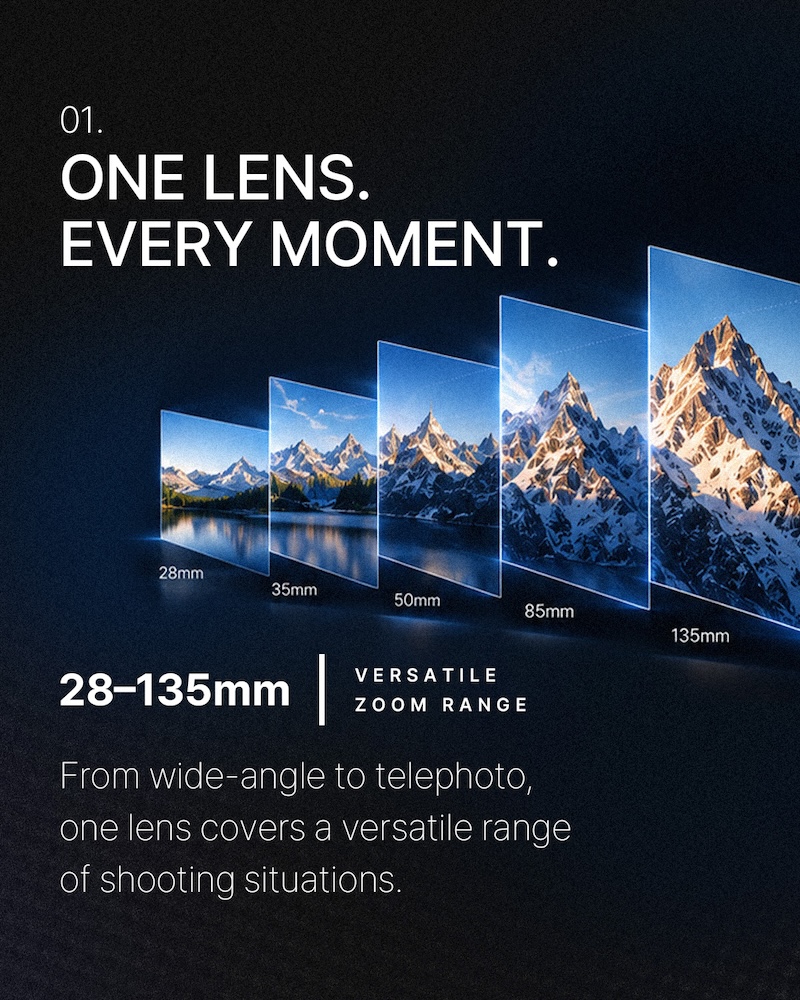
LK Samyang says its forthcoming, fast 28-135 is the lens for “every moment”

Korean lens maker says it has a 28-135mm F2.8 for Sony E-mount coming in February 2027

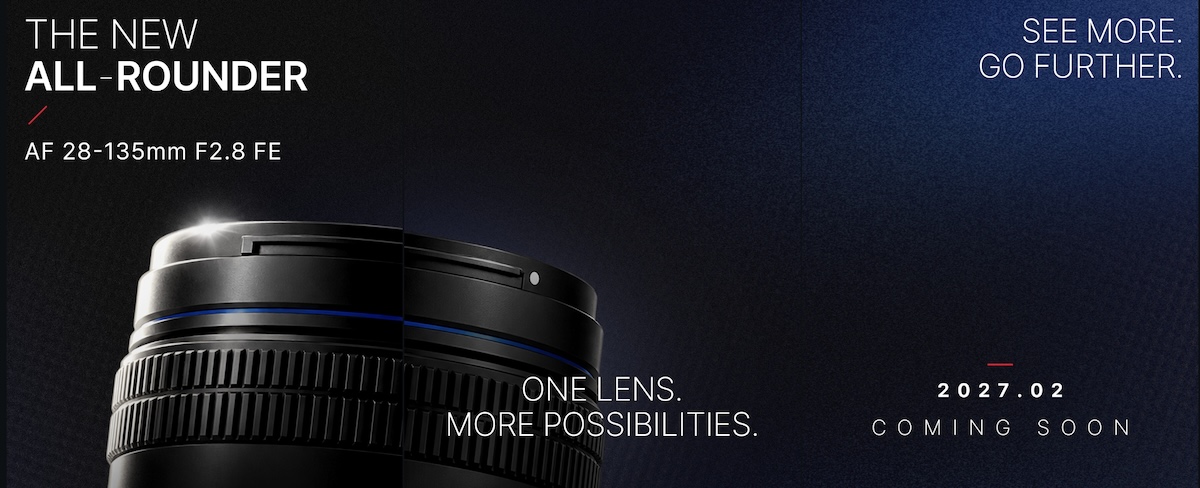
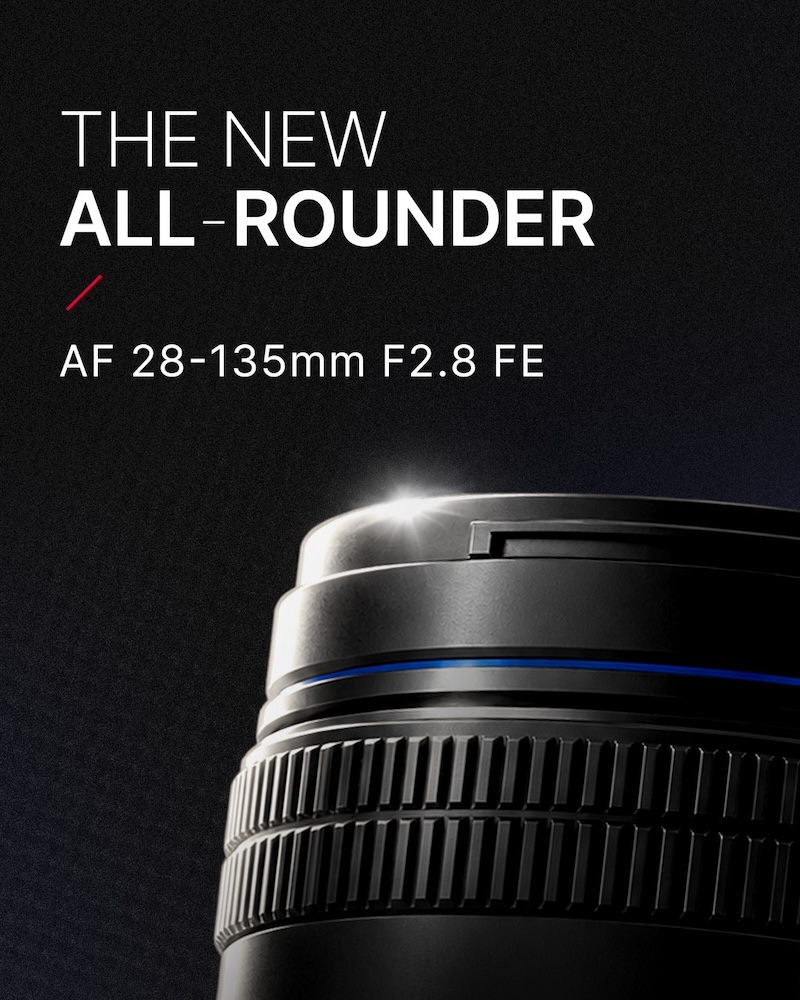
Promotional image showing the top edge of a lens on a black background, with the words "The New All Rounder" and "AF 28-135mm F2.8 FE" overlaidSamyang

LK Samyang has started to tease the arrival of a 28-135mm F2.8 autofocus zoom for Sony E-mount, more than four months ahead of a February 2027 launch.

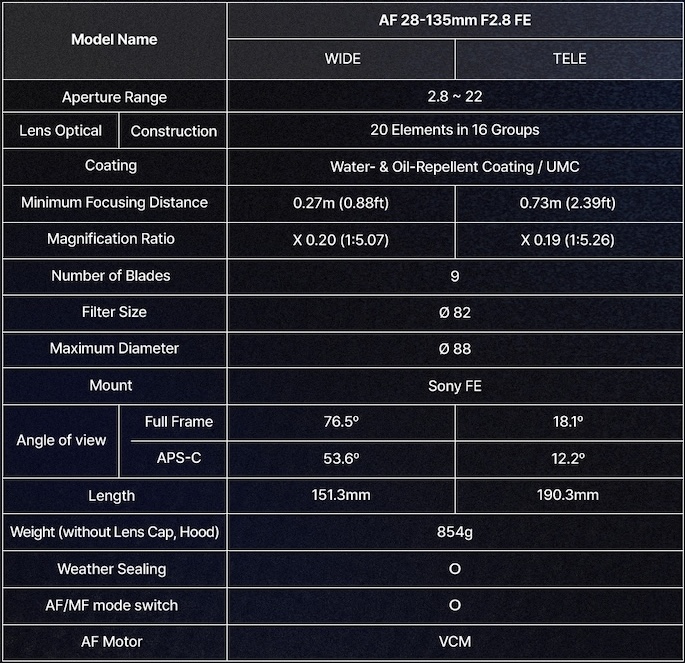
The company has only released close-up photos of the lens, so far, but has also published full specifications.

So we know it’ll be an extending zoom that expands from 151mm to 190mm long, as you zoom in (6.0-7.5″). We also know that it’ll weigh 854g (1.9lbs).

This makes it almost 30% longer than the Tamron 28-75mm F2.8 G2 and around 60% heavier, so you definitely pay a price for the additional flexibility the Samyang should offer. It’s around 27% longer and 50% heavier than Tamron’s 35-100mm F2.8, that doesn’t offer either the wide-angle or telephoto capabilities that this will.

It will also take an 82mm filter, rather than the 67mm filter used by the two Tamrons.

As with other recent LK Samyang lenses, its autofocus will be driven by a voice coil motor, which should be quiet and fast.

And, although no mention of them is made, the preview images show control ring grips that match the company’s lenses co-developed with Schneider-Kreuznach.

About the Author: Richard graduated as a scientist but had a lot more fun writing and shooting for his university magazine. A number of years spent variously as a reporter, writer and editor on science and engineering titles combined his knowledge of science with his interest in images and words. But it was spotting the connections between emission spectra, white balance and all the nonsense he’d taught himself playing around in Photoshop that helped kindle an interest in digital photography. Searching for a camera led to him discovering DPReview and Richard was recruited by Phil Askey in 2007. He’s been combining his love of photography, communication and attention to detail (pedantry?) ever since. He has unusually strong opinions about lenses for the APS-C format.

Want to stay up to date on the latest product news and releases? Add DPReview as a preferred source to ensure our independent journalism makes it to the top of your Google search results.

GoPro officially joined the Micro Four Thirds system standard group

Par : PR admin
30 septembre 2026 à 19:02

GoPro officially joined the Micro Four Thirds system standard group after the release of the MISSION 1 PRO ILS action camera with a 50MP 1″ sensor:

GoPro Joins the Micro Four Thirds System Standard Group

GoPro’s First Interchangeable-Lens Cinema Camera, MISSION 1 PRO ILS, Features a Micro Four Thirds Mount

Tokyo, Japan – OM Digital Solutions Corporation and Panasonic Corporation jointly announced the Micro Four Thirds System standard in 2008 and have since been working to promote the standard.

We are pleased to announce that GoPro, Inc. (headquartered in San Mateo, California, USA; hereinafter “GoPro”) has declared its support for the Micro Four Thirds System standard with the launch of its first interchangeablelens camera on August 26th, 2026.

GoPro is expanding the ways people capture and share their experiences through immersive imagery with MISSION 1 PRO ILS, a compact cinema camera featuring a Micro Four Thirds mount.

MISSION 1 PRO ILS combines GoPro’s compact and rugged design with the flexibility to select different lenses for different shooting needs. GoPro’s participation is expected to further expand the use of the Micro Four Thirds System in amateur filmmaking, professional video production, and at the highest levels of cinema. The participation of a diverse range of companies in this open standard will continue to expand the product lineup and create new possibilities for visual expression and image capture.

As the company that initiated the Four Thirds System and Micro Four Thirds System standards, OM Digital Solutions will continue to work with supporting companies to promote the expansion of products compliant with these standards and contribute to the advancement of digital imaging systems that meet the diverse needs of customers.

GoPro unveiled a new GP3 custom imaging processor for their upcoming cameras

GoPro unveiled a new GP3 custom imaging processor for their upcoming cameras

The post GoPro officially joined the Micro Four Thirds system standard group appeared first on Photo Rumors.

❌