Vue normale

Ford Rehires 'Gray Beard' Engineers After AI Falls Short

30 juin 2026 à 05:34
Ford executives said they've hired 350 veteran engineers — some of them former employees — after AI and automated systems failed to deliver the desired quality, reports TechCrunch: Bloomberg reports the company's chief operating officer Kumar Galhotra told journalists that Ford had been "relying more and more on automated quality systems" with disappointing results. So the company "brought back technical specialists," and those specialists "hunt for failure points before a part ever reaches the plant floor." Charles Poon, Ford's vice president of vehicle hardware engineering, added, "Mistakenly we thought that by just introducing artificial intelligence and ingesting the design requirements that we had, that that would produce a high-quality product." The article points out that Ford is using the rehired gray beard engineers to train younger staff — and, to reprogram its AI tools.

Read more of this story at Slashdot.

Ex-Governors, Big Tech Launch Coalition To Help Workers 'Navigate the AI Economy'

29 juin 2026 à 19:34
"Amid growing public anger over A.I. and a debate over how to regulate it, a group of employers, state governors and foundations has raised $500 million to try to answer some of those questions themselves," reports the New York Times. "Just how many jobs will AI upend?" asks the Wall Street Journal, reporting that the new coalition says it's time to ready the U.S. workforce for a "major" disruption — no matter how large it turns out to be. The coalition "has so far raised more than $500 million — about half of its multiyear goal — from companies and nonprofit groups. It will initially work with state governments in Arkansas, Maryland, Utah and Connecticut. OpenAI and Anthropic are also involved, and academics including MIT economist David Autor sit on an advisory board." [The new "RAISE US" coalition] will be led by former Commerce Secretary Gina Raimondo, who served under former President Joe Biden, and former Indiana Gov. Eric Holcomb, a Republican. Its mandate, they said, isn't just to build retraining programs but also to reconsider decades-old policies such as unemployment insurance and act as a working lab for testing the most effective ways to transition workers to new fields. The group will explore corporate incentives for employers to hold on to workers whose jobs are disrupted by AI and prep them for new roles... The mission of the group is to "pull all the levers at once," Raimondo said. That means teaming up with employers to find ways to help workers gain skills or new roles and joining with educators to roll out different types of training. It also plans to propose policy changes such as tweaking unemployment benefits to let displaced workers continue to get them while they, for instance, start new businesses with AI... In Maryland, the group plans to expand a service-year option in the state to help people gain exposure to such growing fields as healthcare. An effort in Arkansas will focus on supporting "an AI-powered career navigation platform." More from New York Times: The organization will work primarily with governors... The theory: States generally control their community college systems, which can translate work force policy through course offerings and industry partnerships. The bulk of the budget will fund pilot programs overseen by about 15 staff members and consultants. For example, Maryland will expand a "service year" for recent high school graduates to provide experience in fields where there are shortages, such as health care. In other states, Raise Us hopes to offer "wage insurance" for workers who take lower-paying jobs rather than dropping out of the work force entirely. The group plans to furnish technical assistance for companies that want to retain workers as A.I. changes their roles, rather than eliminating them. Microsoft, one of the companies backing the organization, said it had already found a promising model: cross-training its entry-level lawyers in different parts of the organization and equipping them with A.I. skills in order for them to be repositioned as technology evolves. "You can think of doing that with almost any job we have," said Brad Smith, vice chair and president at Microsoft. "It creates an opportunity to transfer people from jobs that are being eliminated to jobs that are being created...." Ms. Raimondo and her colleagues are not fans of a universal basic income, an idea that has gained popularity in Silicon Valley as an answer to job disruption. They emphasize that work provides more than just wages, and plan to focus on helping people find pathways to new jobs. But it's unclear whether A.I. will create jobs at the rate that it will destroy them. Jack Malde studied work force policy for the Bipartisan Policy Center and is now going to work for the Windfall Trust, another A.I.-focused think tank. He said long-term income support might be necessary, even if better models for transitioning workers were found. "The truth is, there's still a lot of uncertainty," Mr. Malde said. "What we think is resilient now might not be resilient later. We're not going to get everything right, so we're going to need those strong safety-net programs." Long-time Slashdot reader theodp writes: If you think you've seen this movie before, prior to "partnering with governors, employers, and training partners to help the American workforce make a successful transition to an AI economy" with RAISE US, Raimondo and Holcomb partnered with governors, employers and training partners to help U.S. K-12 students make a successful transition to a CS economy with the Governors for Computer Science coalition.

Read more of this story at Slashdot.

L’IA coûte bien trop cher et ces nouveaux outils veulent changer les règles du jeu

29 juin 2026 à 19:15

Face à des factures imprévisibles, une nouvelle génération d’outils s’impose pour reprendre le contrôle, tandis que l’open source et les modèles low cost rebattent déjà les cartes du marché de l'IA.

Phishing d’un nouveau genre : des hackers créent de fausses organisations ChatGPT pour piéger des employés

29 juin 2026 à 09:23

Une campagne découverte par Push Security illustre une technique d'attaque simple : usurper l'identité d'une entreprise sur OpenAI pour accéder aux données saisies par ses employés.

Microsoft Slammed for Building Copyright-Infringing Supercomputer for OpenAI in New Court Filing

28 juin 2026 à 23:34
The New York Times alleges Microsoft actively encouraged OpenAI to steal its copyrighted work, reports Ars Technica, citing a new (and heavily redacted) court filing Thursday: NYT's motion comes after the [U.S.] Supreme Court sided with Cox Communications in a case where Sony tried and failed to claim that Cox was contributing to music piracy as an Internet service provider, which set a new standard for contributory infringement. Moving forward, plaintiffs will have to prove that parties intentionally acted to induce illegal conduct. Recognizing that the legal precedent has changed, the NYT now wants to amend its complaint to align its contributory infringement claim against Microsoft with that new standard... A Microsoft spokesperson told Ars that the company views the amended complaint as "a last-ditch effort by the plaintiff to save its claim from unfavorable precedent set in other recent rulings..." The updated complaint seeks to specify that [Microsoft's] supercomputer was tailor-made to help OpenAI infringe and allege that it was built for the explicit purpose of training AI on copyrighted works without permission. And as the NYT alleged, its articles were more heavily weighted by this system, as both firms hoped to train models on the highest-quality journalism possible, so that level of writing could be confidently mimicked in outputs. By building this "unusually complex" machine, Microsoft not only helped select the works that were infringed but also provided a means to seize copyrighted works without permission, the NYT alleged. "Microsoft specifically designed it for the purpose of using essentially the whole Internet — curated to disproportionately feature Times Works — to train the most capable LLM in history," the NYT alleged... Similarly as problematic for the NYT are hallucinations where Microsoft and OpenAI models falsely cite the NYT for content that they never published... "Users who ask a search engine what The Times has written on a subject should be provided with neither an unauthorized copy nor an inaccurate forgery of a Times article, but a link to the article itself," the NYT alleged... In a statement provided to Ars, OpenAI spokesperson Drew Pusateri reiterated the AI firm's often-repeated claims that AI training on copyrighted works is indisputably fair use... OpenAI has argued that "ChatGPT is not a substitute for a Times subscription," the NYT reported, partly because "they transformed the material for a different use." An OpenAI spokesperson told Ars Technica that OpenAI's models "empower innovation," while a New York Times spokesperson insisted that Microsoft "actively encouraged OpenAI to steal our copyrighted works... [O]ur core claims remain the same from the day we filed this lawsuit — that Microsoft and OpenAI stole millions of The Times's copyrighted works to compete with our products and illegally enrich themselves." The article speculates that the case's most extreme outcome "could require OpenAI and Microsoft to wipe models and start over. The NYT has also asked for permanent injunctive relief to prevent future infringement, as well as extensive damages..."

Read more of this story at Slashdot.

Students Around the World are Using AI-Powered Smart Glasses to Cheat on Tests

28 juin 2026 à 16:34
Students are using AI-powered smart glasses to cheat on tests, reports CNN. "And in East Asia's test-obsessed societies, where a single exam could impact the trajectory of a student's future career and social status, educators are scrambling to get ahead of the problem." Already, countries are stepping up inspections for test-takers. For China's grueling annual college entrance exam earlier this month — which more than 10 million hopefuls take each year — authorities required screening of all glasses. In the United Kingdom, the head of England's exam watchdog warned earlier this month that AI glasses and smart devices like earpieces could worsen cheating in exams... [T]wo incidents in South Korea were the country's first reported cases of cheating with AI glasses... In Taiwan, the university where a prospective student was caught cheating is now reviewing rules and standard operating procedures for AI eyewears during examinations. But experts worry these individual cases point to a more widespread issue. "If we're seeing a few cases being reported, we're seeing a lot more cases not being reported," said Thomas Corbin, lecturer at Deakin University in Australia, who has conducted research around the usage of AI-powered glasses and other smart devices in academic assessment. With the rapid development of AI technology, however, smart glasses are becoming slimmer, less noticeable, while integrating AI models that can operate independently with connectivity, raising concerns not only about exam integrity, but also about broader privacy risks... "Wearable AI is as much of a challenge to exams as ChatGPT was to essays in 2022 and I just don't think there is any real way that we can reliably have exam practices moving forward," Corbin said.

Read more of this story at Slashdot.

Developer AI Token Costs Could Exceed Their Salaries in Two Years

28 juin 2026 à 11:34
"Enterprises may soon be paying as much for their developers' AI token usage as they do for their salaries," writes InfoWorld: According to Gartner, these costs will meet, or even exceed, the typical software engineer's monthly salary within the next two years. This is not only because developers are increasingly adopting generative AI and agentic tools, it reflects a trend toward consumption-based licensing models as vendors balance infrastructure investments with profitability... Gartner senior principal analyst Nitish Tyagi explained that it's important to note that Gartner's prediction is based on a global average salary of $2,000 per month; it doesn't mean AI token usage will exceed all salaries. For instance, in the US, yearly pay rates can be six digits or more. However, that kind of spend is not out of the realm of possibility, Tyagi emphasized. "I have heard scary numbers like 'My developer consumed $20K last month,' or 'A business user consumed $32K'." If these amounts sound shocking, that's the point. "The goal is to alarm the industry about the impact of token cost if it is not governed and controlled," he said... AI coding vendors have yet to deliver "mature, built-in cost optimization capabilities," Tyagi said, and prices will likely only continue to rise as vendors further build out their models while at the same time trying to remain profitable. Thus, enterprises struggle to forecast and control costs, and, because AI is moving so fast, many organizations lack the "maturity and frameworks" to determine ROI, he noted. Agent-driven workflows are difficult to govern, context windows become bloated, budgets are wiped out earlier than anticipated, and token spend becomes hard to justify.... "Without a governed engineering operating model, costs can escalate faster than the productivity gains these tools are designed to deliver," Tyagi said.

Read more of this story at Slashdot.

How a Seemingly Harmless Image Can Jailbreak Vision-Language AI Models

27 juin 2026 à 22:52
Slashdot reader BrianFagioli writes: Florida International University researchers have developed a technique called JaiLIP (Jailbreaking with Loss-guided Image Perturbation) that uses subtle image modifications to bypass AI safety guardrails. Unlike traditional jailbreaks that rely on carefully crafted prompts, the attack works through images that appear normal to human viewers. The researchers tested the technique against BLIP-2, a multimodal AI model, and found that manipulated images significantly increased the likelihood of harmful responses. According to the study, the approach outperformed previous image-based jailbreak methods and nearly doubled the number of unsafe outputs generated during testing. The findings highlight a potential security risk for businesses deploying AI systems that process both images and text. While most discussions about AI safety focus on prompts, the research suggests that seemingly harmless images may also serve as an attack vector.

Read more of this story at Slashdot.

Scroll Burned in 79 AD Volcanic Eruption Finally Deciphered Using AI

27 juin 2026 à 19:34
When Mt. Vesuvius erupted in 79 A.D., it buried hundreds of papyrus scrolls. They were rediscovered in the mid-1700s, remembers Smithsonian magazine, "the only surviving collection of its kind from the Greco-Roman world..." "But when scholars tried to unroll them, the carbonized manuscripts crumbled to dust." Every generation that followed faced the same dilemma: They could wait for technology to advance, abandoning hope of reading the ancient texts in their own lifetime. Or they could try to open the scrolls themselves — and risk destroying them. In recent years, researchers have settled on a third option. Using advanced imaging and artificial intelligence, they're deciphering the scrolls without needing to unroll them at all. The Vesuvius Challenge has accelerated the process by turning it into a public competition, complete with cash prizes. In 2023, a student won $40,000 for deciphering a single word — "purple" — from an unopened scroll. Later, contestants would identify 2,000 Greek characters from one scroll ($700,000) and the title of another ($60,000). Now, for the very first time, researchers have recovered all surviving text from a single scroll. The nearly five-foot-long segment includes roughly 20 columns of ancient Greek philosophy, accessible for the first time in nearly 2,000 years. "The tech actually does look like magic, but it's not," Brent Seales, a computer scientist at the University of Kentucky, said at a press conference. (The article points out that Seales partnered with two Silicon Valley investors in 2023 to launch the Vesuvius Challenge, and is now hailing "the restoration of lost voices from the ancient world." Seales has been working on virtually unwrapping the scrolls since the early 2000s. The process involved imaging the bundles of papyrus using technology similar to CT scanners, isolating thin layers and then stitching them together.... "We've developed a systematic and a repeatable approach," Seales told the audience. "Now it's only a matter of time until we read all of the scrolls."

Read more of this story at Slashdot.

Forget Prompt Engineering: 'Loop Engineering' Is All the Rage Now

Par : BeauHD
27 juin 2026 à 15:34
An anonymous reader quotes a report from Business Insider: For the most powerful voices in AI, it's all about being in the loop. Claude Code creator Boris Cherny recently said he doesn't write his own AI prompts much anymore. Thanks to loops, he doesn't have to. "It's an agent that prompts Claude," Cherny recently told CNBC, adding, "I don't write the prompt anymore. Claude writes the prompt, and now I'm talking to that new Claude that is kind of coordinating." In the same interview, Cherny said that loops and a similar feature were examples of the kind of work he would be proudest of in a decade. Cherny isn't the only one embracing "loop engineering." OpenAI engineer Peter Steinberger, the creator of the viral OpenClaw project, wrote a public reminder to users who are still writing out prompts for AI agents. "Here's your monthly reminder that you shouldn't be prompting coding agents anymore," Steinberger wrote recently on X. "You should be designing loops that prompt your agents." [...] Steinberger shared an example of a loop he uses: "Tell codex to maintain your repos, wake up every 5 minutes and direct work to threads. That makes it easy to parallelize+steer work as needed." Claire Vo, founder of ChatPRD and host of the "How I AI," said, "it's really just reminding people that you don't have to use your human fingers to type in a prompt in order for your agent to do work on your behalf." The days of directly prompting generative AI coding tools are "kind of over, or at least some think it's going to be," Addy Osmani, director of Google Cloud, wrote in his post explaining the concept.

Read more of this story at Slashdot.

Evoto AI: The AI Retouching Powerhouse

Par : PR admin
27 juin 2026 à 14:56


Evoto AI is a powerful, AI-driven photo editing platform built specifically for professional photographers who want to dramatically speed up their post-production workflow without sacrificing natural-looking results. It combines advanced per-face retouching, intelligent batch processing, color grading tools, and creative features like the AI Lab into one seamless system that supports the entire process – from tethered shooting and culling to final delivery. Available on desktop, mobile, iPad, and in the browser, Evoto helps photographers handle high-volume work efficiently while maintaining creative control.

Evoto AI: The AI Retouching Powerhouse

Professional photography has always been a race against time – especially after the shutter clicks. Between culling thousands of frames, meticulous skin retouching, stray hair removal, color consistency, and client delivery, post-production can eat up days that could otherwise be spent shooting or with clients.

Evoto AI (evoto.ai) positions itself as the solution: a specialized, AI-first photo editing and retouching platform built specifically for working photographers who need speed, consistency, and natural-looking results without sacrificing control.

Product Information & Key Features

Evoto is an all-in-one AI photo editing suite that covers the full workflow from tethered capture through culling, retouching, color work, and delivery. It runs as a native desktop app (macOS & Windows), with companion iPad/mobile apps and a browser-based version for lighter or on-the-go use. There’s also Evoto Video for portrait retouching and color correction on moving footage, plus an Instant Photo Gallery tool for client proofing and delivery. The software handles both RAW and JPEG files and is fast – users and benchmarks routinely report processing hundreds of images in minutes once presets are dialed in.

Standout AI capabilities include:

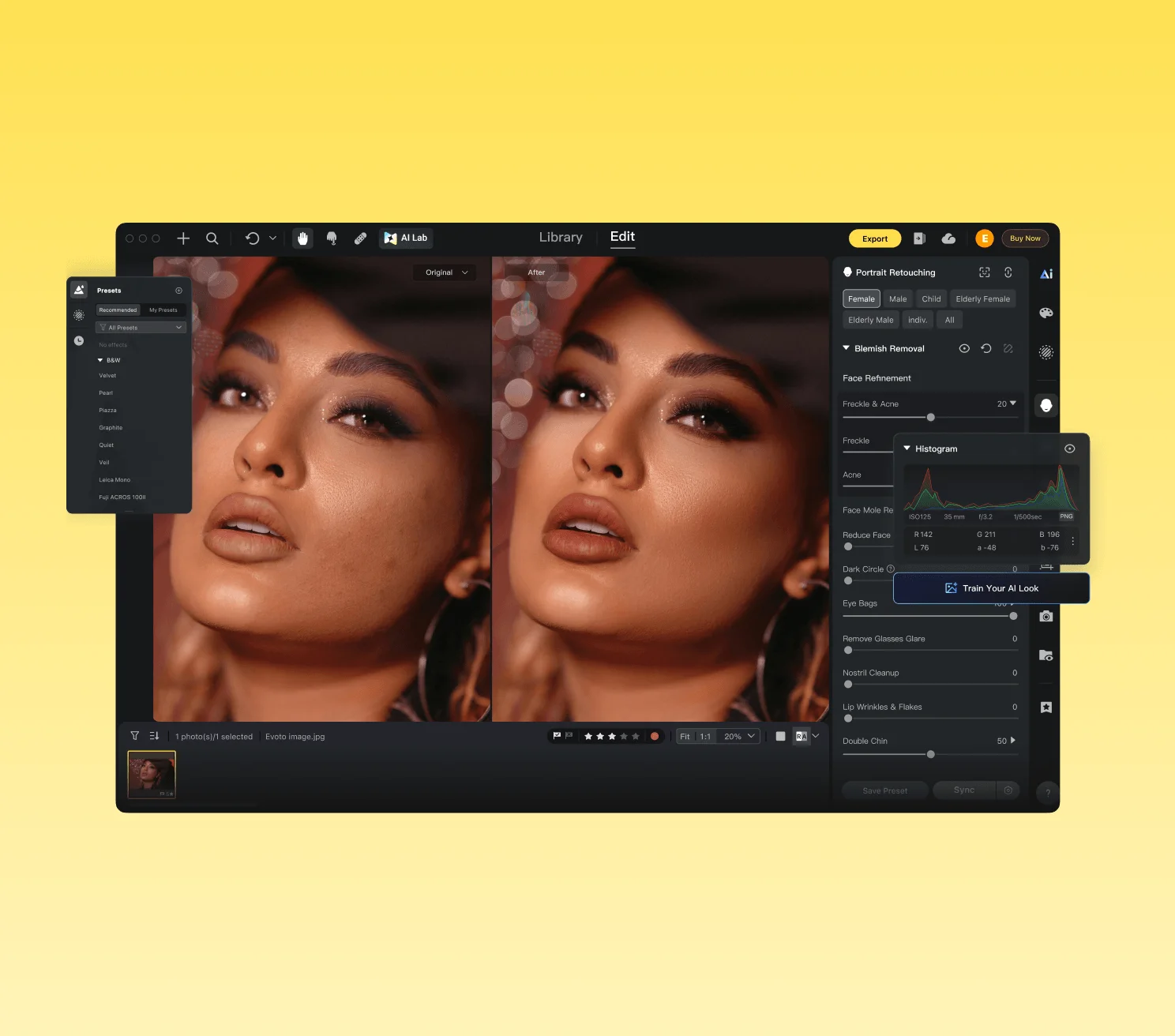
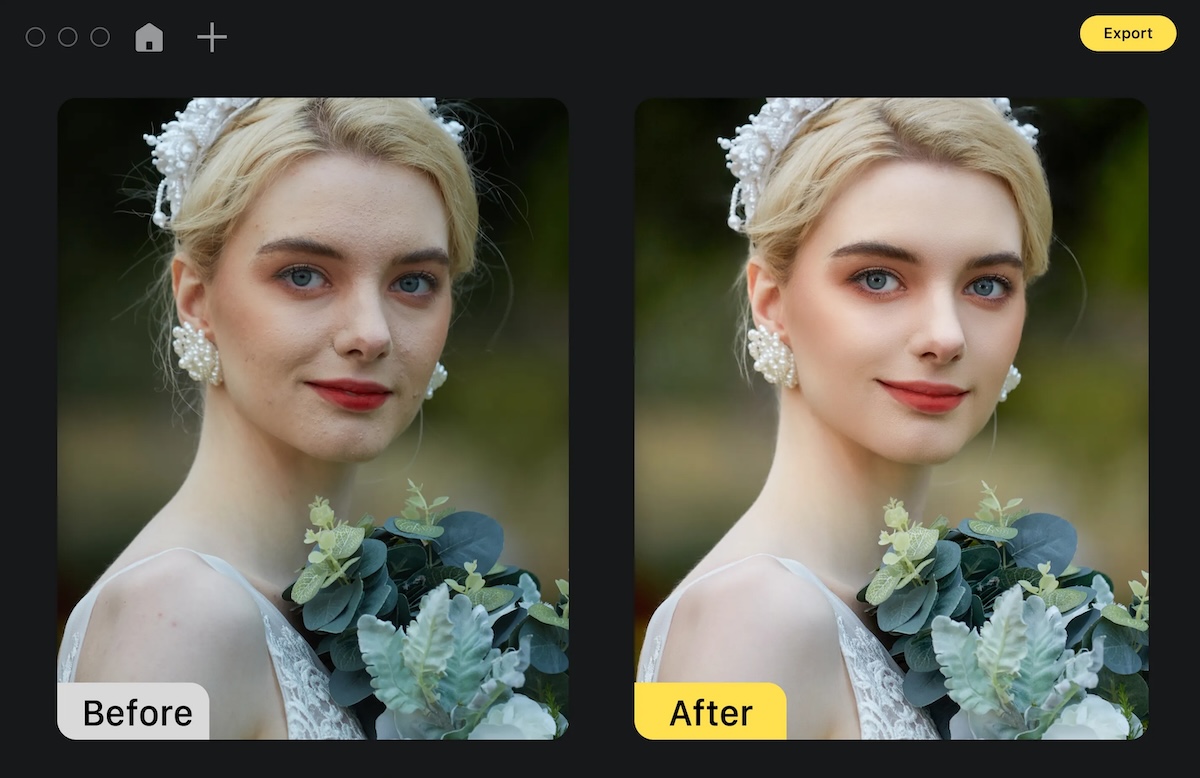
  • Per-face / subject-aware retouching: Skin smoothing that preserves natural texture (freckles, pores), blemish/acne/wrinkle reduction, skin tone balancing, glasses glare removal, stray hair cleanup (inside and outside the frame), red-eye fix, teeth whitening/straightening, and even “open eyes” fixes.
  • Body & clothing tools: Subtle slimming, wrinkle/de-blemish removal on clothes, and color-changing options.
  • Background & environment tools: One-click or masked background removal/clean-up, distraction removal, sky replacement, and backdrop enhancement.
  • Smart culling: AI quickly flags and removes closed eyes, blurry shots, and duplicates.
  • Batch intelligence: Apply edits or presets across a set; the AI adapts per image rather than applying blunt global filters.
  • Additional tools: AI-based old-photo restoration, color matching/grading, tethered shooting support, and a preset system with sync across devices.

AI Color Adjustments

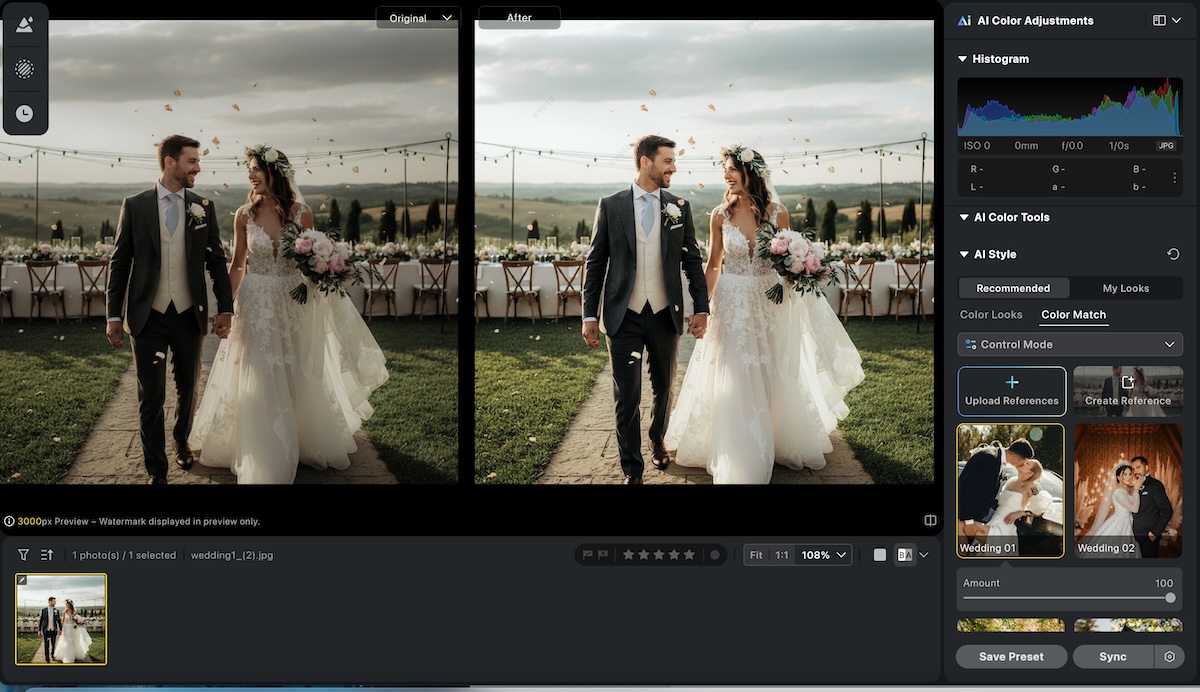
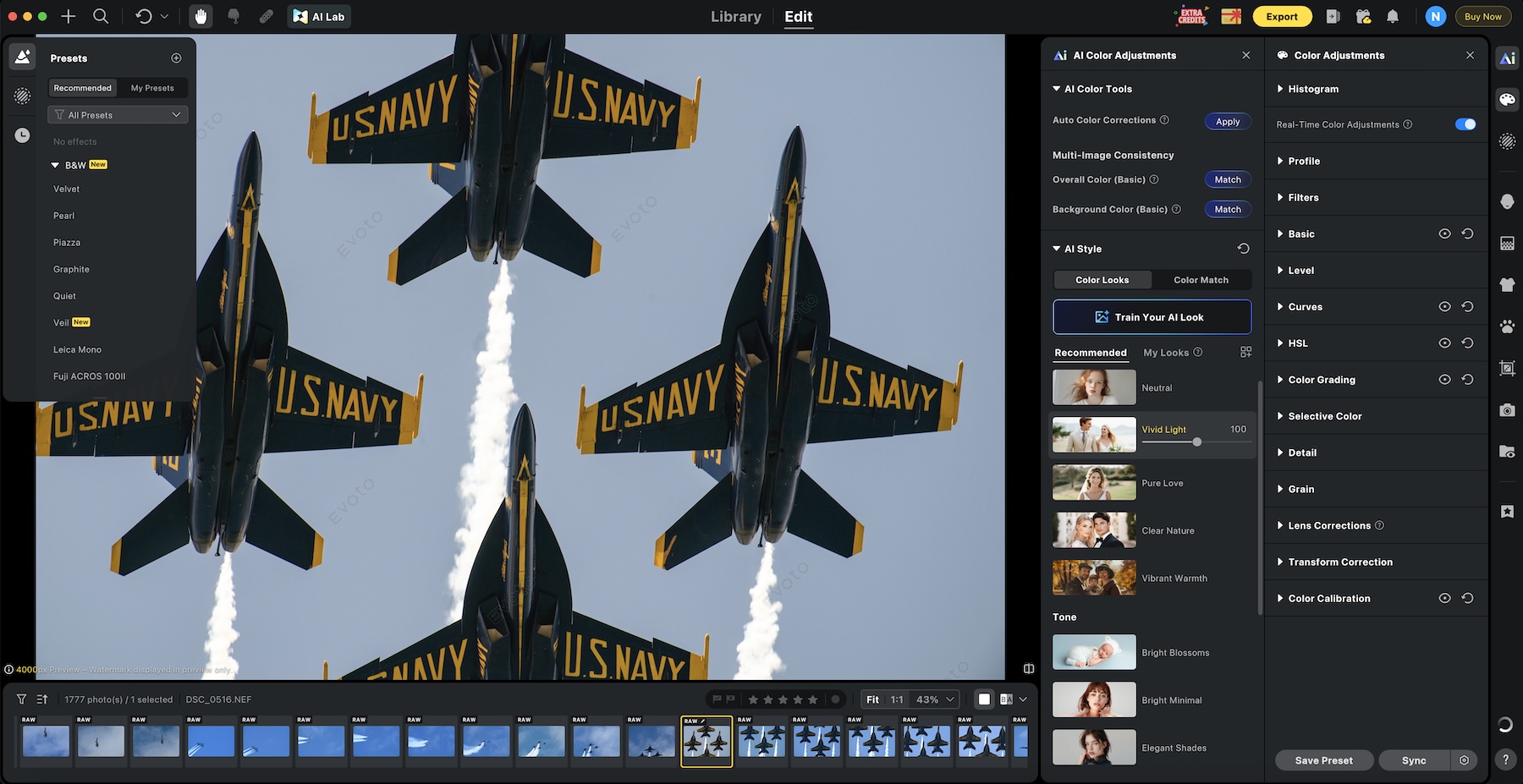
AI Color Adjustments in Evoto AI combine intuitive manual controls with intelligent AI assistance to deliver fast, consistent, and professional color grading across single images or large batches. Photographers can fine-tune exposure, white balance, brightness, tone balance, HSL, curves, and color masking in a Lightroom-style interface, while AI-powered tools like AI Color Match intelligently transfer the tone, mood, and color profile from a reference image to an entire set – ensuring unified results even when lighting varies across a wedding, event, or portrait session. This hybrid approach allows for both precise creative control and automated corrections that adapt naturally to skin tones, backgrounds, and subject matter, dramatically reducing the time spent chasing color consistency while preserving a realistic, non-plastic look that clients expect from professional work.

AI Color Adjustments

AI Color Adjustments in Evoto AI is a comprehensive, intelligent color grading system that blends precise manual controls with powerful AI-driven tools to deliver fast, consistent, and natural-looking results for individual images or large batches.

The AI Color Tools provide an intuitive Lightroom-style panel for fine-tuning exposure, white balance, brightness, tone balance, HSL, curves, color masking, and filters, while AI-powered features like AI Color Match allow photographers to instantly transfer the tone, mood, and color profile from a reference image to an entire set -ensuring unified results even when lighting conditions vary across a wedding, event, or portrait session. Complementing these are the

AI Style (also referred to as AI Color Looks) provides one-click, AI-driven stylistic transformations that intelligently analyze each photo and apply a predetermined aesthetic or “vibe” with natural, adaptive results. With over 20 pro-grade options ranging from warm and cinematic to vintage film, bright modern, or clean natural looks, the algorithms automatically correct color, contrast, and tone to match the chosen style while respecting the original image’s lighting and subject characteristics. This makes it exceptionally powerful for high-volume workflows – such as applying a cohesive “film-inspired” or “high-end portrait” look across an entire wedding gallery in seconds – while still allowing photographers to tweak intensity or combine multiple styles for a custom signature aesthetic that elevates their brand without hours of manual grading.

Presets

Presets functionality in Evoto AI is a cornerstone of efficient, repeatable workflows, letting photographers save any combination of retouching settings, AI Color Adjustments, AI Styles, and manual tweaks as reusable, one-click presets that can be applied to individual images or synced intelligently across entire batches. Official recommended presets (Natural, High-End Portrait, Event, Cinematic, Family, etc.) provide excellent starting points, while users can easily create and organize their own custom presets, capturing a specific color grade plus skin and hair retouching, for example, and apply them consistently across future shoots or different devices via cloud sync. This system not only slashes editing time on high-volume jobs but also helps maintain a recognizable, professional style that strengthens a photographer’s brand identity and enables faster client deliveries.

AI Lab

AI Lab in Evoto AI is a dedicated creative hub (accessed via an icon in the top-left of the Edit interface) that houses advanced, high-resolution AI tools designed for complex editing tasks beyond standard retouching. It specializes in intelligent removal and compositing features, such as People Removal (with auto-detection and passerby selection to cleanly eliminate unwanted individuals from backgrounds), Smart Removal / AI Object Remover for distractions, and AI Background Fusion, which enables sophisticated cutouts and scene compositing, perfect for placing subjects into new environments like school gymnasiums, stages, or custom backdrops. These generative tools deliver professional-grade, full-resolution results while preserving natural lighting and edges, making them invaluable for wedding, event, school, and portrait photographers who frequently need to clean up busy scenes or create polished composites without hours of manual masking in Photoshop. By consolidating these powerful capabilities into one streamlined workspace with its own credit model for generative actions, AI Lab significantly expands Evoto’s utility from fast retouching into true creative production, helping photographers deliver cleaner, more polished final images efficiently.

Evoto Mobile and Evoto Online

Evoto Mobile and Evoto Online extend the power of Evoto AI beyond the desktop, giving photographers true flexibility across devices and locations.

The Mobile version (available on iPad and smartphones) delivers a full-featured AI editing experience optimized for on-the-go use, supporting portrait retouching, color correction, batch processing, preset application, and even tethered shooting directly from compatible cameras. This makes it ideal for location photographers who want to cull, retouch, and show clients polished previews in real time, often closing sales on-site before leaving the session.

Evoto Online is a browser-based editor that provides instant access to core AI tools without installing software, making it especially useful for quick edits, e-commerce product work, background removal, and color adjustments on any computer. Both versions sync seamlessly with the desktop app via the cloud, allowing photographers to start a project on their main workstation, continue refining on an iPad while traveling or at a client meeting, and even perform light edits or client proofing in a browser when needed. Together, they transform Evoto from a powerful studio tool into a complete, location-independent workflow solution that keeps high-quality AI retouching and color work accessible wherever the photographer works.

Evoto Beta and Stable Versions

When downloading Evoto AI, users can choose between the Beta and Stable versions, giving photographers flexibility depending on their priorities.

The Stable version is the recommended choice for most professional users, as it offers a thoroughly tested and reliable experience with fewer bugs, making it ideal for high-volume workflows where consistent performance is critical.

In contrast, the Beta version provides early access to the newest features, AI tools, and improvements – often updated weekly, allowing photographers to test cutting-edge capabilities before they reach the stable release. While the Beta channel is excellent for those who enjoy experimenting with the latest innovations and don’t mind occasional glitches, most working photographers opt for the Stable version to maintain smooth, uninterrupted editing sessions. Evoto makes it easy to switch between the two on their download page, so users can start with Stable for reliability and move to Beta when they want to explore upcoming tools.

Brand Description

Streamlining the workflow for professional photographers worldwide, powered by AI.

Evoto was founded with a clear mission: let AI handle the repetitive “pixel work” so photographers can focus on creativity, storytelling, and client relationships. The company (led by founder/CEO Mitta) has grown rapidly by targeting high-volume professionals – wedding, portrait, newborn, event, school, and commercial shooters, as well as studios that need consistent results at scale.

It claims a large global user base (1M+ photographers across 200+ countries/regions and tens of thousands of collaborating studios). The brand emphasizes ethical AI practices: images are not used to train models without consent, and the platform is GDPR/CCPA compliant with secure cloud options for collaboration and cross-device sync.

Recent expansions (desktop 6.x updates, mobile/Instant apps, and video tools) show Evoto evolving from a specialized retoucher into a broader workflow platform that competes with traditional tools while carving out its AI-retouching niche.

Workflow Examples & Real-World Use Cases

Typical high-volume wedding or event workflow:

  1. Shoot tethered (wired or wireless) directly into Evoto for instant previews and early polishing.
  2. Run AI Smart Culling to quickly eliminate blinks, blur, and duplicates.
  3. Apply or create a portrait preset (skin, hair, glare, teeth) and sync across the gallery, the AI handles per-face variations intelligently.
  4. Quick global or selective color grading.
  5. Export and deliver same-day or push to the Instant Photo Gallery for client viewing/proofing.

Many users report turning what used to be multi-day editing marathons into same-day or next-day deliveries, which improves cash flow and client satisfaction.

Portrait/headshot/fashion studio use case: Photographers often export selects from Capture One or Lightroom into Evoto for targeted cleanup (skin, stray hairs, clothes, background), then do final polish back in their main editor if needed. The per-face controls and masking tools make it excellent for preserving natural skin texture while quickly removing distractions.

On-location/mobile use case: With the iPad or mobile apps, photographers can retouch on-site, show clients polished previews in real time, and even close sales before leaving the location, a game-changer for tourist, event, or mini-session shooters.

Hybrid workflow tip (from working photographers): Do primary color correction in your usual raw processor, export selects to Evoto for AI retouching and cleanup, then finish any ultra-fine texture work in Photoshop only where necessary. This minimizes credit usage while maximizing speed.

Other niches: Newborn and maternity photographers appreciate the gentle, texture-preserving skin tools. E-commerce and content creators use the browser version for quick background removal and product cleanup. Video users are exploring newer video retouching tools to achieve consistent skin and color across talking-head or event footage.

Pricing & Value Proposition

Evoto uses a credit-based model that’s different from traditional subscriptions:

  • Editing, previewing, and most tools are free.
  • Exporting an image typically costs 1 credit per photo (some advanced generative features may cost more – you’ll see the exact cost before exporting).
  • Credits are purchased via annual subscription plans (best value, with rollover and cheaper add-on packs) or pay-as-you-go (more expensive per credit, 2-year expiration).

Approximate annual subscription tiers (as of mid-2026; check site for current):

  • Starter: ~800 credits (~$89/yr)
  • Basic: ~1,600 credits (~$149/yr)
  • Higher tiers scale up to 24,000 credits with better per-credit pricing and add-on discounts.

Pay-as-you-go options start around 200 credits for ~$49. New users usually get starter credits (often 15+), and referrals can add bonus credits.

Value verdict: For high-volume pros who deliver hundreds or thousands of images per month, the time savings (often cited as 5+ hours/day or cutting multi-day jobs to an hour) can easily justify the cost and even increase profitability by enabling faster turnarounds or bringing retouching in-house. Hobbyists or very low-volume shooters may find the credit model less attractive. Some users have noted past price adjustments, so it’s worth modeling your typical monthly exports before committing.

Pros & Cons

Pros:

  • Exceptionally fast and natural-looking portrait and subject retouching.
  • Intelligent batch/sync tools that adapt per image.
  • Strong tethered + culling + retouch + delivery workflow in one app.
  • Cross-platform sync (desktop ↔ iPad ↔ mobile).
  • Ethical/privacy stance and regular feature updates.
  • Free to experiment until you export.

Cons:

  • The credit system requires planning (especially for very high volumes or if you re-export after external edits).
  • Not a full layer-based compositor like Photoshop – best used for targeted cleanup rather than heavy compositing.
  • AI tools (especially culling or complex backgrounds) sometimes need manual refinement.
  • Extreme close-ups or ultra-high-end skin texture work may still benefit from finishing in Photoshop.

Overall verdict: Evoto AI is one of the strongest specialized AI retouching tools available to professional photographers in 2026, particularly for portrait, wedding, and event work, as well as any high-volume work where speed and consistency matter. It won’t completely replace a skilled retoucher or your full creative suite for every job, but it dramatically accelerates the most time-consuming parts of the job while delivering results that clients and photographers describe as natural rather than “AI-plastic.”

Conclusion

Evoto AI stands out as one of the most capable and photographer-focused AI editing platforms available in 2026, combining powerful per-face retouching, intelligent batch processing, advanced color tools (including AI Color Match and AI Style), creative features like the AI Lab for object removal and background fusion, and seamless cross-platform support across desktop, mobile/iPad, and browser versions. By automating the most time-consuming aspects of post-production while still giving photographers precise control and natural-looking results, it enables faster turnarounds, consistent quality across high-volume shoots, and even on-site client presentations that can directly boost sales. While its credit-based pricing model requires some planning, especially for high-volume users, the significant time savings and workflow efficiency often make it a worthwhile investment for professional wedding, portrait, event, and studio photographers. For anyone looking to reduce editing burnout, bring more work in-house, or simply deliver polished galleries faster without sacrificing quality, Evoto AI is well worth testing. Photographers can download the desktop app or try the mobile and online versions for free to experience how it fits into their own workflow.

Related videos

The post Evoto AI: The AI Retouching Powerhouse appeared first on Photo Rumors.

OpenAI dévoile GPT-5.6 Sol, Terra et Luna : trois versions pour répondre à Anthropic

27 juin 2026 à 07:22

Hier soir, OpenAI a annoncé le lancement en accès limité de GPT-5.6, sa nouvelle génération de modèles. Au programme, trois nouvelles versions avec une stratégie totalement différente.

US Government Allows Anthropic Limited Release of 'Mythos' AI Model, Saying 'Appropriate Safeguards are in Place"

27 juin 2026 à 02:09
"The US government has allowed Anthropic to release its powerful Mythos AI model to select companies and organizations," reports CNN, "revising license requirements after ordering an export block earlier this month in the wake of national security fears." Since the export ban earlier in June, "Anthropic has worked with the US government to address risks associated with the Covered Models," Commerce Secretary Howard Lutnick wrote to the company in a letter dated Friday. In light of progress in that work, Lutnick wrote, "I have determined that appropriate safeguards are in place to permit certain trusted partners to access the Claude Mythos 5 Model." The letter does not include permission for Anthropic to release Fable, a less powerful version of Mythos. "We received notice from the US government that Mythos 5, our strongest cybersecurity model, can be redeployed to a small group of cyber defenders and infrastructure providers," Anthropic said in a statement... Conversations between Anthropic and the government are expected to continue into the weekend, with an eye to restoring access to Fable, as well, a source familiar with the discussions told CNN.

Read more of this story at Slashdot.

Notion Mail Is Shutting Down

Par : BeauHD
26 juin 2026 à 11:00
Notion announced that it will shut down its email client on September 22. The company says more than half of users already manage email through Notion's AI agents without opening their inbox, so it is shifting its focus from a traditional email client to agent-run workflows. Engadget reports: It has published an FAQ for users to make sure that they don't lose any messages or data in the transition. Most emails will still exist in a Gmail inbox, but customers will need to manually export their drafts, scheduled emails, snippets and auto label instructions. Notion first began offering Notion Mail after acquiring startup Skiff in 2024.

Read more of this story at Slashdot.

Trump Administration Asks OpenAI To Stagger Release of New Model

Par : BeauHD
25 juin 2026 à 22:00
The Trump administration has reportedly asked OpenAI to stagger the release of GPT-5.6 over security concerns. The model will initially be offered to a small group of partners, with the government "approving access customer by customer during this preview period," reports The Information. The request came from conversations with the Office of the National Cyber Director and the Office of Science and Technology Policy, the report said.

Read more of this story at Slashdot.

Linux Foundation Launches Akrites To Coordinate AI-Driven Open Source Security

Par : BeauHD
25 juin 2026 à 21:00
BrianFagioli writes: The Linux Foundation has announced Akrites, a new initiative to coordinate vulnerability disclosure and remediation for critical open source software as AI dramatically speeds up vulnerability discovery. Founding members include AWS, Google, Microsoft, OpenAI, Red Hat, NVIDIA, IBM, Cisco, JPMorganChase, and others. Akrites will provide a shared Security Incident Response Team (SIRT), a standardized coordinated vulnerability disclosure process, and act as a "maintainer of last resort" for abandoned but widely used packages. The goal is to reduce duplicate reports, avoid conflicting patches, and help upstream maintainers address vulnerabilities before they can be exploited. As AI makes it easier to find security flaws, can a coordinated industry effort help protect open source, or does it risk giving large corporations too much influence over the ecosystem? "Akrites is the largest coordinated effort in history to create systems and deploy tooling that leverages the collective power of the community to make everyone safer," the Linux Foundation said in an open letter. "Akrites participants will contribute engineering resources; work to build and ship fixes; or fund the engineers who do. Some companies have contributed mightily already. The reality is, collectively, we need to contribute more."

Read more of this story at Slashdot.

Anthropic Says Alibaba Must Be Punished For Largest Claude Cloning Attack

Par : BeauHD
25 juin 2026 à 18:12
An anonymous reader quotes a report from Ars Technica: Anthropic has accused the Chinese firm Alibaba of launching the largest attack yet attempting to clone Claude, as China races to match the capabilities of Anthropic's leading model following Mythos' release and subsequent restriction from foreign markets. Ars obtained a June 10 letter sent to Senators Tim Scott (R-S.C.) and Elizabeth Warren (D-Mass.) one day ahead of a Senate committee hearing on "AI and the American Dream." In the letter, Anthropic shared "new, confidential evidence of the largest campaign to illicitly extract Claude's capabilities we have ever measured." The attacks occurred between April 22 and June 5, when "operators afliated with Alibaba and Alibaba Qwen, Alibaba's AI lab" allegedly generated "more than 28.8 million exchanges with Claude through almost 25,000 fraudulent accounts," Anthropic said. Violating Claude's terms of service and access restrictions, this campaign "targeted some of Claude's most valuable capabilities, such as agentic reasoning, software engineering, and long-horizon tasks." According to Anthropic, Alibaba evaded detection by "using obfuscation techniques and proxy networks." As Chinese demand for reliable obfuscation techniques increases, Anthropic warned there's already "a growing circumvention economy" to fuel an ever-expanding web of future distillation attacks. [...] "Alibaba is governed by an independent board, none of whom has any military affiliation," Alibaba said. "Its products and services are built for retail, logistics, and enterprise information technology -- not weapons, defense, or intelligence." Anthropic appears unconvinced, however, that Alibaba isn't working with the Chinese government. In the letter, Anthropic warned that without stronger interventions, these distillation attacks will "help China reach Mythos Preview-level capabilities sooner." To keep the US ahead of China, Anthropic recommended that Congress pass legislation with three objectives. First, antitrust laws must be updated to allow AI firms to share information about evolving Chinese tactics to deter more threats. Second, the US needs more export controls on chips to hamstring Chinese access to advanced compute so that they simply can't train on US model outputs. That could make conducting distillation attacks pointless, Anthropic suggested. Finally, Congress should pass laws penalizing Chinese labs' "bad behavior" so that it's "more difficult and costly" to rely on distillation attacks to advance Chinese models. Penalties could include limiting Chinese firms from accessing US models or advanced US chips or from relying on data centers outside of China, Anthropic suggested.

Read more of this story at Slashdot.

Ford Rehires 350 Engineers After AI Fails To Preserve Expertise or Train Juniors

Par : BeauHD
25 juin 2026 à 17:00
After Ford's automated quality-control systems and AI tools fell short, the automaker hired 350 veteran engineers over the past three years to mentor younger staff and reprogram the underperforming technology. "Artificial intelligence is a fantastic tool, but it's only as good as the information you use to train it," Charles Poon, Ford's vice president of vehicle hardware engineering, told reporters on a call Wednesday. "Over prior years, we didn't pay as much attention as we should have to the experience of our most knowledgeable engineers that have been with us through many product cycles." Bloomberg reports: Those engineers were "at the heart" of Ford's efforts to turn around quality problems, said Kumar Galhotra, chief operating officer. They now run mandatory meetings that rigorously troubleshoot quality problems and they have reprogrammed AI tools to head off glitches before they happen. "We had been relying more and more on automated quality systems" and not getting the desired results, Galhotra said. "We brought back technical specialists" and "they hunt for failure points before a part ever reaches the plant floor." The return of the veteran engineers at Ford cuts against the prevailing wisdom -- and fear -- that AI will replace all kinds of knowledge workers. But Ford found the machines couldn't replace experience. "Mistakenly we thought that by just introducing artificial intelligence and ingesting the design requirements that we had, that that would produce a high-quality product," Poon said. But "we recognized that for us to enhance some of our automation and machine learning and artificial intelligence tools we needed to ensure that they were trained by the most experienced individuals." As a result of the efforts of the old hands, Ford vaulted above quality stalwarts such as Toyota and Honda on JD Power's bellwether survey that measures the quality of a car during the first three months of ownership. Only luxury brands Porsche and Genesis topped Ford this year.

Read more of this story at Slashdot.

Mistral lance OCR 4, une IA capable de déchiffrer les manuscrits et 170 langues

24 juin 2026 à 09:41

Mistral met à jour son IA de lecture de documents (OCR) et la pousse vers les manuscrits et les langues rares. Derrière l'outil pour développeurs, l'enjeu est très concret : numériser des montagnes d'archives, jusque dans nos administrations.

❌